In most Dubai villa communities, a pergola needs approval from the master developer or community management before it goes up, even when it is freestanding. A building permit may also apply if the pergola is fixed to the villa, has a solid roof, carries wiring or is large. Rules differ by community, so check the current guidelines first.
This guide explains what communities usually look at, when a permit may be needed too, and what to prepare. It is general information. Each community sets its own rules, and those rules change.
Why does a pergola need community approval in Dubai?
A pergola needs community approval in Dubai because it is a permanent outdoor structure that changes how a villa looks from the street and from neighbouring gardens. It also carries wind loads, sheds rainwater and is often fixed to walls that keep the house dry, so communities treat it as an exterior modification.
Master-planned communities protect a consistent street view and the rights of neighbours. That is why most of them treat a pergola as an exterior modification, the same as a new boundary wall or a change of façade colour.
What do community design guidelines control for pergolas?
Community design guidelines commonly control a pergola's position, height, setbacks from boundaries, footprint, materials, colours, roof type, fixing to the villa and drainage. The street view is the most protected area, so front-garden pergolas face the strictest limits, and solid roofs are treated more strictly than open slats or louvres.
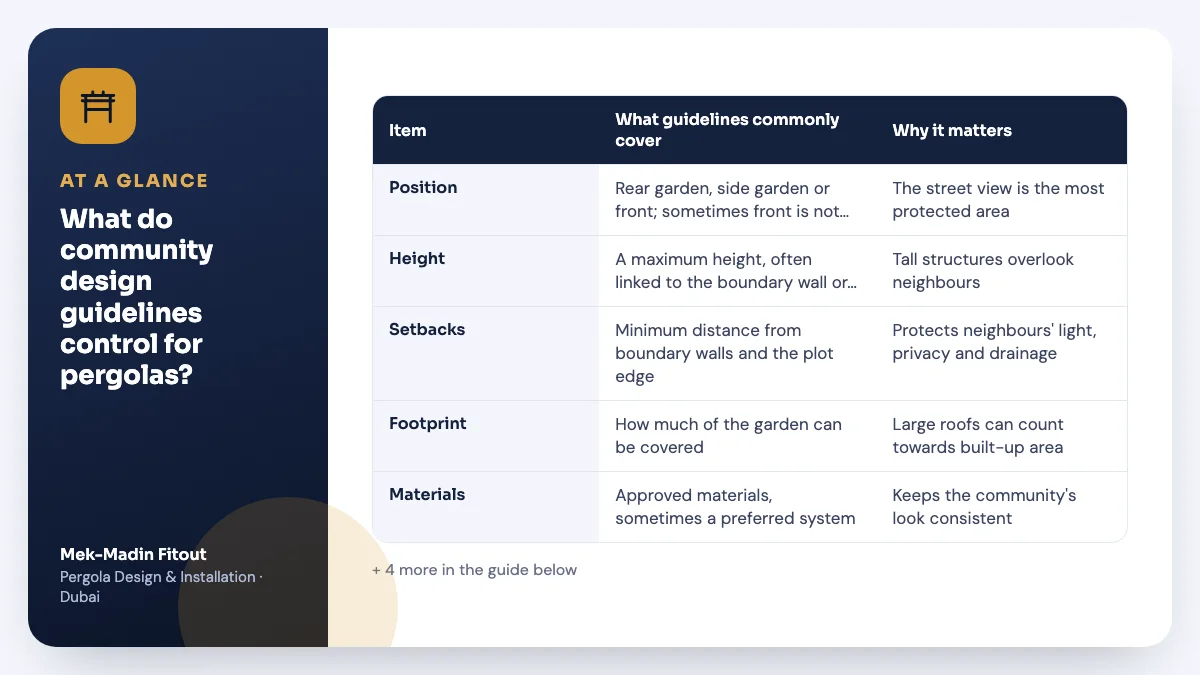
Most master developers publish design guidelines or a homeowner handbook. These often include a section on shade structures. The points they cover tend to be similar, though the limits differ.
| Item | What guidelines commonly cover | Why it matters |
|---|---|---|
| Position | Rear garden, side garden or front; sometimes front is not allowed | The street view is the most protected area |
| Height | A maximum height, often linked to the boundary wall or ground floor | Tall structures overlook neighbours |
| Setbacks | Minimum distance from boundary walls and the plot edge | Protects neighbours' light, privacy and drainage |
| Footprint | How much of the garden can be covered | Large roofs can count towards built-up area |
| Materials | Approved materials, sometimes a preferred system | Keeps the community's look consistent |
| Colours | A palette or specific colour codes matching the villa | Avoids clashing finishes along a street |
| Roof type | Open slats, louvres, fabric or solid panels | Solid roofs are treated more strictly |
| Fixing to the villa | Whether wall or slab fixing is allowed, and how | Protects waterproofing and structure |
| Drainage | Where roof water goes | Water must not run onto neighbours' plots |
Ask the community office for the current version of the guidelines. Older copies passed around by neighbours may be out of date.
Do freestanding and attached pergolas need different approvals?
Freestanding and attached pergolas both usually need community approval, but the questions asked are different. A freestanding pergola stands on its own posts and footings, while an attached pergola uses the villa wall or roof slab for support on one or more sides, which brings extra scrutiny of fixings and waterproofing.
| Freestanding pergola | Attached pergola | |
|---|---|---|
| Community approval | Usually needed | Usually needed |
| Extra scrutiny | Footings, setbacks, height | Wall or slab fixing, waterproofing, structure |
| Building permit | Less likely, unless large or roofed solid | More likely, especially with a solid roof |
| Typical concerns | Wind loads and anchoring into paving | Damage to the façade or the roof membrane |
Some communities do not allow fixing to the villa at all. Others allow it with approved brackets. A freestanding design is the usual answer where wall fixing is not permitted.
When does a pergola need a building permit as well?
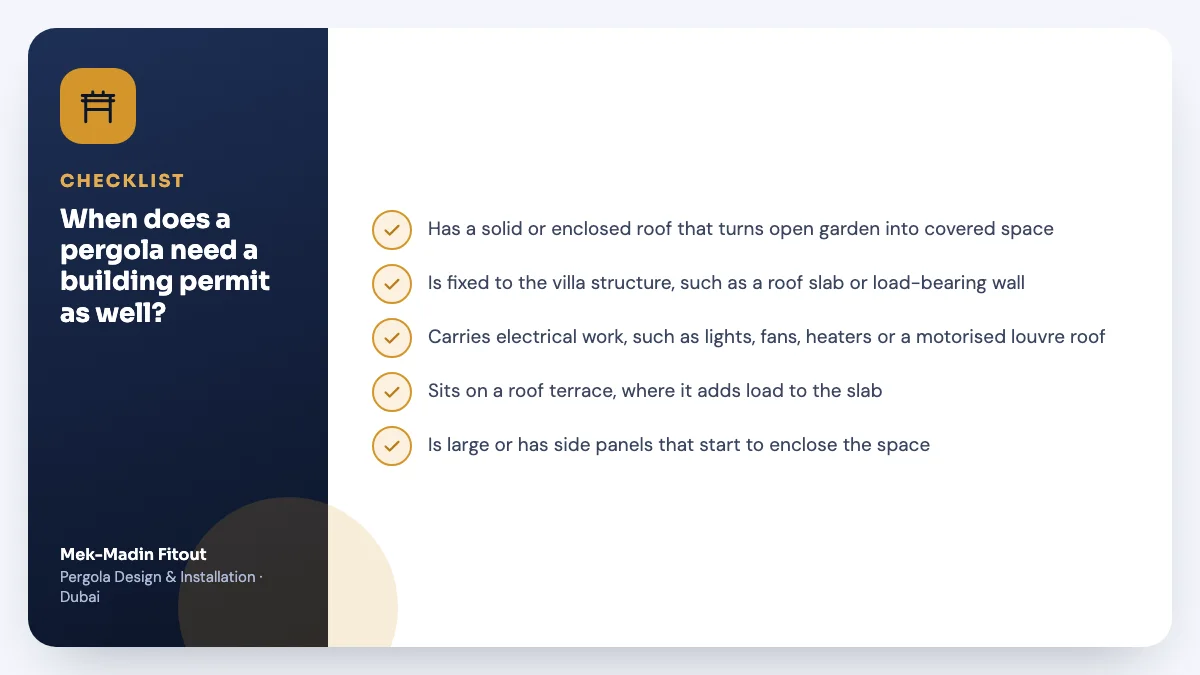
A pergola in Dubai is more likely to need a building permit as well as community approval when it has a solid roof, is fixed to the villa structure, carries electrics, sits on a roof terrace or is large. Side panels that start to enclose the space make a permit more likely too.
Community approval is one layer. For some pergolas, a building permit from the relevant authority may be needed as well. Our guide to villa renovation permits in Dubai explains how these two layers fit together, so we keep it brief here.
A permit becomes more likely when the pergola:
- Has a solid or enclosed roof that turns open garden into covered space.
- Is fixed to the villa structure, such as a roof slab or load-bearing wall.
- Carries electrical work, such as lights, fans, heaters or a motorised louvre roof.
- Sits on a roof terrace, where it adds load to the slab.
- Is large or has side panels that start to enclose the space.
Which authority issues it depends on where the villa is. In much of Dubai that is Dubai Municipality, but some areas fall under Dubai Development Authority or Trakhees instead. Your master developer can tell you which applies, and a licensed consultant usually handles the application.
Dubai Municipality's list of services includes a "Permit to Make Modifications or Additions to Buildings" for "existing or under construction buildings". In Dubai Development Authority areas, the building modification permit page lists the contractor as the requester and says the service "is available after the issuance of building completion certificate".
What documents do you need to submit for pergola approval?
For pergola approval in a Dubai community, expect to submit proof of ownership and the owner's ID, a site plan with distances to boundaries, elevation drawings, material, colour and product details, fixing and electrical details, and the contractor's trade licence and insurance. Some communities also charge a deposit or fee.
Every community has its own checklist. These items come up often:
- Proof of ownership, such as the title deed, and the owner's ID.
- A site plan showing the pergola's position and distances to boundaries.
- Elevation drawings with the height and overall dimensions.
- A specification of materials, finishes and colour codes.
- Product details for louvre, fabric or panel systems.
- Fixing and footing details, especially for attached designs.
- Electrical details, if lights, fans or motors are included.
- The contractor's trade licence and insurance.
- Any deposit or fee the community charges.
If you rent the villa, the landlord usually has to apply or authorise the application. Material choice affects what you submit, so it helps to decide early. Our comparison of pergola materials for Dubai's heat covers aluminium, timber and steel.
How do neighbours and shared walls affect a pergola?
Pergolas near a boundary get the most attention, as they can affect a neighbour's light, privacy or drainage. In townhouse communities such as Town Square, gardens are smaller and walls are often shared, so this happens easily. Fixing to a shared boundary wall and roof water running onto a neighbour's plot are the two most common sticking points.
Fixing to a shared boundary wall is a common sticking point. The wall may belong to both plots, or to the community. Some communities may ask for a neighbour's consent in this case, so ask before you design around that wall.
Roof water is the other issue. Louvred and solid roofs collect rain and need gutters that drain onto your own plot. Water running into a neighbour's garden causes complaints quickly.
How long does it take to get a pergola approved?
Pergola approval in Dubai has no single timeline. It depends on the community, the time of year and how complete your application is. A simple freestanding pergola that follows the guidelines is usually quicker than an attached one that also needs a building permit, and missing documents are a common cause of delay.
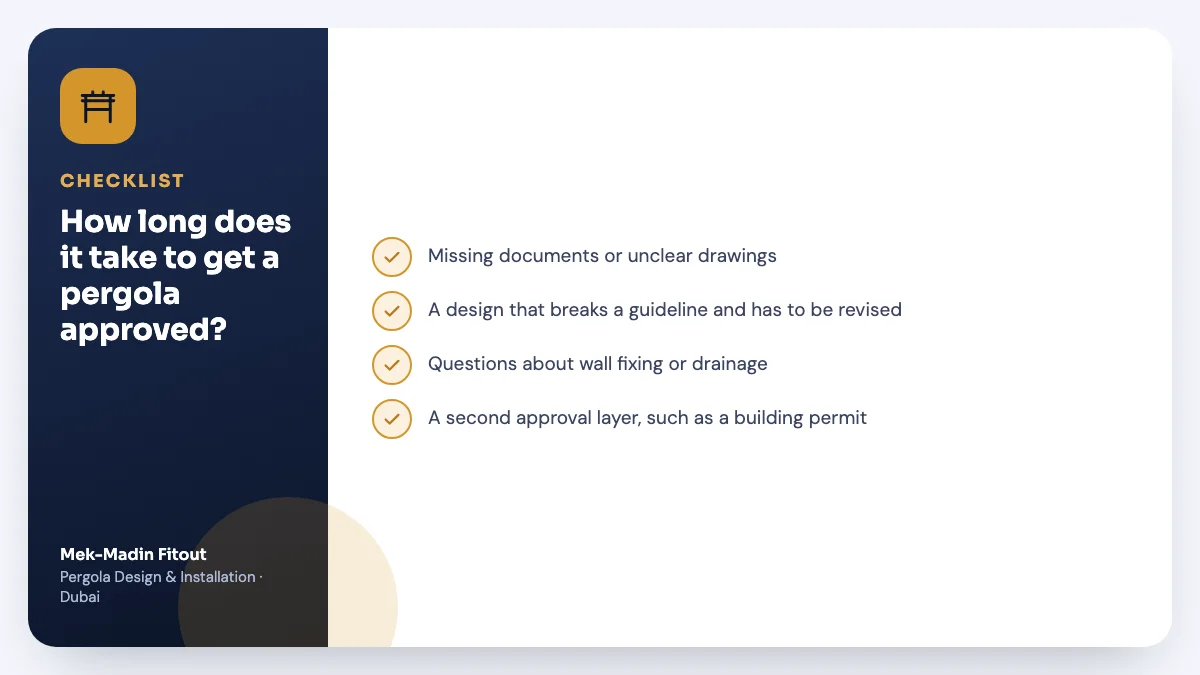
The most common causes of delay are:
- Missing documents or unclear drawings.
- A design that breaks a guideline and has to be revised.
- Questions about wall fixing or drainage.
- A second approval layer, such as a building permit.
Ask the community office how long they currently take. Do not order materials or book installation until written approval arrives.
Can you put a pergola on an apartment or penthouse terrace?
A pergola can go on an apartment or penthouse terrace only where building management allows it, because the terrace follows building rules rather than villa community rules. Building management usually controls anything visible on the façade, and many towers do not allow fixed structures on terraces at all.
Glass enclosures on terraces and balconies face similar façade rules, covered in our guide to balcony enclosure approvals.
Where they are allowed, expect close attention to the roof waterproofing and the load on the slab. Get written approval from building management before any work starts.
When should you bring in a pergola designer?
A pergola that suits the community rules and the site is designed with approval in mind from the start. Height, position, colour and fixing details are much easier to get right on paper than to change after an objection. Drainage and waterproofing also need care where the pergola meets the villa.
Our team handles pergola design and installation across Dubai, including the drawings communities usually ask for. Call or WhatsApp +971 52 884 8916 to arrange a site visit. We confirm a visit time when you call.
FAQs
Do I need approval for a freestanding pergola?
In most master-planned communities, yes. Freestanding pergolas are still exterior structures, so they usually need community approval. They are often simpler to approve than attached designs because nothing is fixed to the villa.
Can I add lights or a fan to my pergola later?
Possibly, but treat it as a change to the approved design. Electrical work outdoors must be done safely and may need its own approval. It is simpler to include lighting and fans in the original application.
Does a shade sail need approval?
Often, yes. Shade sails are usually covered by the same guidelines as pergolas, especially when fixed to walls or posts set in concrete. Rules on colour and position commonly apply, so check with your community office.
How long does pergola approval take in Dubai?
It varies by community and by how complete the application is. Attached or solid-roof pergolas that also need a building permit take longer. Ask your community office for their current timing and allow extra time in your plans.