Most villa renovations in Dubai need at least a no-objection certificate (NOC) from your master developer or community management before work starts. Structural changes, extensions and major MEP work usually also need a building permit from the relevant authority. Cosmetic work often needs less, but rules differ by community, so always confirm first.
This guide explains how approvals usually work, which jobs tend to need what, and who to ask. It is general information, not legal advice. Requirements change, and each community sets its own rules.
Why do villa renovations in Dubai need approval?
Villa renovations in Dubai need approval because the master developer or community management wants changes to respect its rules, shared infrastructure and design standards, while the government authority wants structural and safety work done to code. That is why most villa projects face two layers of approval: one for the community's rules and one for building safety.
A villa in Dubai sits inside a planned community. The master developer or community management company looks after shared infrastructure, the look of the streets and the rules every owner signed up to. They want to know what you are changing so it does not affect neighbours, utilities or the community's design standards.
Separately, the government authority that controls building in your area wants structural and safety work done to code. That is why there are often two layers of approval: one for the community's rules and one for building safety. Apartments often follow the same two layers, as our guide on whether you can remove an apartment wall explains.
What is the difference between an NOC and a building permit?
An NOC is a letter from the master developer or community management saying they have no objection to your proposed villa work. A building permit is a separate approval from the relevant authority, such as Dubai Municipality, and is usually needed for structural work, extensions or significant changes to services. Many villa projects need both.
What is a developer or community NOC?
The NOC is a letter from the master developer or community management saying they have no objection to your proposed work. Developers such as Emaar, Nakheel, Meraas, Dubai Properties, DAMAC and Sobha each run their own process. Most now handle applications through an online portal or a community office.
You usually submit drawings, a description of the work and your contractor's details. Some communities also ask for a refundable deposit to cover damage to roads, kerbs or landscaping. The amount and conditions vary, so ask your community office.
When does a villa renovation need a building permit?
For structural work, extensions or significant changes to services, a building permit is usually needed as well. Which authority issues it depends on where your villa is.
In much of Dubai this is Dubai Municipality. Some zones fall under other bodies, such as Dubai Development Authority or Trakhees.
Dubai Municipality's list of services includes a "Permit to Make Modifications or Additions to Buildings", which it describes as a way to "apply for a permit to make modifications and additions to existing or under construction buildings". In Dubai Development Authority areas, the building modification permit page lists the contractor as the requester and says the service "is available after the issuance of building completion certificate".
Building permits are normally applied for by a licensed consultant or engineering office on the owner's behalf. They prepare the drawings and submit them in the required format. Your developer NOC is often one of the documents they need. On new villas and extensions, the consultant can also confirm how solar water heating fits villa approvals.
Which villa works need an NOC or a building permit?
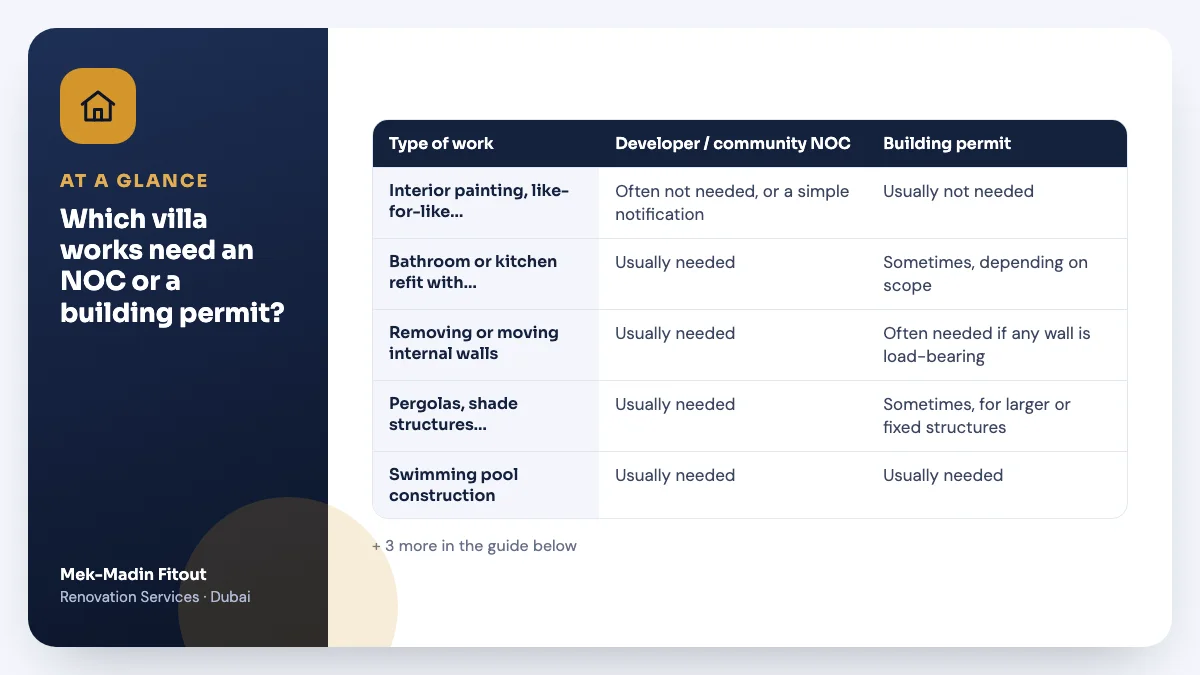
Cosmetic villa jobs such as interior painting, like-for-like flooring or new kitchen fronts often need little or no approval, while pools, extensions and façade changes usually need both a community NOC and a building permit. Bathroom refits, pergolas and wall removals sit in between, depending on the scope and on how strict your community is.
If you are repainting the outside, our guide to choosing exterior villa paint compares paint types once your colour is approved.
The table below shows how approvals commonly work. It is a starting point for your conversation with the community office, not a final answer. Some communities are stricter than others.
| Type of work | Developer / community NOC | Building permit | Notes |
|---|---|---|---|
| Interior painting, like-for-like flooring, new kitchen fronts | Often not needed, or a simple notification | Usually not needed | Some communities still want to know when contractors are on site |
| Bathroom or kitchen refit with new plumbing routes | Usually needed | Sometimes, depending on scope | Waterproofing and drainage changes get more scrutiny |
| Removing or moving internal walls | Usually needed | Often needed if any wall is load-bearing | An engineer should confirm what each wall does |
| Pergolas, shade structures, garden rooms | Usually needed | Sometimes, for larger or fixed structures | Height, colour and position rules are common |
| Swimming pool construction | Usually needed | Usually needed | Expect drawings and a licensed contractor |
| Extensions, extra rooms, enclosing a terrace | Usually needed | Usually needed | Plot coverage and setback rules apply |
| Changing the external façade, windows or boundary walls | Usually needed | Often needed | Communities guard the street view closely |
| Major electrical or AC system changes | Usually needed | Sometimes | DEWA may also be involved for load changes |
For pools, Dubai Municipality's Private Swimming Pools Safety Guidelines state that all swimming pools in a private residential villa "shall be registered to Dubai Municipality prior start of construction/installation".
If a job sits between two rows, treat it as the stricter one until you hear otherwise. Pergolas are covered in more detail in our guide to pergola approval in Dubai communities.
Who should you ask first before renovating a villa?
Before renovating a villa in Dubai, start with your community's design guidelines and the community office or portal, then appoint a consultant if structural work is involved. Choose a contractor who can work within the rules, and wait for written approval before anything starts. Tenants also need the landlord's written consent first.
Getting the order right saves time. A common sequence looks like this:
- Read your community rules. Most developers publish design guidelines or a homeowner handbook. These often list what is allowed and what is not.
- Contact the community office or portal. Describe the work and ask what they need. Ask whether the job needs a building permit too.
- Appoint a consultant if structural work is involved. They will prepare drawings and handle the authority application.
- Choose a contractor who can work within the rules. The contractor's trade licence and insurance details are often part of the NOC application.
- Wait for written approval before starting. Keep the NOC and any permit on site, as inspectors or security may ask to see them.
If you rent the villa, you will also need the landlord's written consent. In most cases the landlord, as owner, applies for the NOC. Our guide on renovating a rented home in Dubai covers consent and reinstatement in more detail.
What documents do you need for a villa renovation NOC?
For a villa renovation NOC, Dubai communities commonly ask for the title deed or proof of ownership, the owner's Emirates ID or passport, drawings of the existing and proposed layout, a written description of the work and the contractor's trade licence and insurance details. Some also charge a deposit or fee, or ask for the building permit.
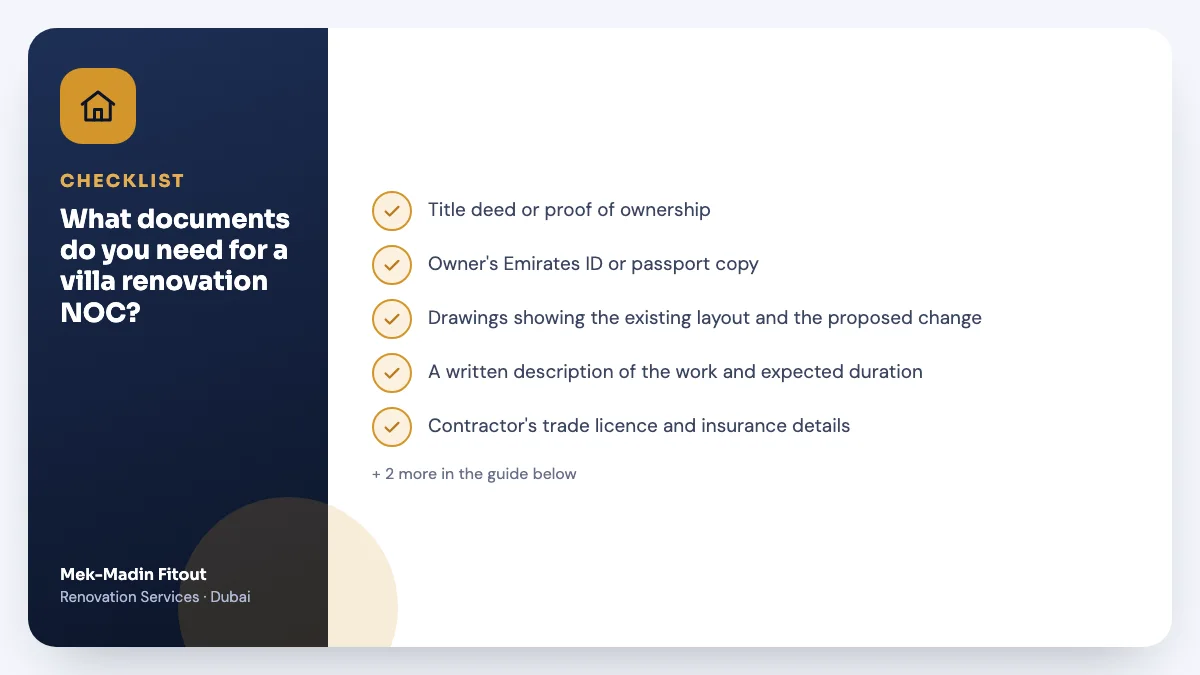
Every community has its own list, but these come up often:
- Title deed or proof of ownership
- Owner's Emirates ID or passport copy
- Drawings showing the existing layout and the proposed change
- A written description of the work and expected duration
- Contractor's trade licence and insurance details
- Any deposit or fee the community charges
- Building permit, where one is required, or proof of application
Ask the community office for their current checklist. Lists change, and an incomplete application is the most common cause of delay.
What rules apply while renovation work is under way?
Approval is not the end of a villa renovation. Most Dubai communities also set rules for how the work is carried out, covering noisy working hours, passes for workers and vehicles, prompt removal of waste, protection of roads and landscaping, and sometimes inspections before the developer closes the file.
Expect some of the following:
- Working hours. Noisy work is usually limited to set daytime hours, often with tighter limits at weekends and on public holidays.
- Contractor access. Workers may need passes, and vehicles may need to be registered at the gate.
- Waste and skips. Debris often has to be removed promptly, and skips may need approval.
- Protection of shared areas. Damage to roads, kerbs or landscaping may come out of any deposit.
- Inspections. Some developers inspect during or after the work before closing the file.
Your community office can confirm the exact hours and conditions. Pass them to your contractor in writing before work starts.
What happens if you renovate a villa without approval?
Renovating a villa without the right approvals is a real risk. Communities can stop work, issue fines or ask you to reverse the change. Unapproved structural changes can also cause trouble later, when you sell, insure or rent out the villa, long after the contractor has left the site.
A buyer's surveyor may spot alterations that do not match the approved drawings. Sorting that out late is usually slower and more expensive than asking at the start. It is far simpler to get approval first.
How can you avoid delays with villa renovation approvals?
To avoid delays with villa renovation approvals, plan the full scope before applying, because adding work later can mean a fresh application. Keep your paperwork together and build the approval period into your timeline. For apartments, our step-by-step kitchen renovation order shows where approval sits in the wider sequence.
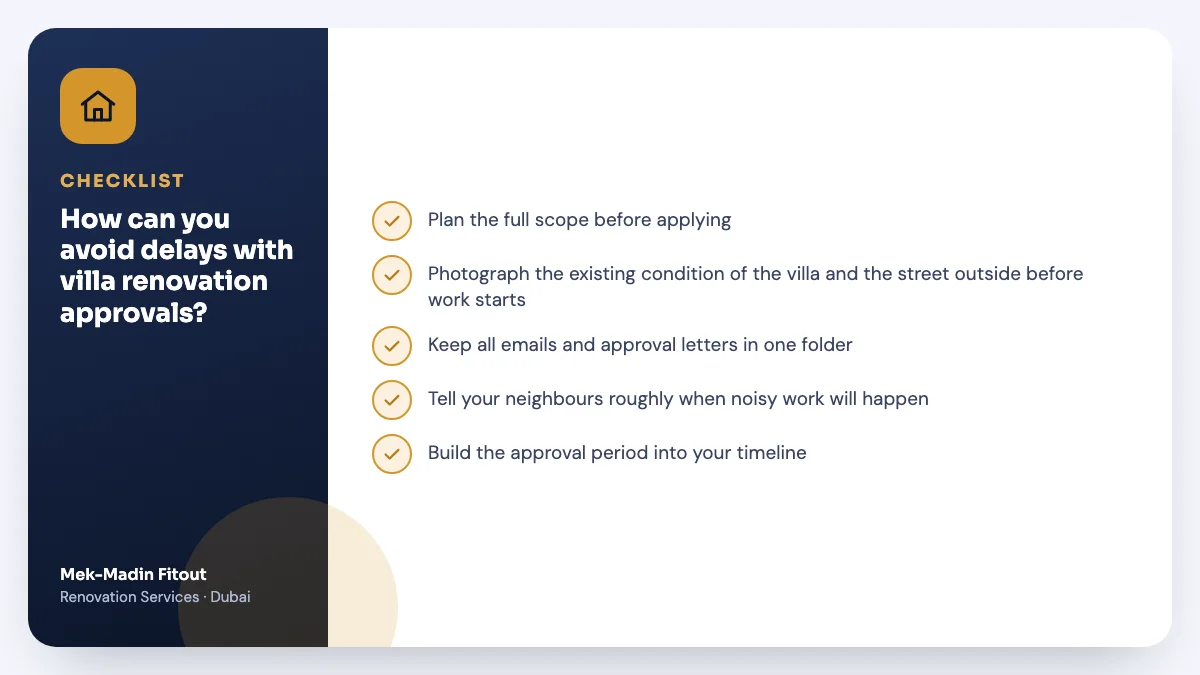
- Plan the full scope before applying. Adding work later can mean a fresh application.
- Photograph the existing condition of the villa and the street outside before work starts.
- Keep all emails and approval letters in one folder.
- Tell your neighbours roughly when noisy work will happen.
- Build the approval period into your timeline. Do not book trades for a start date you cannot guarantee.
Communities in areas such as Arabian Ranches and Dubai Hills Estate each have their own design guidelines. Even neighbouring communities from the same developer can differ.
When should you involve a renovation contractor?
If your villa renovation plans go beyond painting and like-for-like replacements, it helps to involve a contractor early. A good contractor will look at your scope, flag which parts are likely to need approval, and work alongside your consultant where a building permit is needed.
Mek-Madin Fitout carries out villa and apartment renovation work across Dubai, from kitchen and bathroom refits to larger layout changes. We can help you plan the work around your community's rules. Call or WhatsApp +971 52 884 8916 to talk through your plans.
FAQs
Do I need an NOC to repaint my villa?
Interior repainting usually does not need an NOC, though some communities like to be told when contractors are on site. Changing the external colour is different. Most communities control exterior colours closely, so ask your community office before painting outside walls.
How long does a villa renovation NOC take in Dubai?
It depends on the developer, the scope of work and how complete your application is. Simple applications can be quick, while structural work that also needs a building permit takes longer. Ask your community office for their current processing time and allow extra margin in your plans.
Can my contractor apply for the NOC for me?
In many communities the contractor or consultant can prepare and submit the application, but the owner usually has to authorise it. The owner's details and proof of ownership are almost always required. Check with your developer how they handle applications made on an owner's behalf.
I am a tenant. Can I renovate the villa I rent?
Only with the landlord's written consent. The landlord, as the owner, is normally the person who applies for any NOC. Agree in writing who pays, what can be changed and whether the villa must be returned to its original state when you leave.