You can sometimes remove a wall in a Dubai apartment, but only after a structural engineer confirms it is safe and you have written approval from building management. Structural changes usually also need the developer and the relevant authority. Many internal walls are lightweight partitions, but some carry structure, fire separation or hidden services.
This guide is general information, not engineering or legal advice. Every building is different, and approval rules vary by developer and authority. Always confirm with your building management before any work starts.
What is the difference between a load-bearing and a partition wall?
Load-bearing walls in a Dubai apartment, such as concrete shear and core walls, carry the building's loads and are not removed. Partitions are non-structural walls of blockwork or gypsum board on a metal frame that simply divide rooms. Once plastered and painted, the two can look the same, so only an engineer can confirm which is which.
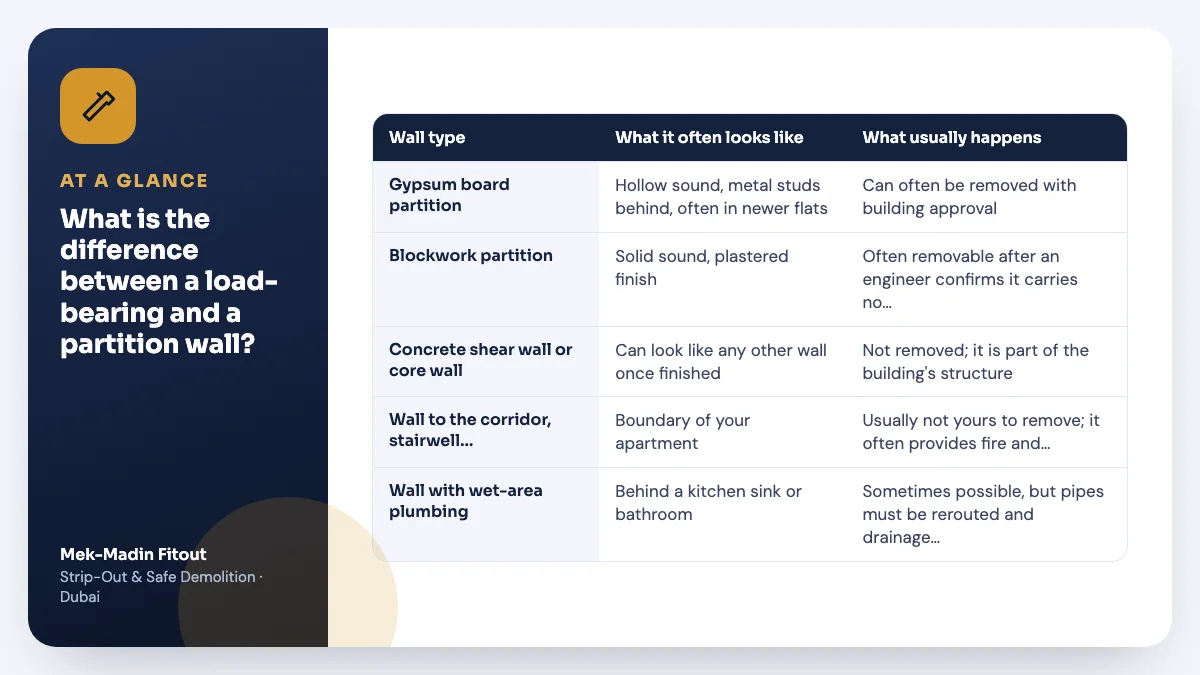
Most residential towers in Dubai are built around a reinforced concrete frame. Columns, floor slabs and concrete shear walls carry the loads and keep the building stable. Many of the walls between rooms are non-structural partitions, built from blockwork or gypsum board on a metal frame.
The problem is that once plastered and painted, they can all look the same.
Can you tell a load-bearing wall by looking or knocking?
Tapping a wall tells you very little. Gypsum board sounds hollow, but plastered blockwork and concrete can sound almost identical. Thickness is not a reliable guide either.
Walls near the core of the building, around lifts and stairs, or lined up with walls on the floors above and below are more likely to be structural. That is a reason to be cautious, not a way to decide.
Who can confirm whether a wall is structural?
A structural engineer reviews the building's drawings and, where needed, inspects the wall on site. Building management or the developer can often tell you how to request the relevant drawings. Never guess, and never let anyone start cutting on the basis of how a wall sounds.
| Wall type | What it often looks like | What usually happens |
|---|---|---|
| Gypsum board partition | Hollow sound, metal studs behind, often in newer flats | Can often be removed with building approval |
| Blockwork partition | Solid sound, plastered finish | Often removable after an engineer confirms it carries no load |
| Concrete shear wall or core wall | Can look like any other wall once finished | Not removed; it is part of the building's structure |
| Wall to the corridor, stairwell or a neighbour | Boundary of your apartment | Usually not yours to remove; it often provides fire and sound separation |
| Wall with wet-area plumbing | Behind a kitchen sink or bathroom | Sometimes possible, but pipes must be rerouted and drainage stacks rarely move |
What services are hidden inside apartment walls?
Apartment walls in Dubai towers can hide electrical cables, water supply and drainage pipes, AC parts such as fan coil units and condensate lines, fire safety devices, and data, TV or intercom wiring. Even a simple partition can carry these services, so they must be found and dealt with before the wall comes down.
Even a simple partition can carry more than you expect. Before any wall comes down, the services inside it need to be found and dealt with.
- Electrical cables for sockets, switches, lights and sometimes the distribution board
- Water supply pipes to kitchens, bathrooms and water heaters
- Drainage pipes and connections to the building stack
- AC parts such as fan coil units, ducts, condensate drain lines and thermostat wiring
- Fire safety devices including smoke detectors, alarm wiring and sometimes sprinkler pipework
- Data and TV cabling, and intercom or access-control wiring
Moving cables and pipes is part of the job, and it often shapes what is possible. Changes to fire alarm or sprinkler devices usually need sign-off through the building's fire safety arrangements. Ask building management how that works in your tower.
Which approvals do you need to remove a wall in Dubai?
Removing a wall in a Dubai apartment usually needs the owner's consent, a building management NOC or work permit, any master community approval and, for structural changes, a permit from Dubai Municipality or the authority covering that zone. Authority permits are normally prepared and submitted by a licensed consultant or engineering office.
Approvals for a wall removal usually come in layers. The exact list depends on the building, the developer and where the building sits.
- The owner's consent. If you rent, you need the landlord's written permission before anything else. The landlord usually applies for building approvals, not the tenant. Our guide to tenant renovation approvals in Dubai explains the order.
- Building management or owners' association. Most towers ask for a no-objection certificate (NOC) or work permit before any demolition. Expect to submit a description of the work, drawings and contractor details.
- The master developer or community. Some buildings sit within a master community whose rules also apply.
- The relevant authority. Structural changes, and some significant layout changes, usually need a permit from Dubai Municipality or the authority covering that zone, such as Dubai Development Authority, DMCC or Trakhees.
Authority permits are normally prepared and submitted by a licensed consultant or engineering office. They produce drawings and, where needed, structural calculations. Our guide to renovation permits in Dubai explains how NOCs and building permits usually fit together, and the same two layers often apply in towers.
What happens if you skip approval?
Unapproved work can be stopped part-way, and you may be asked to reinstate the wall at your own cost. It can also cause problems when you sell, rent out or insure the apartment. Above all, removing the wrong wall can put the building and your neighbours at risk.
Tenants face a further risk. Under Article 25 of Dubai's Law No. (26) of 2007, as amended by Law No. (33) of 2008, a landlord may request eviction before the lease ends "where the Tenant makes any change to the Real Property that endangers its safety in a manner that makes it impossible to restore the Real Property to its original state".
How does a wall strip-out work in an occupied tower?
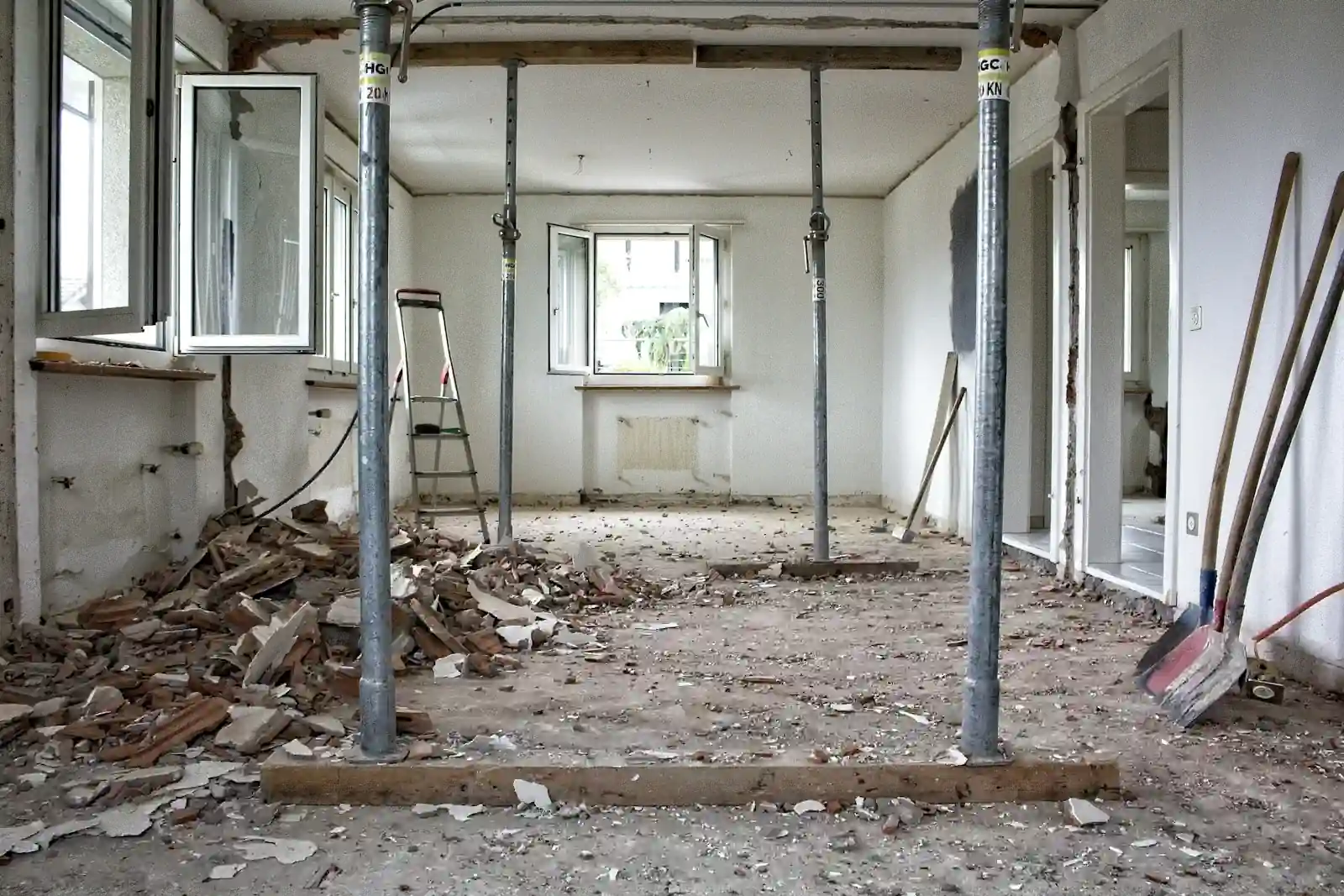
Once approvals are in place, removing a partition wall in an occupied Dubai tower is a controlled, step-by-step job: survey, booking, isolation, protection, removal, clearing and making good. The wall is taken down in sections from the top, and debris goes down the service lift at permitted times.
Our guide to the full apartment strip-out process covers the same stages for a whole flat.
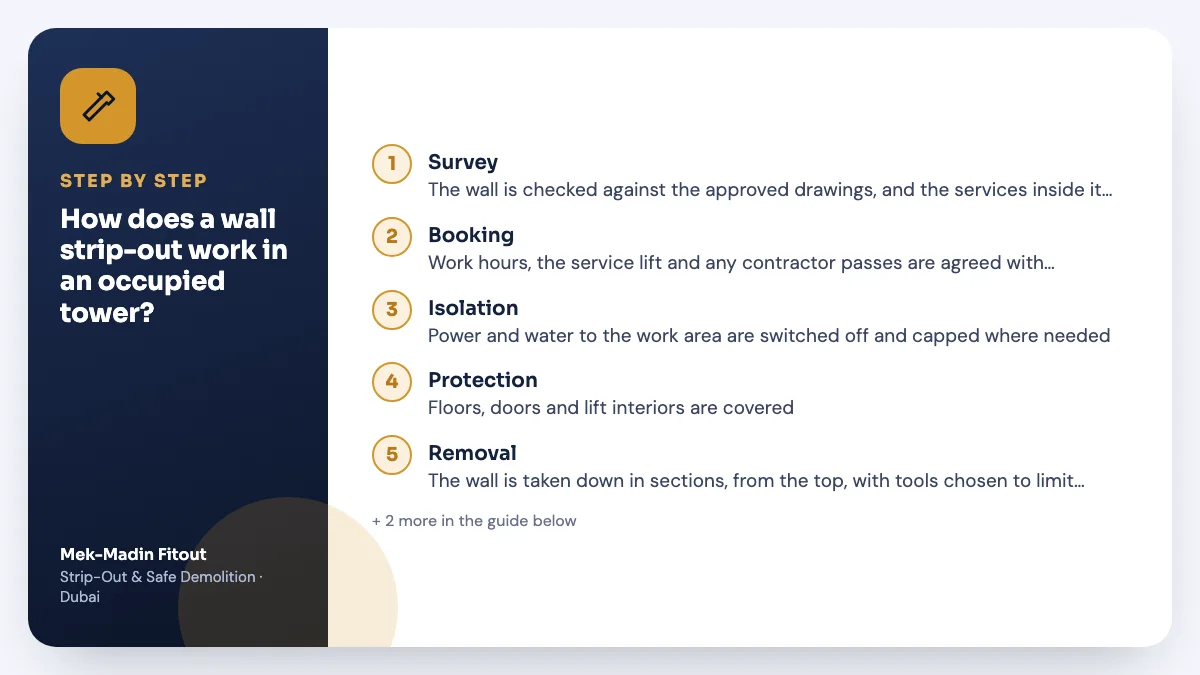
- Survey. The wall is checked against the approved drawings, and the services inside it are traced.
- Booking. Work hours, the service lift and any contractor passes are agreed with building management.
- Isolation. Power and water to the work area are switched off and capped where needed.
- Protection. Floors, doors and lift interiors are covered. Dust screens go up, and AC returns and smoke detectors are protected as building management allows.
- Removal. The wall is taken down in sections, from the top, with tools chosen to limit noise and vibration.
- Clearing. Debris is bagged, taken down in the service lift at permitted times and sent for proper disposal.
- Making good. The floor, ceiling and walls where the partition stood are repaired, and rerouted services are finished off.
That last step is often underestimated. The floor under the old wall may have no tiles or screed, and the ceiling may need new gypsum. Plan the finishing work with your renovation contractor before the wall comes down.
What dust and debris rules apply in Dubai towers?
Most Dubai towers limit noisy work to set daytime hours, send debris down the service lift only, ban construction waste in chutes and residents' bins, and expect corridors to stay clear and smoke detectors and AC to be protected. The details vary by building, so ask building management for their rules.
Living in a tower means the work affects other residents. Most buildings set rules to manage that, and the details vary.
- Noisy work hours. Drilling and breaking are usually limited to set daytime hours, and are often banned on some days.
- Service lift only. Debris normally goes down the service lift, never the passenger lifts.
- No debris in chutes or bins. Rubbish chutes and residents' bins are not for construction waste.
- Clear corridors. Bags and materials should not be left in shared areas.
- Smoke detectors. Dust can trigger the fire alarm, so detector covers are usually agreed with building management in advance.
- AC protection. Fine dust drawn into fan coil units and ducts can spread through the apartment.
In dense tower districts such as Dubai Marina, lift bookings and loading bays are often in demand. Book early and keep the timetable realistic.
What can you do if the wall has to stay?
If an engineer says an apartment wall must stay, you may still be able to open up the space with a wider opening and an engineer-designed beam, a half-height wall or breakfast counter, a glass partition or large sliding doors. Each of these options still needs the same checks and approvals as a removal.
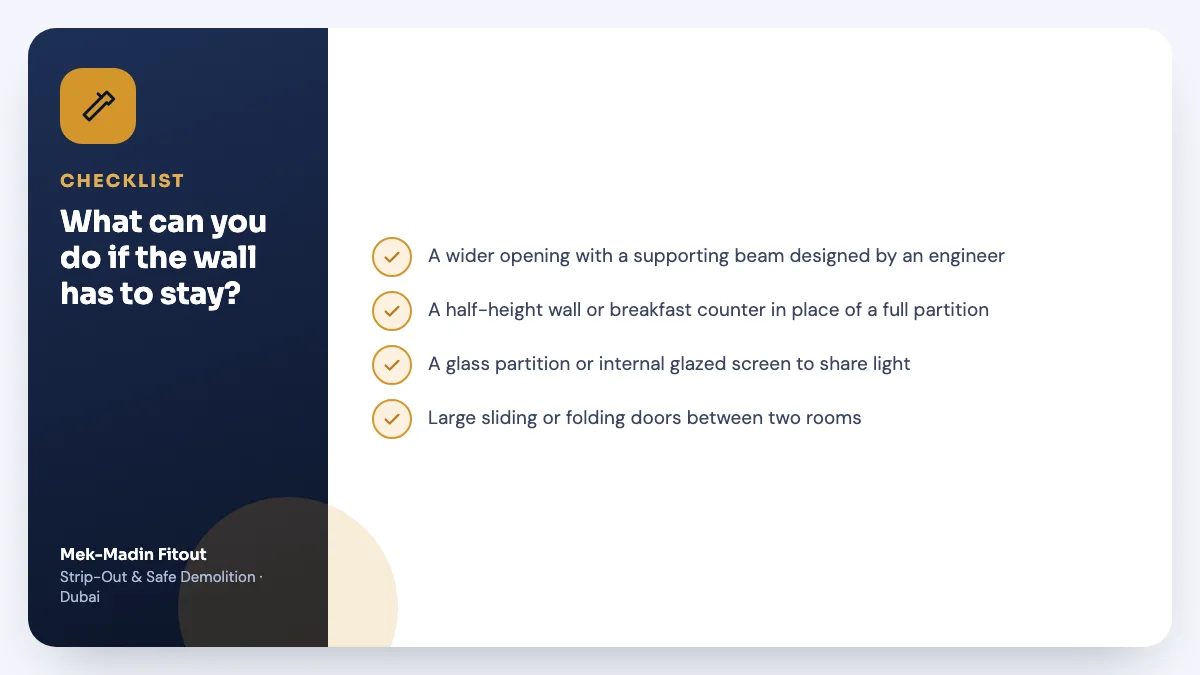
Depending on the wall, options can include:
- A wider opening with a supporting beam designed by an engineer
- A half-height wall or breakfast counter in place of a full partition
- A glass partition or internal glazed screen to share light
- Large sliding or folding doors between two rooms
Each of these still needs the same checks and approvals.
Should you take down an apartment wall yourself?
Removing an apartment wall in Dubai is not a DIY job. Wall removal needs an engineer's confirmation, the right approvals and a contractor who knows how to work cleanly inside an occupied building, from isolating services and controlling dust to taking debris down the service lift.
Mek-Madin Fitout carries out interior strip-out and safe demolition across Dubai, including partition removal, service isolation, dust control and debris disposal. Anything that may be structural is referred to an engineer before work starts. Call or WhatsApp +971 52 884 8916 to talk through your plans, and we confirm a visit time when you call.
FAQs
How do I know if a wall in my apartment is load-bearing?
You cannot tell reliably by looking or knocking. A structural engineer needs to check the building's drawings and, if needed, inspect the wall. Ask building management how to get the drawings for your unit.
Can I remove a wall in a rented apartment?
Only with the landlord's written permission, and the landlord usually needs to get the building approvals. Starting without consent can lead to a dispute and a demand to reinstate the wall. Agree in writing who pays for the work and for reinstatement at the end of the tenancy.
Can I knock through to make an open-plan kitchen?
Often, if the wall is a non-structural partition and building management approves it. Plumbing, extraction and fire safety arrangements may need changes. Some buildings have specific rules about open kitchens, so ask before you design the layout.
How long does it take to remove a partition wall?
The physical removal is often the quickest part. Approvals, lift bookings and making good the floor and ceiling usually take longer. Ask building management about their approval process before you set a start date.