
If you rent an apartment in Dubai, you usually need your landlord's written consent before any renovation. After that comes a no-objection certificate (NOC) from building management or the owners' association. Larger structural, plumbing or electrical work may also need an authority permit, and your tenancy contract sets the starting rules.
This guide is general information, not legal advice. Every tenancy contract and every building is different. If anything in your contract is unclear, ask the landlord or take proper advice before you spend money.
Why does a tenant need permission to renovate?
As a tenant, you have the right to live in the apartment, not to change it. The apartment belongs to the landlord, and the building's shared parts belong to the owners together. Changes to either affect people other than you. Repairs are a separate question from improvements, covered in our guide on whether the tenant or landlord pays for repairs.
Most Dubai tenancy contracts include a clause on alterations. It usually says the tenant must not make changes without the landlord's approval. Dubai's tenancy rules take a similar line, so assume consent is needed unless your contract clearly says otherwise.
Article 19 of Law No. (26) of 2007 regulating the relationship between landlords and tenants in Dubai says the tenant may not "make any changes or carry out any restoration or maintenance works" to the property unless the landlord permits it and the required licences have been obtained from the competent official entities.
What approvals does a tenant need, and in what order?
A tenant renovating a rented Dubai apartment usually needs the landlord's written consent first, then a no-objection certificate (NOC) from building management or the owners' association, then authority approval for bigger structural, plumbing, electrical or AC work. Each approval tends to ask for proof of the one before.
Approvals usually run in a set order. Skipping ahead wastes time, because each layer tends to ask for proof of the one before.
1. The landlord's written consent
Start with the landlord, or the agent who manages the unit for them. Explain what you want to do, why, and who will do the work. Send photos, a short description and, for bigger jobs, a simple drawing or product list.
A verbal "that's fine" is not enough. Ask for consent by email or in a signed letter. It should name the specific work, not just say "renovation".
The law expects landlords to help with the paperwork for lighter work. Article 18 of Law No. (26) of 2007 says the landlord must provide the approvals required by the competent official entities when the tenant wishes to carry out decoration works or other works that need such approvals, provided the works "do not affect the structure of the Real Property".
2. Building management or owners' association NOC
Most towers ask for an NOC before any interior work, even a kitchen or bathroom refit. The building is usually run by a management company on behalf of the owners' association. They control access, lifts, working hours and how debris leaves the building.
In many buildings, the NOC application must come from the unit owner or carry their authorisation. So your landlord's consent letter is often part of the application. Expect requests for contractor details, a trade licence, insurance and sometimes a refundable deposit.
3. Authority approval for bigger work
Some work goes beyond what building management can approve on its own. Changes to structure, moving wet areas, new electrical circuits or AC alterations may need a permit from the relevant authority. In much of Dubai that is Dubai Municipality, but some areas fall under other bodies.
For example, towers in JLT sit within the DMCC free zone, so approvals there may follow DMCC's process. DEWA may also be involved if the electrical load changes. Building management can usually tell you which authority applies.
Removing or moving a wall is its own subject. It needs an engineer to confirm what the wall does and is rarely a job a tenant should take on. We cover it in our guide on removing a wall in a Dubai apartment.
Which renovation jobs need landlord consent or a building NOC?
In a rented Dubai apartment, hanging pictures often needs no consent, painting and new fittings usually need the landlord's approval, and kitchen, bathroom, flooring, electrical and wall changes usually need both landlord consent and a building NOC. Your tenancy contract and your building's rules come first.
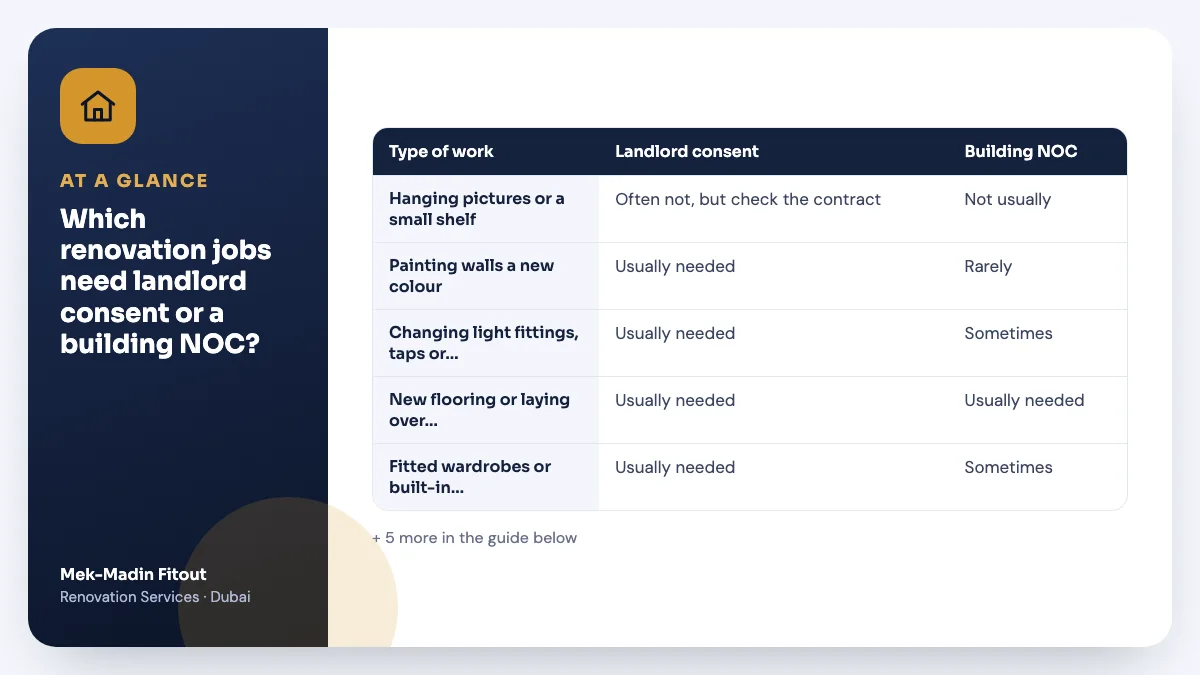
The table below shows how this commonly works. It is a guide for your conversation with the landlord, not a final answer. Your contract and your building's rules come first.
| Type of work | Landlord consent | Building NOC | Notes |
|---|---|---|---|
| Hanging pictures or a small shelf | Often not, but check the contract | Not usually | Fill and touch up holes before you leave |
| Painting walls a new colour | Usually needed | Rarely | You may have to repaint to the original colour |
| Changing light fittings, taps or shower heads | Usually needed | Sometimes | Keep the originals safe |
| New flooring or laying over existing tiles | Usually needed | Usually needed | Some towers have rules on noise and underlay |
| Fitted wardrobes or built-in joinery | Usually needed | Sometimes | Fixings go into walls the landlord owns |
| Kitchen refit | Needed | Needed | Gas, drainage and extraction raise more questions |
| Bathroom refit | Needed | Needed | Waterproofing must be done properly under new tiles |
| New electrical circuits or AC changes | Needed | Needed | May also need authority or DEWA involvement |
| Balcony enclosures or façade changes | Needed | Needed | Often not allowed at all in towers |
| Removing or moving walls | Needed | Needed | Usually also needs an engineer and a permit |
If a job sits between two rows, treat it as the stricter one until you hear otherwise.
Who pays for renovating a rented flat, and who owns the work?
There is no fixed answer to who pays for renovating a rented flat in Dubai: it depends on what the tenant and landlord agree. The tenant may pay in full, the landlord may pay, or the cost may be shared. Fixed improvements, like a new kitchen or flooring, are generally treated as part of the property.
Common arrangements include:
- The tenant pays in full and the improvement stays with the apartment.
- The landlord pays, because the work adds value to their property.
- The cost is shared, often in a set split agreed before work starts.
- The tenant pays, and the landlord gives something back, such as a rent-free period or a reduction at renewal.
Ownership at move-out also depends on the agreement. In general, anything fixed into the apartment, like a new kitchen or flooring, is treated as part of the property. If you expect to take something with you, such as fitted wardrobes or light fittings, agree that in writing first. Our comparison of fitted and freestanding wardrobes for Dubai homes covers this choice for renters.
Dubai's tenancy law sets the same default. Article 23 of Law No. (26) of 2007 says that, "unless otherwise agreed by the parties", the tenant may not remove any leasehold improvements they made when vacating and handing back the property.
What is a reinstatement clause, and why does it matter?
Many Dubai tenancy contracts include a reinstatement clause, which means the tenant must return the apartment in the condition they received it, apart from normal wear and tear. A reinstatement clause can undo a renovation at the tenant's cost, and the landlord may deduct that cost from the security deposit if the work is not done.
Commercial leases often have stricter reinstatement terms, as our guide to returning an office to shell and core explains.
In practice, reinstatement might mean repainting a feature wall back to white, or refitting the original light fittings. In a bigger case it could mean removing a kitchen you paid for. The landlord may deduct the cost from your security deposit if you do not do it.
There are two ways to protect yourself. Ask the landlord to waive reinstatement in writing for the specific work, or keep the original items and photos so you can put things back.
Our guide to move-out repairs in Dubai covers what to check before you hand back the keys.
What should a written renovation agreement with your landlord cover?
A written renovation agreement with your landlord should set out the work, who applies for approvals, who pays, which contractor does it, who owns each improvement, whether reinstatement applies, who is responsible if something goes wrong and how your deposit is affected. Both of you should sign it.
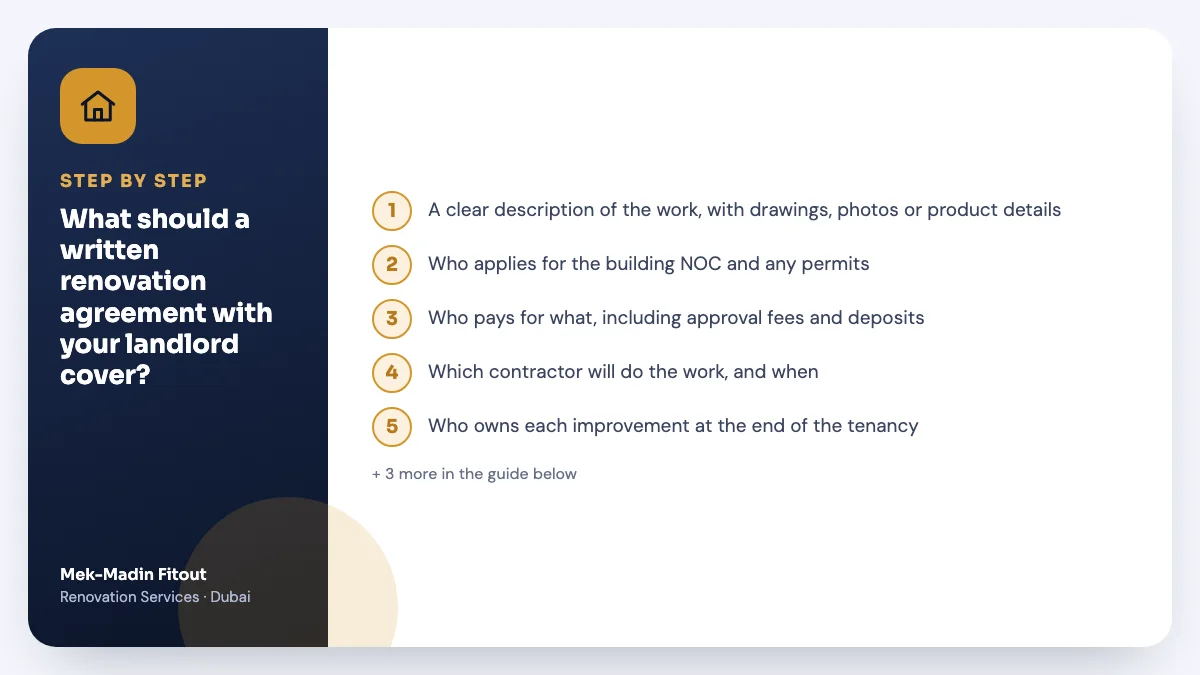
A short written agreement, signed by both of you, prevents most disputes. Keep it with your tenancy contract. It should cover:
- A clear description of the work, with drawings, photos or product details.
- Who applies for the building NOC and any permits.
- Who pays for what, including approval fees and deposits.
- Which contractor will do the work, and when.
- Who owns each improvement at the end of the tenancy.
- Whether reinstatement applies, and to which items.
- Who is responsible if something goes wrong, such as a leak into the flat below.
- How the work affects your security deposit.
If rent or renewal terms change as part of the deal, include that too. Rental disputes in Dubai are handled through the Dubai Land Department's processes, and clear paperwork makes any dispute simpler.
What should a tenant do before renovation work starts?
Before renovation work starts in a rented Dubai apartment, check your tenancy contract for alteration and reinstatement clauses, photograph every room, store the original fittings, learn the building's rules on hours, lifts and debris, get the NOC and any permit in hand, and keep all the paperwork together.
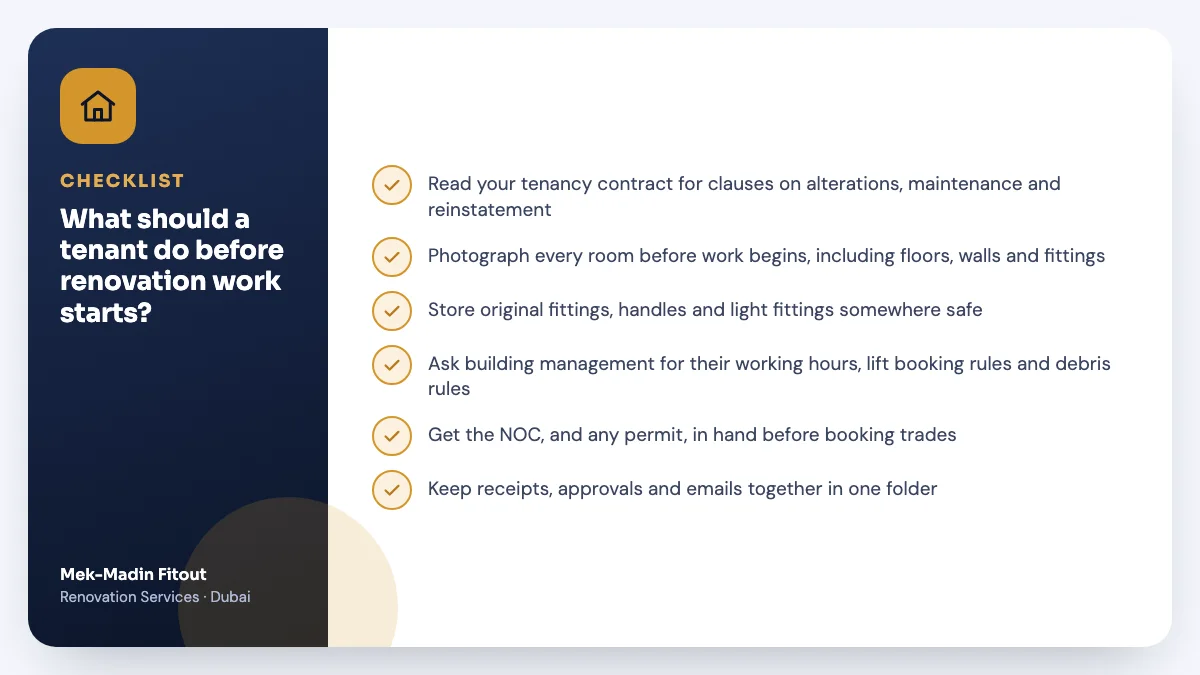
- Read your tenancy contract for clauses on alterations, maintenance and reinstatement.
- Photograph every room before work begins, including floors, walls and fittings.
- Store original fittings, handles and light fittings somewhere safe.
- Ask building management for their working hours, lift booking rules and debris rules.
- Get the NOC, and any permit, in hand before booking trades.
- Keep receipts, approvals and emails together in one folder.
Most of these steps apply whether you rent in a tower or a villa. For villas, the community and master developer rules add another layer, explained in our guide to villa renovation permits in Dubai.
When should a tenant bring in a renovation contractor?
Small jobs like hanging shelves rarely need outside help, but a kitchen, bathroom or flooring project in a rented Dubai apartment is different. That work has to satisfy the landlord, building management and sometimes an authority, and it has to be easy to inspect at move-out.
Our guides to the apartment strip-out process and the order of works for an apartment kitchen show what happens on site.
Mek-Madin Fitout carries out apartment and villa renovation in Dubai. We can look at your plans and point out which parts are likely to need approval.
Call or WhatsApp +971 52 884 8916 to talk it through. We confirm a visit time when you call.
FAQs
Can my landlord refuse permission to renovate?
Yes. The landlord owns the apartment and can say no, or agree only to part of what you propose. A clear, written proposal that explains the work, who pays and what happens at move-out often makes a yes more likely.
Do I need a building NOC just to paint my apartment?
Usually not for painting alone, although some buildings want to know when contractors are on site. You will normally still need the landlord's consent for a new colour. You may also have to repaint to the original colour when you leave.
Will I get my money back for improvements when I move out?
Only if your agreement with the landlord says so. In general, fixed improvements stay with the apartment and are not refunded. Agree any payment, rent reduction or right to remove items in writing before the work starts.
Can I apply for the building NOC myself as a tenant?
Some buildings accept applications from tenants, but most want the owner's authorisation. Ask building management what they need, and expect the landlord's signed consent to be part of the application.