
A fitted wardrobe usually suits owners who want to use every bit of wall height and alcove space. A freestanding wardrobe usually suits tenants and anyone likely to move, because it goes with you. In Dubai, the bigger factor is often moisture: board quality, ventilation and which wall the wardrobe sits on matter as much as the style.
This guide compares the two side by side, then looks at the climate issues, rental rules, materials and door choices that affect the decision here.
How do fitted and freestanding wardrobes compare?
Fitted wardrobes use the full wall height and alcove space and stay with the property, while freestanding wardrobes leave gaps above and at the sides but move with you and need no landlord consent. In Dubai, board quality, ventilation and which wall the wardrobe sits on matter as much as the style.
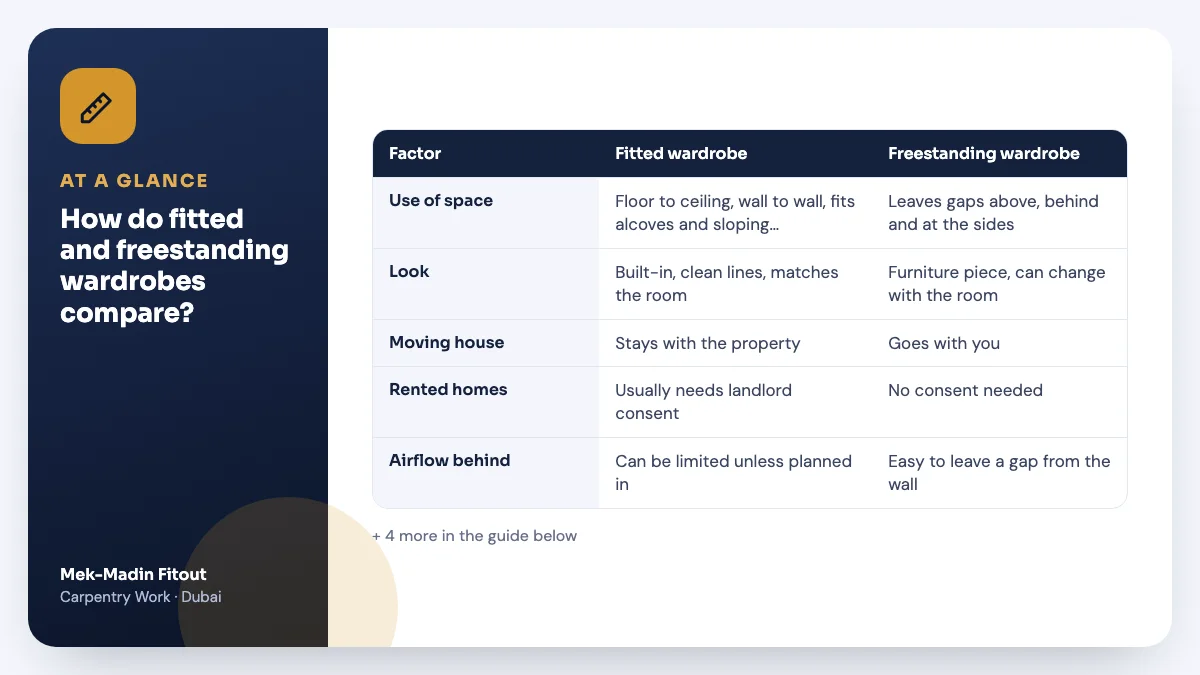
| Factor | Fitted wardrobe | Freestanding wardrobe |
|---|---|---|
| Use of space | Floor to ceiling, wall to wall, fits alcoves and sloping walls | Leaves gaps above, behind and at the sides |
| Look | Built-in, clean lines, matches the room | Furniture piece, can change with the room |
| Moving house | Stays with the property | Goes with you |
| Rented homes | Usually needs landlord consent | No consent needed |
| Airflow behind | Can be limited unless planned in | Easy to leave a gap from the wall |
| Lead time | Measuring, design, making and fitting | Off the shelf or ordered, then delivery and assembly |
| Cost pattern | Higher upfront, made to measure | Wide range, from budget to high end |
| Repairs | Panels and doors can be replaced to fit | Often easier to replace the whole unit |
| Effect on resale | Can help if well made and neutral | No effect |
Neither option is right for every home. The rest of this guide helps you weigh the factors that matter most for yours.
Which wardrobe makes better use of space in a Dubai bedroom?
Fitted wardrobes make the most of awkward spaces. They can fill the area beside a column, run up to a high ceiling or work around a bulkhead hiding AC ducts. In smaller apartment bedrooms, that extra storage can make a real difference.
Freestanding wardrobes need a straight, clear wall. They leave dead space on top, which collects dust, and a gap at the sides. They are more flexible, though, because you can move one to another wall or room.
Many Dubai apartments already come with built-in wardrobes. If yours does, the question may be whether to repair, refit or add to them, rather than starting again.
How do humidity and AC affect wardrobes in Dubai?
Humidity and AC affect wardrobes in Dubai through big swings in indoor moisture: dry air when the AC runs hard, and damp, closed-up rooms when it is off, such as during summer travel. Those swings can swell standard board, trap musty smells and let mould grow behind wardrobes on external walls.
Dubai homes go through big swings in indoor moisture. The air is dry when the AC runs hard, and damp when it is switched off, such as when you travel in summer. Wardrobes made from board feel those changes.
Why do MDF and chipboard wardrobes swell?
Standard MDF and chipboard (particle board) absorb moisture through any exposed or poorly sealed edge. Once they swell, they rarely return to their original shape. Doors stop lining up, hinge screws pull out and shelves sag. Our guide to fixing swollen cabinets and wardrobes covers tracing the water and replacing damaged panels.
Do moisture-resistant boards help?
Moisture-resistant MDF and chipboard are made to cope better with damp. They are not waterproof, but they hold their shape much longer in humid conditions. Sealed edges matter as much as the board itself, so ask how cut edges and hinge holes are finished.
How much ventilation does a wardrobe need?
Clothes need air. A wardrobe packed full and closed for months, with the AC off, is likely to smell musty. Ventilated door panels, a small gap at the top or base, and leaving doors open for a while after you return from a trip all help.
Why does mould grow behind wardrobes on external walls?
This is the most common hidden problem. An external wall can be cooler or warmer than the room, depending on the season and the AC. When a wardrobe sits flat against it, air does not move behind it and condensation can form on the wall.
The result is mould on the wall and on the back panel, often only found when the wardrobe is moved. To reduce the risk:
- Put wardrobes on internal walls where you can.
- If it has to go on an external wall, leave an air gap behind it.
- On fitted wardrobes, ask for a ventilated back or a back panel set off the wall.
- Fix any leak or damp patch on the wall before the wardrobe goes in.
If you find mould behind a wardrobe, clean and treat the wall and let it dry fully. Our painting and decoration team can treat stained walls with suitable paint once the cause is fixed.
How does renting affect the choice of wardrobe?
In a rented home, a fitted wardrobe usually counts as an alteration to the property. You will normally need written consent from your landlord. Some buildings also need management approval before contractors work in the unit, so check that too. Our guide to renovating a rented apartment in Dubai sets out the usual order of approvals.
Agree in writing what happens when you leave. The landlord may want the wardrobe left in place, or the wall restored to how it was. Filling fixing holes, repainting and repairing skirting are common items at move-out, as our guide to move-out repairs in Dubai explains.
Dubai's tenancy law explains why. Article 19 of Law No. (26) of 2007 regulating the relationship between landlords and tenants in Dubai says the tenant may not "make any changes" to the property without the landlord's permission and the required licences. Article 23 adds that, "unless otherwise agreed by the parties", a tenant may not remove leasehold improvements they made when vacating, so agree in writing if you want to take a fitted wardrobe with you.
A freestanding wardrobe avoids these questions. It moves with you, and the only marks it usually leaves are from an anti-tip strap fixed to the wall.
How long does a fitted wardrobe take compared with a freestanding one?
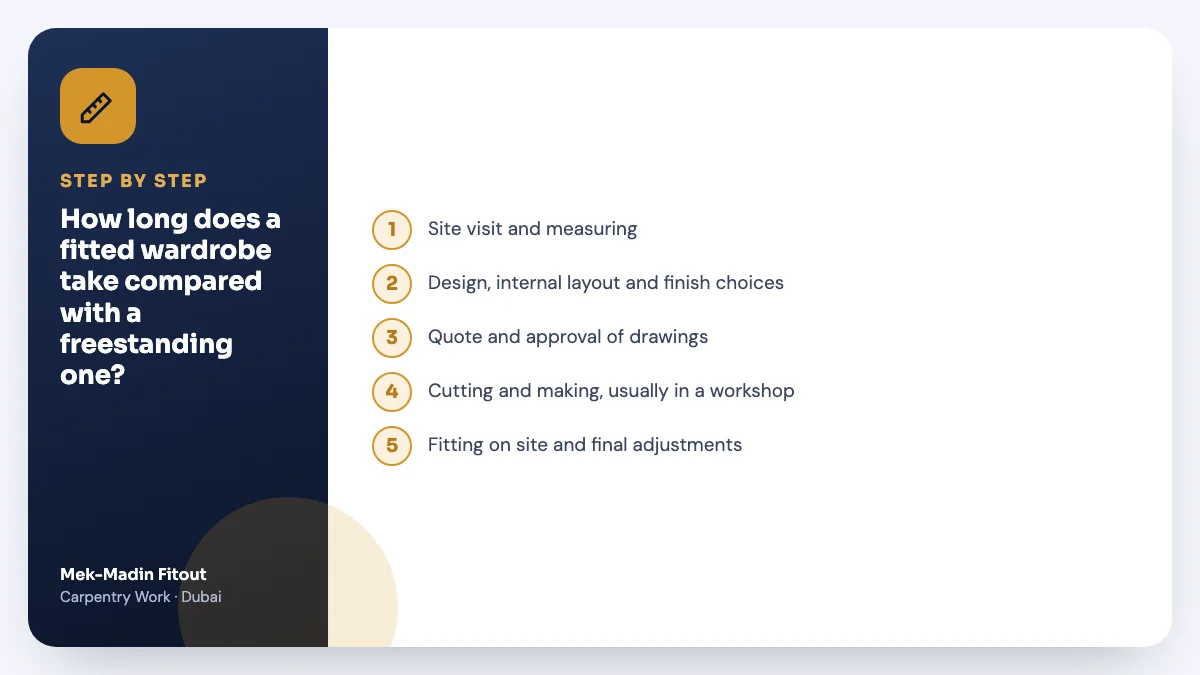
A fitted wardrobe often takes several weeks from measuring to fitting, because it goes through a site visit, design, quote and drawings, workshop making and fitting on site. A freestanding wardrobe can arrive quickly if it is in stock, while ordered or imported pieces take longer and flat-pack units need assembly.
A freestanding wardrobe can be in your home quickly if it is in stock. Ordered or imported pieces take longer. Flat-pack units also need assembly, which our handyman services can handle.
A fitted wardrobe follows a longer sequence:
- Site visit and measuring.
- Design, internal layout and finish choices.
- Quote and approval of drawings.
- Cutting and making, usually in a workshop.
- Fitting on site and final adjustments.
This often takes several weeks, depending on the design, materials and how busy the workshop is. If the wardrobe is part of a renovation, it usually goes in after flooring and painting are finished.
Which wardrobe materials cope best with Dubai humidity?
Moisture-resistant MDF or chipboard with sealed edges copes better with Dubai humidity than standard board, which swells if moisture gets in through its edges. Plywood is strong and holds screws well, solid timber can be refinished, and near the coast, stainless or coated hardware resists corrosion from salty air.
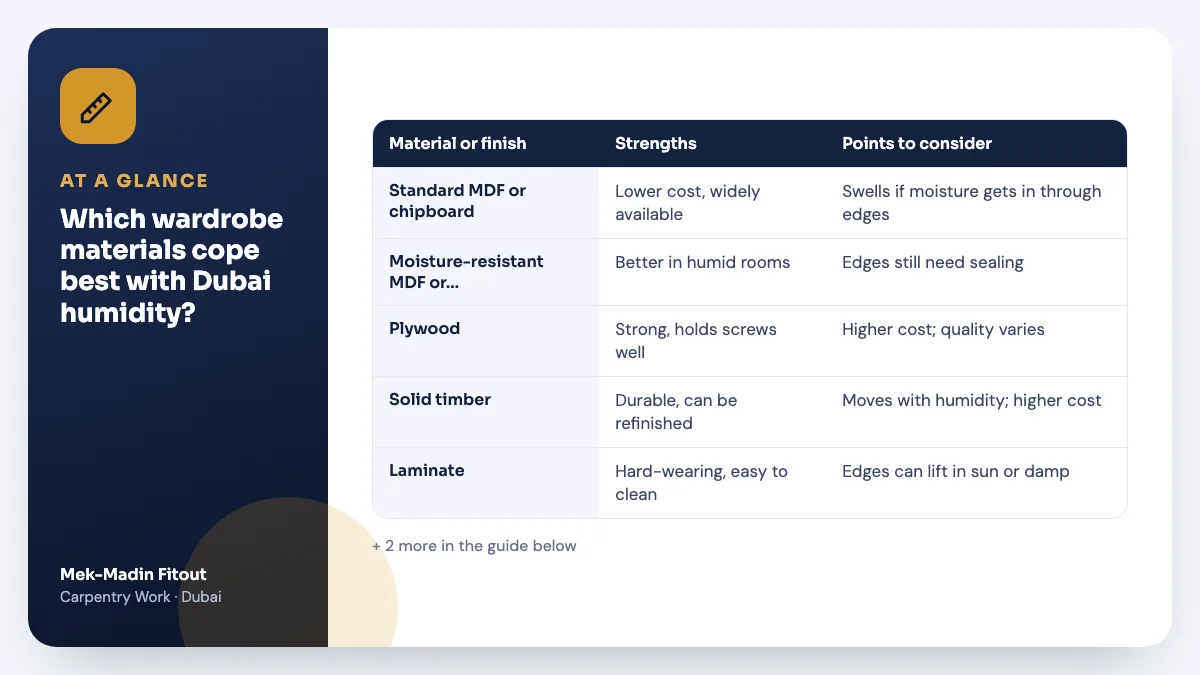
| Material or finish | Strengths | Points to consider |
|---|---|---|
| Standard MDF or chipboard | Lower cost, widely available | Swells if moisture gets in through edges |
| Moisture-resistant MDF or chipboard | Better in humid rooms | Edges still need sealing |
| Plywood | Strong, holds screws well | Higher cost; quality varies |
| Solid timber | Durable, can be refinished | Moves with humidity; higher cost |
| Laminate | Hard-wearing, easy to clean | Edges can lift in sun or damp |
| Lacquer or paint | Smooth, any colour | Shows chips and fingerprints |
| Veneer | Real wood look | Can fade in strong sun |
Hardware matters as much as the boards. Good hinges, runners and drawer slides keep doors aligned for longer. Near the coast, stainless or coated hardware resists corrosion from salty air.
Sliding or hinged wardrobe doors: which suits your room?
Sliding wardrobe doors suit narrow bedrooms because they need no space to open, though you only see part of the wardrobe at a time and the bottom tracks need regular cleaning of dust and sand. Hinged doors let you see everything at once but need clear space in front to swing.
Sliding doors
Sliding doors need no clearance to open, which suits narrow bedrooms where a bed sits close to the wardrobe. You can only see part of the wardrobe at a time, though. Bottom tracks collect dust and sand, so they need regular cleaning to keep running smoothly.
Hinged doors
Hinged doors open fully, so you can see everything at once. They need clear space in front to swing. Soft-close hinges reduce wear, and hinges can be adjusted if a door starts to drop.
For tall doors, sliding systems need a straight floor and ceiling. Hinged doors on tall wardrobes may need more hinges to stop warping. A carpenter can tell you which suits your room after measuring.
Can you fit a wardrobe yourself, or do you need a carpenter?
Freestanding wardrobes and flat-pack units are often a do-it-yourself job, as long as they are fixed to the wall. Fitted wardrobes are different. They need accurate measuring, the right boards for the room, planned ventilation and careful fitting to uneven walls and floors.
Our carpentry work in Dubai covers new fitted wardrobes, refits of existing built-ins, sliding track replacement and repairs to swollen or sagging doors. Call or WhatsApp +971 52 884 8916 and we will confirm a visit time when you call.
FAQs
Are fitted wardrobes worth it in a Dubai apartment?
They often are for owners, because they make the most of the space and can suit awkward layouts. For tenants, a freestanding wardrobe is usually the simpler choice, since a fitted one needs landlord consent and stays behind when you move.
Why does my wardrobe smell musty?
Usually because moisture is trapped inside. This is common when the AC is off for a long time or the wardrobe sits against an external wall. Air the wardrobe, check the wall behind it for damp or mould, and improve ventilation.
Can a swollen wardrobe door be repaired?
Swollen MDF or chipboard rarely goes back to shape. The damaged door or panel is usually replaced, ideally with a moisture-resistant board and sealed edges. Find and fix the source of moisture first.
Do I need permission to install a fitted wardrobe in a rented flat?
Usually, yes. A fitted wardrobe is normally treated as an alteration, so get written landlord consent first. Some buildings also need management approval for contractors to work in the unit.