
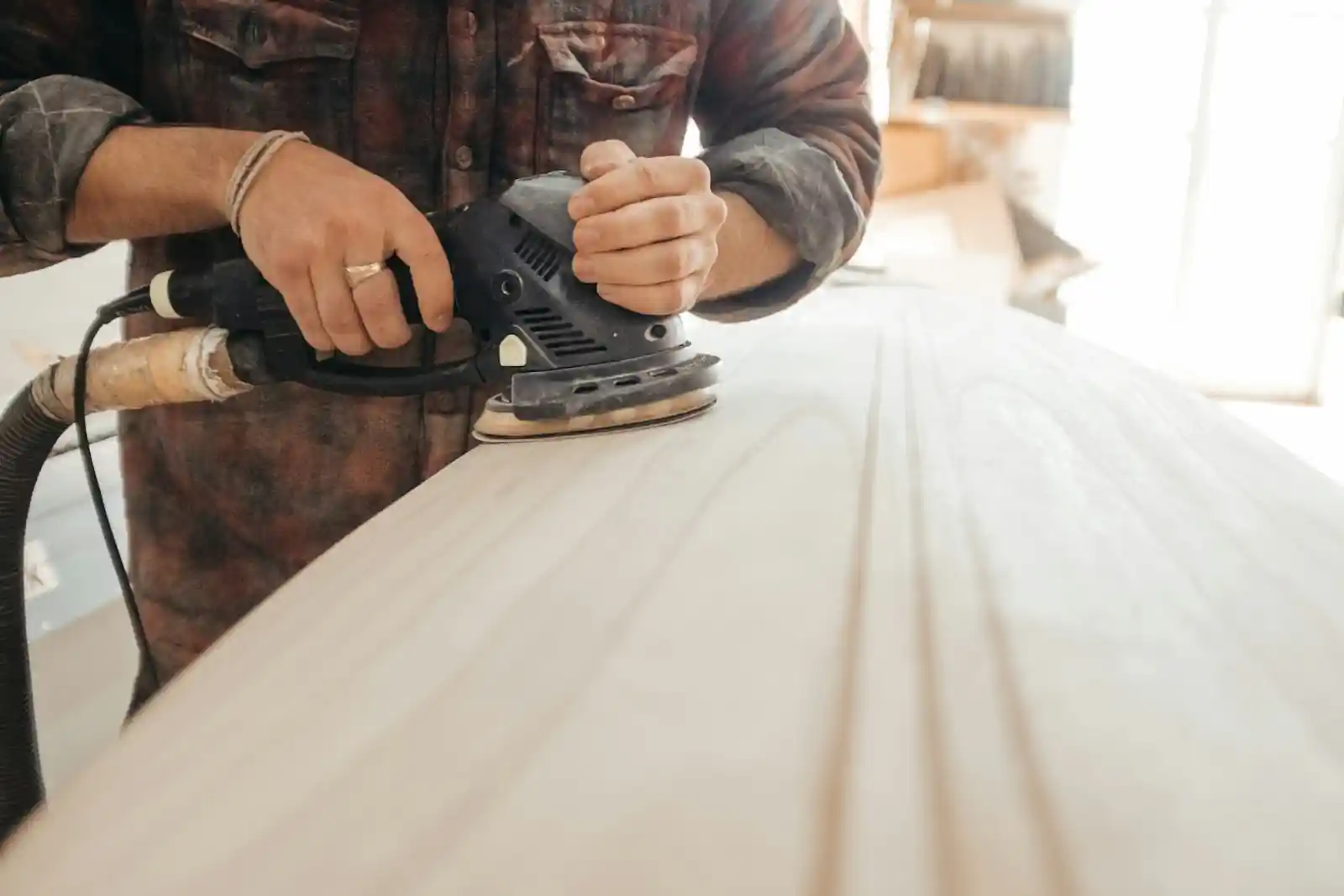

A wooden door usually sticks in summer because the timber absorbs moisture from humid air and swells, often where the edges were never sealed. Loose hinges make it worse by letting the door drop. Tighten the hinges first, find exactly where it rubs, ease only that spot, then seal every edge.
Many doors that stick in late summer close freely again in the cooler months. That is why planing should be the last step, not the first.
Why do wooden doors stick in a Dubai summer?
Timber takes in moisture from the air and swells across its width, then shrinks as the air dries. Dubai's summer humidity, especially in coastal areas, can make a door grow just enough to catch on the frame. Heat, strong sun on outside doors and loose hinges add to the problem.
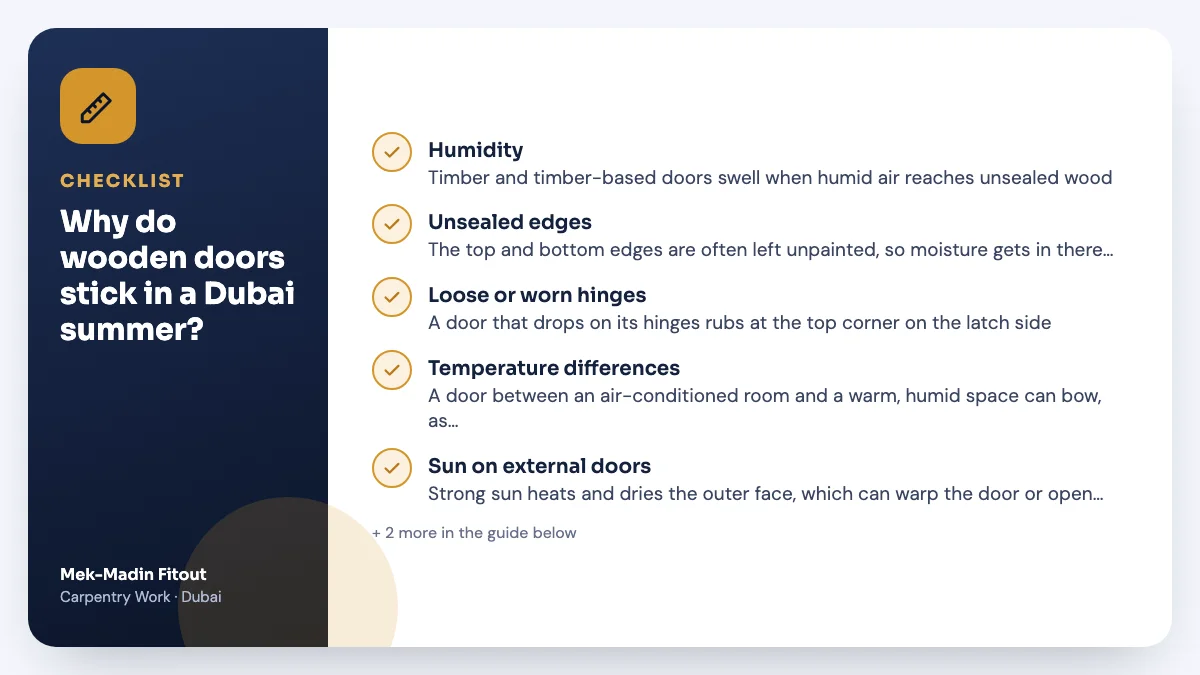
- Humidity. Timber and timber-based doors swell when humid air reaches unsealed wood.
- Unsealed edges. The top and bottom edges are often left unpainted, so moisture gets in there first.
- Loose or worn hinges. A door that drops on its hinges rubs at the top corner on the latch side.
- Temperature differences. A door between an air-conditioned room and a warm, humid space can bow, as each face reacts differently.
- Sun on external doors. Strong sun heats and dries the outer face, which can warp the door or open its joints.
- Paint build-up. Layers of paint on edges and frames slowly close the gap.
- Floor changes. New tiles, a threshold or a thick rug can raise the floor so the bottom edge catches.
Homes near the coast, such as apartments in Dubai Marina, can see doors near balconies stick first, as humid air comes in whenever the balcony door opens.
How do you find where a door is sticking?
Close the door slowly and watch the gap around it. Look for shiny, scuffed or worn paint on the door edge and frame, which marks the rubbing points. Sliding a sheet of paper around the edges of the closed door also helps, because it will catch wherever the door touches.
| Where it sticks | Likely cause | First thing to try |
|---|---|---|
| Top corner, latch side | Door dropped on loose hinges | Tighten or pack the top hinge |
| Bottom edge | Sagging door or a raised floor | Tighten hinges, then check the floor or threshold |
| Along the whole latch edge | Swelling across the width | Tighten hinges, then ease the edge |
| Hinge side | Hinges set too deep or paint build-up | Pack the hinges or remove excess paint |
| Latch will not catch | Strike plate out of line | Adjust or move the strike plate |
| Middle of the door | Door bowed or frame twisted | Check frame fixings, or ask a carpenter |
How do you fix a sticking wooden door, step by step?
Work from the least invasive fix to the most: tighten the hinges, adjust the strike plate and lower the humidity first. Only sand or plane the door if it still sticks, and remove as little timber as possible. Then seal the bare wood straight away so it cannot soak up moisture again.
Step 1: Tighten the hinges
Open the door and check every hinge screw. Tighten any that are loose. If a screw spins without gripping, fit a longer screw that reaches firmer timber behind, or plug the hole and refix.
Pulling the door back up on its top hinge often clears a rub at the top latch corner without any planing. If a hinge is bent or its knuckle is worn, replace it with one of the same size so the door hangs true.
Step 2: Check the latch and strike plate
If the door closes but will not latch, the strike plate may be out of line. Mark where the latch meets the plate, then file the opening slightly or move the plate.
Step 3: Lower the humidity
Run the AC or a dehumidifier, and use extract fans in bathrooms and kitchens. A door that is only slightly tight may ease on its own as the room dries.
Step 4: Sand or plane only the high spot
If it still sticks, mark the rubbing area with a pencil while the door is closed. Take the door off if you need to plane the top, bottom or hinge edge. Remove a little at a time and test often, remembering the door will shrink again in drier weather.
Wooden doors are heavy. Have two people lift a door off its hinges and support it on its edge while you work. Wear eye protection when planing or sanding, and keep children away from the work area.
If you do not have the right tools, or the door is large or glazed, a carpenter can ease and rehang the door without taking off more than needed.
Step 5: Seal every edge
Prime and paint, or varnish, the planed edge straight away. Seal the top and bottom edges too, which is easiest with the door off. Sealed timber takes in moisture far more slowly than bare wood.
What should you avoid doing to a sticking door?
Do not plane a door heavily in peak summer, force it shut or leave bare timber exposed. Planing too much leaves a wide gap once the air dries, and forcing it can split the frame or loosen hinges. Fire-rated doors should not be cut or planed without checking first.
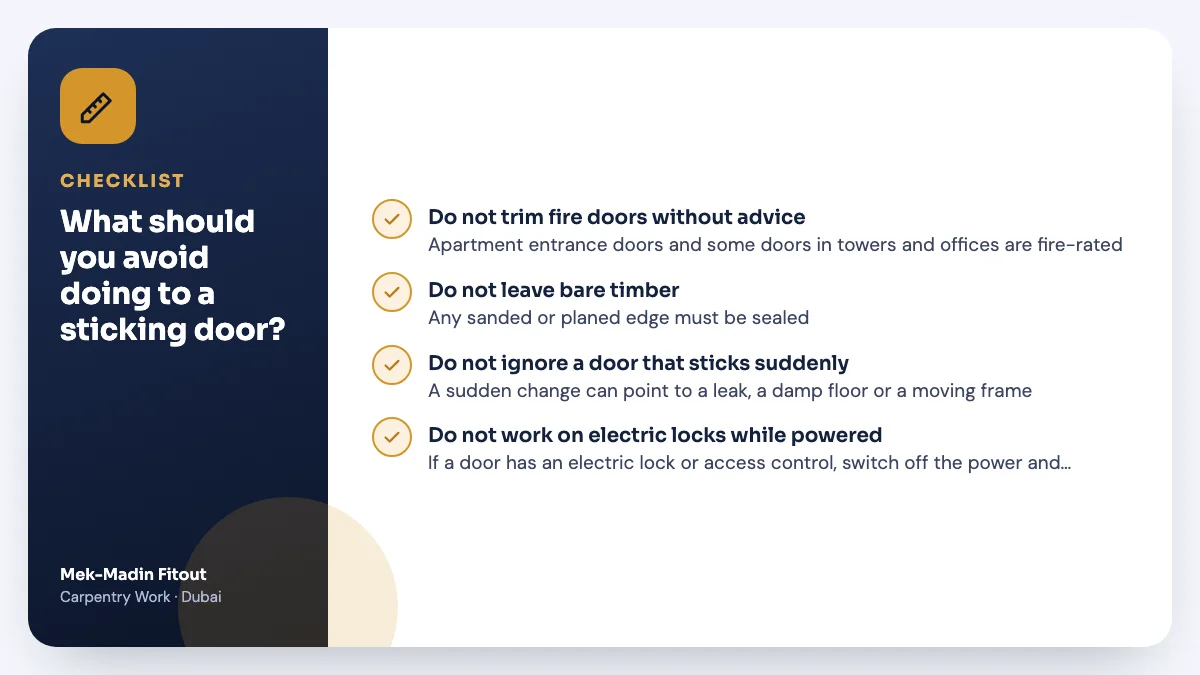
- Do not trim fire doors without advice. Apartment entrance doors and some doors in towers and offices are fire-rated. Cutting them, changing the gaps or removing seals can affect how they perform, so check with building management first.
- Do not leave bare timber. Any sanded or planed edge must be sealed.
- Do not ignore a door that sticks suddenly. A sudden change can point to a leak, a damp floor or a moving frame.
- Do not work on electric locks while powered. If a door has an electric lock or access control, switch off the power and call a professional for anything electrical.
Why do some doors swell more than others?
Solid timber, veneered doors and doors made from MDF or chipboard all react to moisture, but in different ways. Solid wood swells and shrinks with the seasons and can be planed. Board-based doors swell badly if water reaches a cut edge and rarely recover, so they are usually repaired or replaced.
- Bathroom doors swell most at the bottom edge, where steam and mopping water reach.
- Doors near balconies and outside doors take on humid air every time they are opened.
- Wardrobe doors on external walls can pick up moisture from cooler wall surfaces.
Board swelling is the same problem seen in kitchen units and wardrobes. Our guide to swollen kitchen cabinets and wardrobes explains why board-based panels rarely shrink back.
Aluminium and glass doors are different again. A balcony sliding door that will not close is usually down to sand, salt or worn rollers rather than swelling.
How can you stop a wooden door sticking next summer?
Keep the timber sealed on every face and edge, keep the hinges tight and control humidity indoors. Check doors before the most humid part of the year, when small problems are easy to fix. Repaint or revarnish worn edges before they let moisture in, and keep extract fans working.
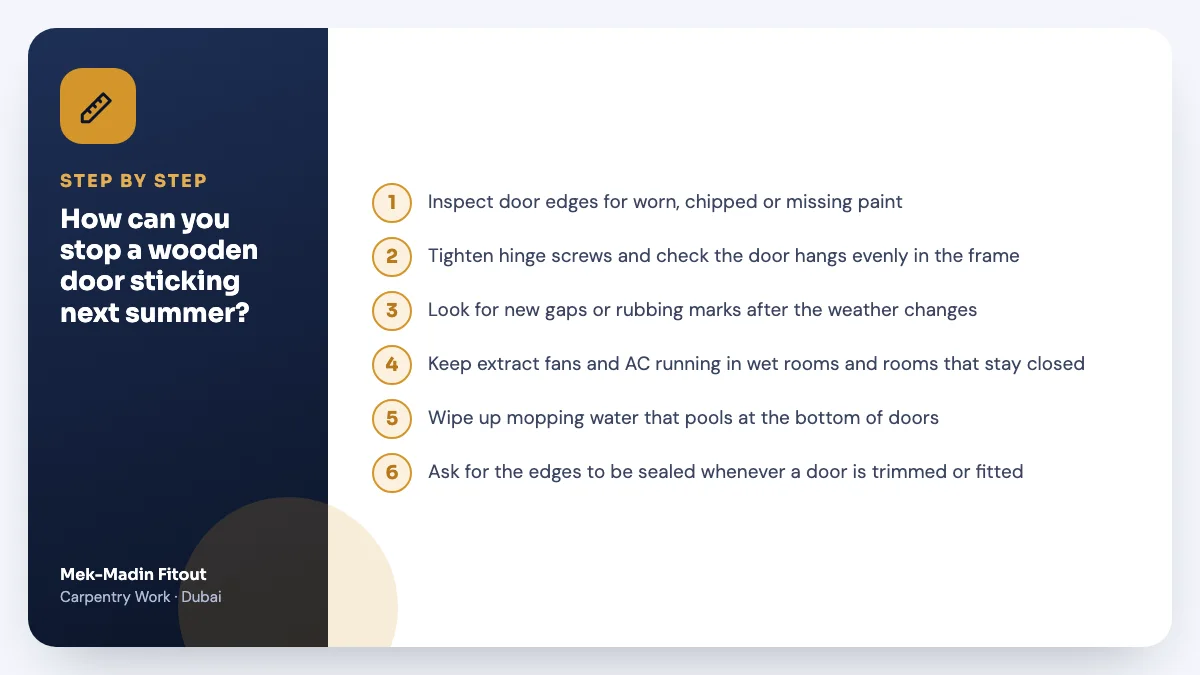
- Inspect door edges for worn, chipped or missing paint.
- Tighten hinge screws and check the door hangs evenly in the frame.
- Look for new gaps or rubbing marks after the weather changes.
- Keep extract fans and AC running in wet rooms and rooms that stay closed.
- Wipe up mopping water that pools at the bottom of doors.
- Ask for the edges to be sealed whenever a door is trimmed or fitted.
When should you call a carpenter about a sticking door?
Call a carpenter if the door still sticks after you have tightened the hinges, if it needs taking off and planing, if the frame is loose or twisted, or if the door is fire-rated. Get help too if the door swelled after a leak, as the water source needs fixing first.
Our carpentry and door repair service handles door easing, rehanging, hinge replacement and frame repairs across Dubai. Call or WhatsApp +971 52 884 8916, and we will confirm a visit time when you call.
FAQs
Will my door stop sticking when the weather cools?
Often, yes, if the cause is humidity. Timber shrinks as the air dries. That is why you should ease only the rubbing spot rather than plane a wide gap.
Should I plane the top or the bottom of the door?
Plane only where it rubs. Most often that is the top corner on the latch side, after the hinges have loosened. Fix the hinges first, as that may solve it.
Can I use soap or wax to stop a door sticking?
Rubbing wax on the edge can ease a door that only just catches. It is a short-term help and does not deal with swelling or loose hinges.
Is a sticking door a sign of a structural problem?
Rarely, on its own. Seasonal sticking is normal for timber. If several doors suddenly stick, or cracks appear near frames, get the building checked.