

A sliding door that will not close in Dubai usually has sand packed in the bottom track, rollers that are worn or seized, or a panel that has dropped out of line. Near the coast, salt corrosion speeds all of this up. Cleaning the track often helps straight away; rollers, locks and bent tracks need repair or replacement.
Balcony and patio sliders take more punishment here than almost any other part of a home. This guide explains the common causes, what is safe to do yourself, and when a part has reached the end of its life.
Why do sliding doors struggle in Dubai?
Sliding doors struggle in Dubai because sand, salt air and heat all work on the small rollers and narrow track that carry the door's weight. Wind blows fine sand into tracks, salt speeds up corrosion in coastal areas, and strong sun hardens seals and can soften or crack plastic roller wheels.
Hinged timber doors catch for a different reason, as humid air makes the wood swell, which we cover in our guide to a timber door that sticks in humid weather.
A sliding door panel rests its whole weight on two small rollers running along a narrow track. Anything that gets between the wheel and the rail makes the door drag. Anything that wears the wheel down makes the panel sit lower and rub.
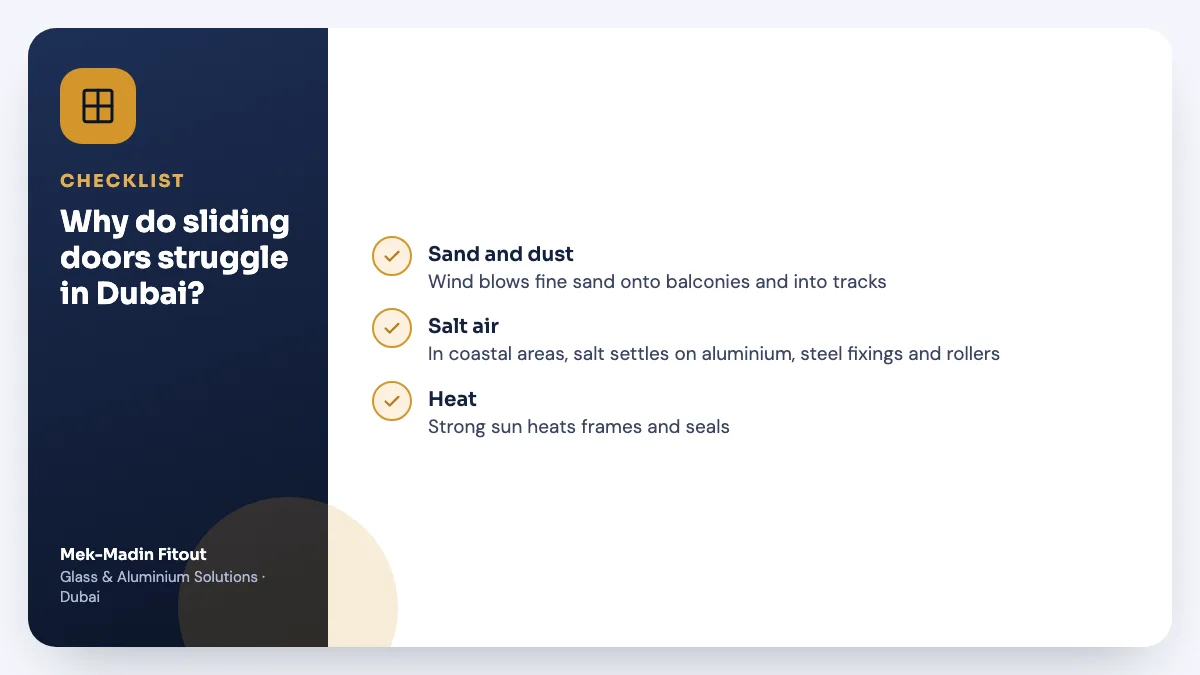
Dubai adds three pressures:
- Sand and dust. Wind blows fine sand onto balconies and into tracks. It mixes with moisture and cleaning water to form a gritty paste.
- Salt air. In coastal areas, salt settles on aluminium, steel fixings and rollers. It speeds up corrosion, especially on parts that are not stainless.
- Heat. Strong sun heats frames and seals. Rubber and brush seals harden and shrink over time, and plastic roller wheels can soften or crack.
How can you tell what is stopping your sliding door closing?
The symptom usually shows what is stopping a sliding door closing: grinding means sand in the track, heavy or jerky movement means worn or seized rollers, scraping along the bottom means the rollers have worn down, and a lock that will not catch often means a misaligned panel.
| Symptom | Likely cause | What usually fixes it |
|---|---|---|
| Door grinds or feels gritty | Sand and debris in the track | Clean the track and drainage holes |
| Door is heavy, then moves in jerks | Worn, flat-spotted or seized rollers | Adjust or replace rollers |
| Door scrapes the bottom of the frame | Rollers worn down, or adjustment lost | Raise the panel with the roller adjusters, or replace rollers |
| Gap at top or side when closed | Panel out of line or frame moved | Adjust rollers and keeper; check the frame |
| Lock will not catch | Misaligned panel or worn keeper | Realign the panel, adjust or replace the keeper |
| Handle loose or stiff | Worn handle or lock body, corroded screws | Replace the handle or lock mechanism |
| Dust and noise get in when closed | Hardened or missing brushes and seals | Replace weather brushes and gaskets |
| White powder or pitting on metal | Salt corrosion | Clean, protect, replace affected parts |
How do you know sand in the track is the problem?
This is the most common cause and the easiest to fix. Sand builds up at the ends of the track and around the drainage slots, so the door may run well in the middle but stick near the end. If water pools in the track after rain or balcony washing, the drainage holes are probably blocked too.
How does salt corrosion affect doors near the coast?
Homes in JBR, Dubai Marina and on the Palm Jumeirah see more salt in the air than inland communities. Look for white powder on aluminium, rust stains around screws and rollers that feel rough when turned by hand. Corroded rollers rarely recover with cleaning alone.
What are the signs of worn or flat-spotted rollers?
Rollers carry the full weight of a heavy glass panel every time the door moves. Their bearings wear, and plastic or nylon wheels can develop flat spots, especially if the door has been dragged over sand. A flat-spotted roller makes the door thump or jerk as it moves.
Many roller housings have an adjustment screw at the bottom edge of the panel. Turning it raises or lowers that corner. If adjustment has run out and the door still drags, the rollers usually need replacing.
Why do sliding panels drop out of line?
Panels drop out of line when one roller wears faster than the other or an adjuster has slipped. The door then sits at a slight angle. It may close at the bottom but leave a gap at the top, or the lock may miss its keeper.
Building movement can also twist a frame slightly over time. If the frame is out of square, adjusting the rollers only goes so far.
What happens when seals and brushes wear out?
Sliding doors seal with pile brushes and rubber gaskets rather than by pressing tight like a hinged door. Once these flatten, harden or fall out, dust, noise and hot air come in. Worn brushes do not stop a door closing, but they are usually replaced at the same visit. If the frames themselves are failing, our guide on whether double glazing is worth it compares seals, film and new units.
Why will a sliding door lock not engage?
A lock that will not engage is often a symptom of misalignment rather than a broken lock. If the panel is in line and the lock still fails, the mechanism or keeper may be worn. On balconies, a lock that works matters for safety, especially with children at home.
How do you safely clean a sliding door track yourself?
To clean a sliding door track safely, vacuum its full length, loosen packed sand with a nylon brush rather than metal tools, clear the drainage holes, wipe with mild soapy water instead of hosing, and apply a little silicone-based dry lubricant to the rail, never oil or grease.
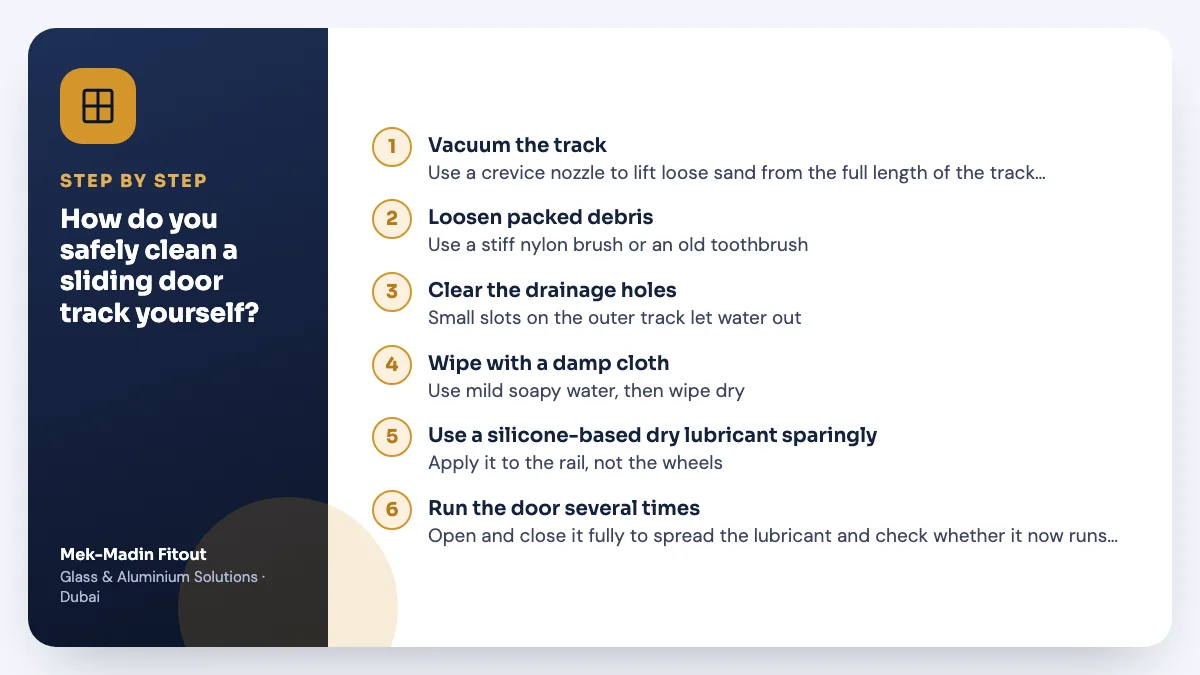
Track cleaning is a reasonable job for most owners. Keep to these steps:
- Vacuum the track. Use a crevice nozzle to lift loose sand from the full length of the track, including both ends.
- Loosen packed debris. Use a stiff nylon brush or an old toothbrush. Avoid metal tools, which scratch the rail and create new rough spots.
- Clear the drainage holes. Small slots on the outer track let water out. Gently clear them with a thin plastic tool or pipe cleaner.
- Wipe with a damp cloth. Use mild soapy water, then wipe dry. Do not hose the track, as the water carries sand further in.
- Use a silicone-based dry lubricant sparingly. Apply it to the rail, not the wheels. Avoid oil or grease, which hold sand and make the problem worse.
- Run the door several times. Open and close it fully to spread the lubricant and check whether it now runs freely.
Do not try to lift a glass panel out of its frame. Large panels are heavy and awkward, and a dropped panel can shatter or cause injury.
When do sliding door rollers or tracks need replacing?
Sliding door rollers or tracks need replacing when the door still drags after a thorough clean, roller adjustment has run out, or wheels, rails or fixings are cracked, bent, worn or corroded. Replacement rollers must match the profile and weight rating of the door system, or they may wear quickly or derail.
Cleaning will not fix a mechanical fault. Rollers or tracks usually need replacing when:
- The door still drags after a thorough clean.
- Roller adjustment has run out and the panel still scrapes.
- Wheels are cracked, flat-spotted or rough when turned.
- The track rail is bent, dented or worn through to a groove.
- Corrosion has pitted the rollers, track or fixings.
Replacement rollers need to match the profile and weight rating of the door system. A generic roller that fits loosely may wear quickly or derail. The track itself can sometimes be fitted with a stainless steel cap rail, rather than replacing the whole frame.
How often should you maintain a sliding door in Dubai?
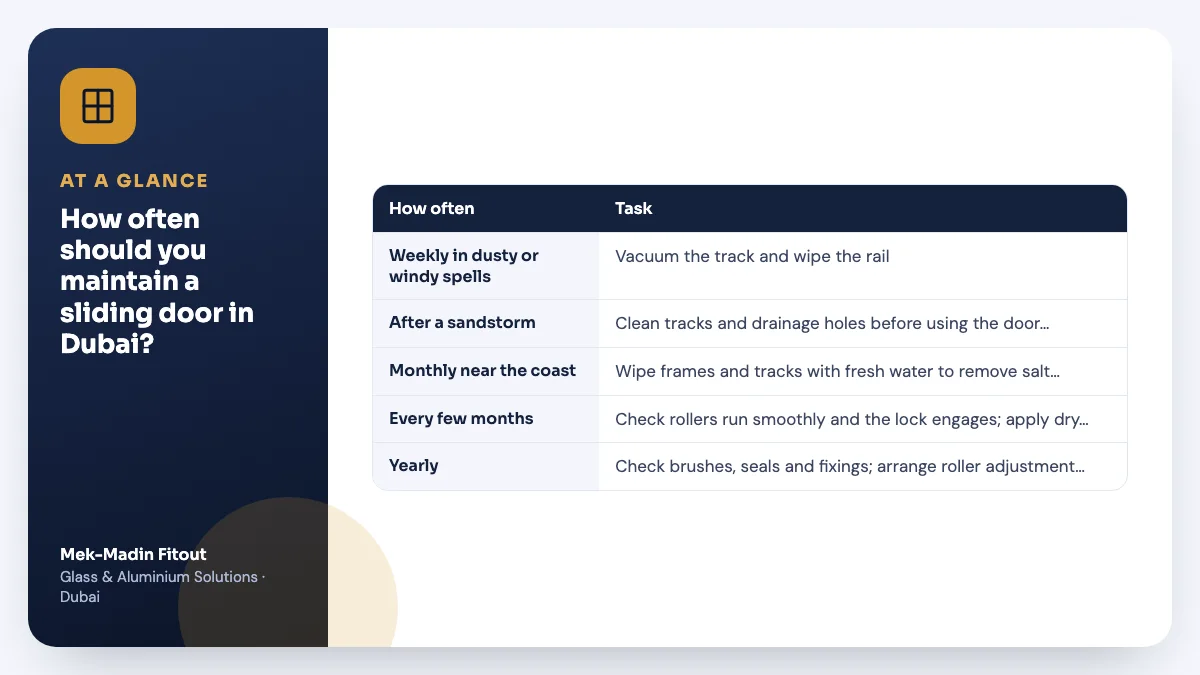
In Dubai, vacuum a sliding door track weekly in dusty spells and after sandstorms, wipe salt off frames and tracks with fresh water monthly near the coast, check the rollers and lock and lubricate the rail every few months, and check brushes, seals and fixings once a year.
| How often | Task |
|---|---|
| Weekly in dusty or windy spells | Vacuum the track and wipe the rail |
| After a sandstorm | Clean tracks and drainage holes before using the door heavily |
| Monthly near the coast | Wipe frames and tracks with fresh water to remove salt, then dry |
| Every few months | Check rollers run smoothly and the lock engages; apply dry lubricant to the rail |
| Yearly | Check brushes, seals and fixings; arrange roller adjustment if the door has dropped |
If you are moving out, a door that runs freely and locks properly is one less item on the handover list. Our guide to move-out repairs before handover covers the rest.
When should you call a professional about a sliding door?
Call a professional if a sliding door will not lock, if a panel has come off its track, or if the glass is cracked. These are safety issues, particularly on a high-floor balcony. Book a repair too if cleaning has not helped, or if you can see corroded or broken rollers.
We repair sliding doors, rollers, tracks, locks and seals across Dubai, and replace parts where needed. In towers by the sea, our handyman service in Dubai Marina can also handle smaller fixes at the same visit. Call or WhatsApp +971 52 884 8916 and we will confirm a visit time.
FAQs
Why does my sliding door get harder to open every summer?
Summer brings more dust, sandstorms and heat, so sand builds up in the track, seals harden in the sun and plastic rollers can wear faster. A track clean usually helps. If the door stays heavy, the rollers likely need adjusting or replacing.
Can I use WD-40 or oil on sliding door tracks?
It is best avoided on tracks. Oil and grease attract sand and turn it into a sticky paste that wears the rollers faster. A silicone-based dry lubricant applied lightly to the rail works better in Dubai's dusty conditions.
How do I know if the rollers are worn?
Signs include a door that sits lower than before, scrapes the bottom of the frame, moves in jerks or makes a thumping or grinding noise. If adjusting the roller screws no longer lifts the panel, the rollers are usually worn out.
Is it worth repairing an old sliding door instead of replacing it?
Often, yes. If the frame is straight and the glass is sound, new rollers, a track cap, seals and a lock can restore smooth running. Full replacement makes more sense when the frame is badly corroded, bent or the building is being renovated.