

A frameless shower screen uses thicker toughened glass held by hinges and clamps, so it looks cleaner and is easier to wipe down. A framed screen holds thinner glass in an aluminium frame, so it usually seals better against splashes, suits walls that are not perfectly straight and costs less. The right choice depends on your bathroom and budget.
This guide compares the two, explains where semi-frameless fits in, and shows what to check before you choose.
What is the difference between a frameless and a framed shower screen?
The difference is how the glass is held. A frameless screen relies on thick toughened glass that stands on its own, fixed to the wall and floor with small hinges, clamps or channels. A framed screen sets thinner glass inside an aluminium frame on every edge, and the frame carries much of the strength and the seals.
Because the glass in a frameless screen has to support itself, it is heavier and its fixings must go into solid wall or properly reinforced backing. A framed screen spreads its weight through the frame, which is more forgiving.
Both types use toughened safety glass. The look, the way water is contained and the way you clean them are where they really differ.
How do frameless and framed shower screens compare?
Frameless screens win on looks and ease of cleaning, while framed screens usually win on water control, tolerance of uneven walls and cost. Neither is better in every bathroom. The table below sets out the main differences, so you can weigh what matters most in yours, whether that is appearance, budget or a fully dry floor.
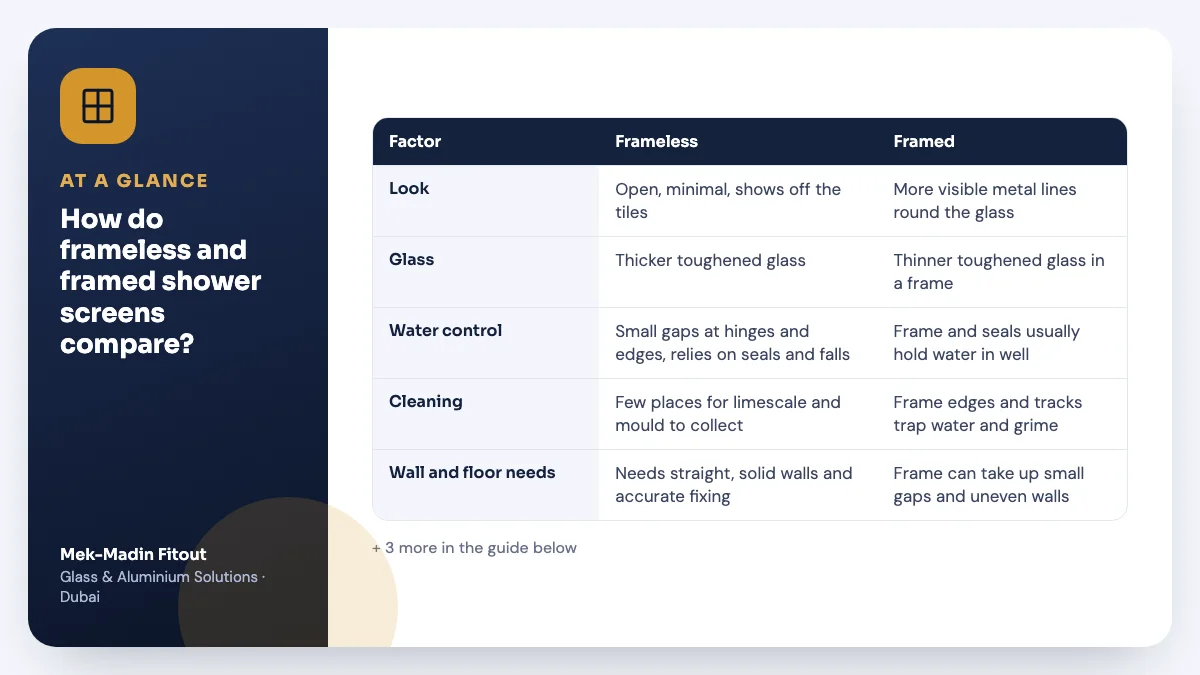
| Factor | Frameless | Framed |
|---|---|---|
| Look | Open, minimal, shows off the tiles | More visible metal lines round the glass |
| Glass | Thicker toughened glass | Thinner toughened glass in a frame |
| Water control | Small gaps at hinges and edges, relies on seals and falls | Frame and seals usually hold water in well |
| Cleaning | Few places for limescale and mould to collect | Frame edges and tracks trap water and grime |
| Wall and floor needs | Needs straight, solid walls and accurate fixing | Frame can take up small gaps and uneven walls |
| Weight | Heavy panels, need solid fixing and careful handling | Lighter, easier to move into a tower flat |
| Cost factors | More glass, heavier hardware and more precise fitting | Less glass and simpler fitting |
| Repairs | Hinges, seals and clamps can be replaced | Rollers, seals and frame parts can be replaced |
Which type keeps water in the shower better?
A framed screen usually keeps water in better, because the frame and its seals close the edges. A frameless screen has small gaps around the door and at the hinges, which rely on clear plastic seals and a well-designed floor. With the right layout, a frameless screen can stay dry, but it is less forgiving.
The floor matters as much as the glass. The shower area should fall towards its drain, so water runs away from the door. If the floor is flat or slopes the wrong way, water will escape under any screen.
Placing the door away from the shower head also helps, as does a fixed panel that takes most of the spray. Our guide to choosing bathroom tiles for a humid climate explains why floor falls and the waterproofing layer behind the tiles matter.
Which is easier to clean in hard water and humidity?
Frameless screens are easier to keep clean, because there are no frame edges or tracks for water to sit in. Dubai's hard water leaves limescale spots as droplets dry, and humid bathrooms let mould grow in damp corners. Fewer edges means fewer places for both to build up, though the glass still needs regular wiping.
A simple routine keeps either type looking clear:
- Squeegee the glass after each shower so droplets do not dry into limescale
- Choose an easy-clean coating on new glass, which helps water run off
- Use a mild, non-abrasive cleaner, as scouring pads can scratch glass and coatings
- Dry the frame and track on framed screens, where water collects
- Leave the door open and run the extract fan after showering so the area dries
- Check the silicone and seals for black spots or gaps
If the silicone around the screen has turned black, our guide on whether to clean or regrout black grout explains when silicone needs replacing rather than cleaning.
What is a semi-frameless shower screen?
A semi-frameless screen sits between the two. It usually has a slim frame or channel round the fixed panels and the outer edges, while the door itself is unframed glass on hinges. It gives a cleaner look than a fully framed screen, with better tolerance of uneven walls and often a lower cost than fully frameless.
It suits bathrooms where the walls are not quite true, or where you want a lighter look without the extra glass weight of a frameless design. The channels can be set slightly to take up small variations in the wall.
It also keeps some of the cleaning advantage. The door, which gets the most handling, has no frame to trap water.
Does your bathroom suit a frameless shower screen?
A frameless screen suits a bathroom with straight, solid walls, a well-sloped floor and enough room for the door to swing. It is less suited to uneven walls, hollow partitions without backing, or tight layouts. A quick check of these points before ordering saves problems on installation day.
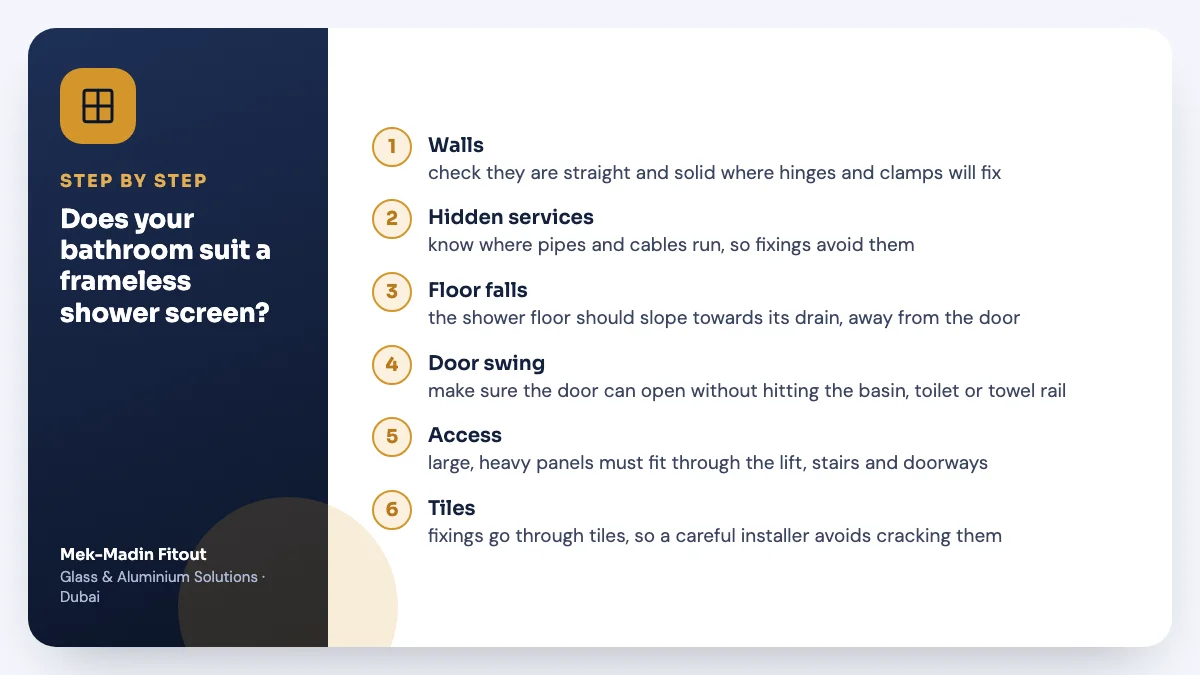
- Walls: check they are straight and solid where hinges and clamps will fix
- Hidden services: know where pipes and cables run, so fixings avoid them
- Floor falls: the shower floor should slope towards its drain, away from the door
- Door swing: make sure the door can open without hitting the basin, toilet or towel rail
- Access: large, heavy panels must fit through the lift, stairs and doorways
- Tiles: fixings go through tiles, so a careful installer avoids cracking them
In apartment towers, getting large glass panels in can need lift booking and building management approval. Ask before measuring so the panels are sized to fit the route in.
What safety points apply to any shower screen?
Every shower screen should use toughened safety glass, which breaks into small blunt pieces rather than sharp shards. Fixings must go into solid material, hinges must be aligned and edges must be protected from knocks. On rare occasions toughened glass can break without an obvious impact, so damage to edges should never be ignored.
Look out for these warning signs on an existing screen:
- A chip or crack on any edge, even a small one
- A door that drops, sticks or catches on the floor
- Loose hinges, clamps or wall channels
- Movement in a fixed panel when you push it gently
If you see any of these, stop using the door and have the screen checked. Some suppliers offer heat-soaked glass, a test process that reduces the risk of spontaneous breakage, so it is worth asking about when ordering.
Which shower screen should you choose?
Choose frameless if appearance and easy cleaning matter most, and your walls and floor are in good shape. Choose framed if you want the best water control, a lower budget or a forgiving fit on uneven walls. Semi-frameless offers a balance of the two, and your bathroom's layout often makes the decision for you.
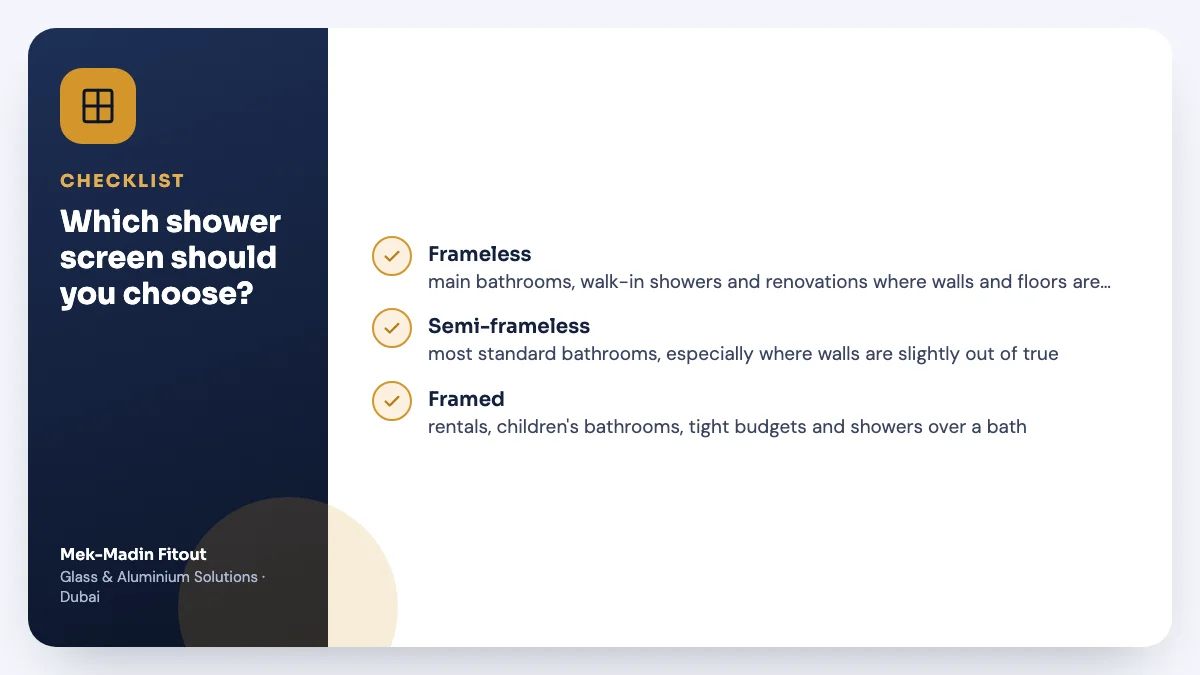
- Frameless: main bathrooms, walk-in showers and renovations where walls and floors are being redone
- Semi-frameless: most standard bathrooms, especially where walls are slightly out of true
- Framed: rentals, children's bathrooms, tight budgets and showers over a bath
We often find that a screen that leaks is not the wrong type, but was fitted on a floor that drains the wrong way. If you are changing the screen anyway, check the floor and the silicone at the same time.
Our glass and aluminium services include frameless and framed shower enclosures, as well as seal and silicone renewal for existing screens.
When should you call a professional to fit a shower screen?
Call a professional to measure, supply and fit any new screen, and to check an existing one that leaks, drops or has a chipped edge. Frameless glass is heavy, needs accurate fixing into solid backing and is unforgiving of small measuring errors. A framed screen is lighter, but still needs a true, sealed fit.
If water is getting past the screen into the floor or the flat below, the problem may be the waterproofing rather than the glass. Our guide to a bathroom leaking into the flat below explains how leaks are traced.
Mek-Madin Fitout offers glass and aluminium solutions in Dubai, including shower screens, mirrors and splashbacks. Send us photos and rough measurements of your shower area. Call or WhatsApp +971 52 884 8916, and we will confirm a visit time when you call.
FAQs
Do frameless shower screens leak?
They can leak a little at the hinges and door edges, as they have small gaps. Clear seals, a well-placed door and a floor that falls towards the drain keep most water inside.
Is a frameless shower screen harder to install?
Yes. The glass is heavier, the walls must be solid and straight, and the measuring has to be exact. It is not a job to try yourself.
What thickness of glass is used for a shower screen?
Frameless screens use thicker glass than framed screens, because there is no frame to support it. The right thickness depends on the panel size and fixing method, so ask the installer.
How do I stop limescale on my shower glass?
Squeegee the glass after every shower, use a mild cleaner, and consider an easy-clean coating on new glass. Good ventilation helps the glass dry faster.