

If your grout has turned black only on the surface and comes clean with a gentle scrub, cleaning and sealing is enough. If the stain returns within weeks, or the grout is cracked, crumbling or letting water behind the tiles, regrouting is the better fix. Ventilation decides how long either result lasts.
This guide helps you work out what the black actually is, how to clean it safely and what a proper regrout involves.
What makes bathroom grout turn black?
Black grout usually comes from mould, from dirt and soap scum, or from grout that has broken down, and each needs a different response. Getting the diagnosis right saves you scrubbing grout that needs replacing, or replacing grout that only needed a clean.
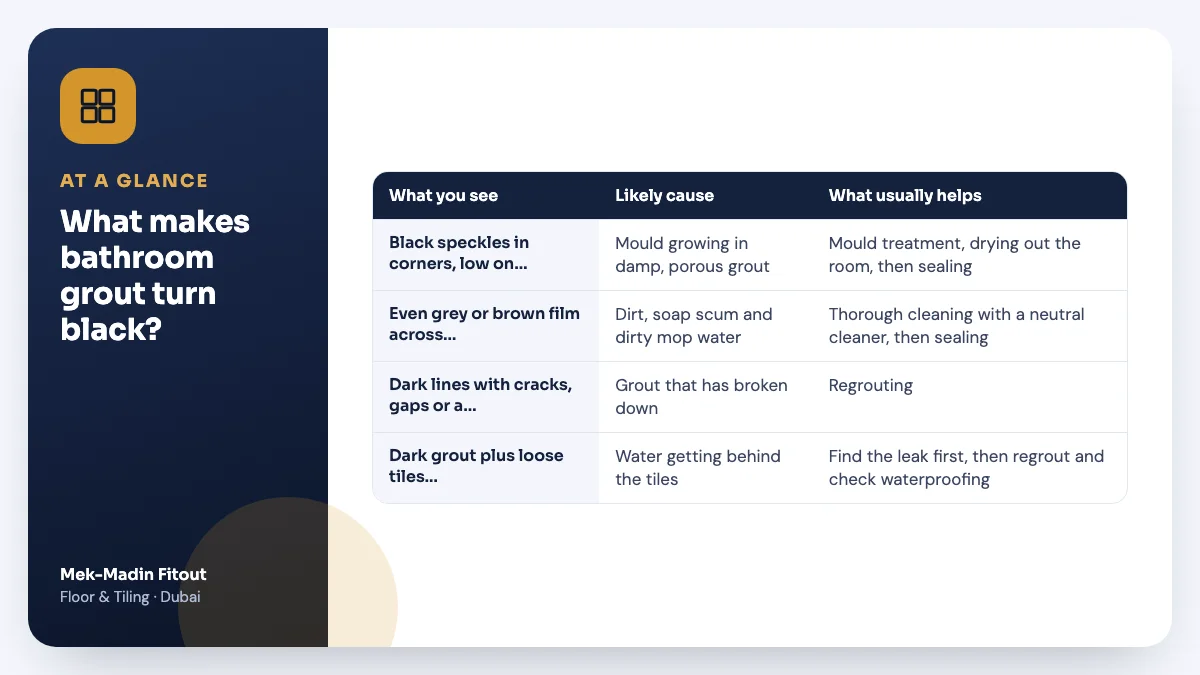
| What you see | Likely cause | What usually helps |
|---|---|---|
| Black speckles in corners, low on shower walls and along the floor edge | Mould growing in damp, porous grout | Mould treatment, drying out the room, then sealing |
| Even grey or brown film across floor grout, darker in walkways | Dirt, soap scum and dirty mop water | Thorough cleaning with a neutral cleaner, then sealing |
| Dark lines with cracks, gaps or a sandy, powdery surface | Grout that has broken down | Regrouting |
| Dark grout plus loose tiles, stains on the wall behind or the ceiling below | Water getting behind the tiles | Find the leak first, then regrout and check waterproofing |
How can you tell mould from dirt or failed grout?
Scrub a small patch with warm water, a neutral cleaner and a nylon brush. If the colour lifts, it was mostly dirt. If dark spots stay deep in the grout, it is usually mould.
Then press the grout firmly with a fingernail or the edge of a key. Sound grout feels hard. If it scratches away easily, crumbles or leaves sand on your finger, it has failed.
How do you clean black grout without damaging the tiles?
To clean black grout without damaging the tiles, start with warm water, a pH-neutral cleaner and a stiff nylon brush, then treat any remaining mould with a bathroom mould remover, following the label. Avoid wire brushes, acidic cleaners on cement grout and grout pens over mould, and seal cement grout once it is completely dry.
Start gentle
Begin with warm water, a pH-neutral tile cleaner and a stiff nylon brush. Work on a small area at a time, rinse well and dry the surface with a cloth. Many floors look much lighter after this alone.
How do you treat mould in grout?
For mould, use a bathroom mould remover and follow the label exactly. Open the door, run the extractor fan and wear gloves and eye protection. Leave the product for the stated time, scrub, rinse and let the area dry fully.
Diluted bleach can lighten mould stains on white cement grout. It can also fade coloured grout and damage some stone, so test a hidden patch first.
What should you avoid when cleaning grout?
- Wire brushes and scourers. They scratch glazed tiles and wear grout away.
- Acidic cleaners and vinegar on cement grout. Repeated use eats into the grout and etches marble and other natural stone.
- High-pressure steam or jet washing on weak grout. It can blow out joints that are already failing.
- Grout pens over mould. They hide the colour for a while, but the mould and the damp remain underneath.
Should you seal grout after cleaning it?
Once cement grout is clean and completely dry, apply a penetrating grout sealer. Sealing slows water and dirt soaking in, so the grout stays lighter for longer. Reseal from time to time, as the product directs.
How do you know when grout needs replacing?
Grout needs replacing when it is cracked, crumbling or missing, when joints have washed out below the tile edge, when mould returns within weeks of a thorough clean, or when deep staining will not lift. Signs of water behind the tiles also call for regrouting, once the leak has been traced.
Cleaning only works on grout that is still sound. Regrouting is usually the better choice when you see any of these:
- Grout that is cracked, crumbling or missing in places
- Joints that have washed out and now sit well below the tile edge
- Mould that comes back within weeks of a thorough clean
- Staining that sits deep in the grout and will not lift
- Signs of water behind the tiles: loose tiles, a musty smell, damp patches on the other side of the wall or marks on the ceiling below
The last point needs care. Grout is not waterproof on its own, even when it is in good condition. The membrane behind the tiles keeps water out of the wall and floor. Tiles that sound hollow when tapped can be another clue, as our guide to hollow floor tiles and their causes explains.
If water is already getting through, new grout may not solve it. Have the leak traced, and check whether the shower needs waterproofing repairs before regrouting. If a neighbour has reported water coming through, see our guide to a bathroom leaking into a neighbour's flat.
What does a proper bathroom regrout involve?
A proper bathroom regrout is slow, careful work: the old grout is raked out deep enough for new grout to bond, the joints are vacuumed, cleaned and dried, and new grout is pressed in fully, tooled, cured and sealed. Silicone at corners and edges is replaced at the same time.
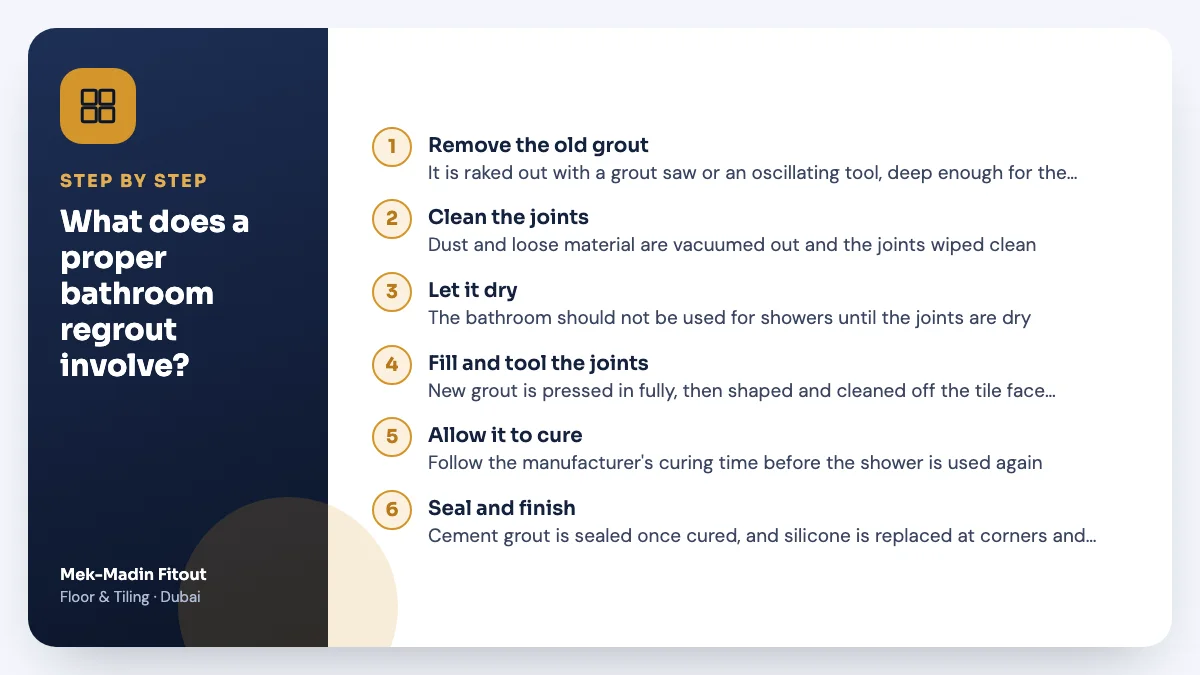
The steps usually look like this:
- Remove the old grout. It is raked out with a grout saw or an oscillating tool, deep enough for the new grout to bond properly. Care is needed not to chip tile edges.
- Clean the joints. Dust and loose material are vacuumed out and the joints wiped clean.
- Let it dry. The bathroom should not be used for showers until the joints are dry.
- Fill and tool the joints. New grout is pressed in fully, then shaped and cleaned off the tile face before it sets.
- Allow it to cure. Follow the manufacturer's curing time before the shower is used again.
- Seal and finish. Cement grout is sealed once cured, and silicone is replaced at corners and edges.
A thin skim of new grout over old, dirty grout rarely lasts. It does not bond well and often cracks or flakes off.
Should you regrout with epoxy or cement grout?
Epoxy grout absorbs very little water and resists mould and staining, so it suits shower floors and wet walls. Cement grout is easier and cheaper but needs sealing. Epoxy is harder to install, sets faster and is harder to remove later, while cement grout is simple to patch and suits walls and dry areas.
Choosing the right grout matters as much as the workmanship. Here is how the two main types compare in a bathroom.
| Feature | Cementitious grout | Epoxy grout |
|---|---|---|
| Water absorption | Porous unless sealed | Very low |
| Resistance to mould and staining | Fair, better when sealed and dry | High |
| Sealing | Needed, with periodic resealing | Not usually needed |
| Ease of installation | Easier, more forgiving | Harder; sets faster and must be cleaned off quickly |
| Cost | Lower | Higher |
| Repairs later | Simple to patch | Harder to remove and patch |
| Best suited to | Walls and dry areas | Shower floors, wet walls and busy floors |
Some cement grouts include polymers that improve them, sitting between the two. For a shower that keeps going black, epoxy is often the longer-lasting choice. If you are also changing tiles, our guide to bathroom tiles for a humid climate covers the tile side.
Which bathroom joints need silicone rather than grout?
Bathroom movement joints need flexible silicone rather than grout: internal corners, the wall-to-floor joint, around the bath, shower tray and basin, and where tiles meet a door frame or glass screen. Where two surfaces move slightly against each other, rigid grout cracks, and that crack lets water and mould in.
If you are replacing the screen itself, our comparison of frameless vs framed shower screens explains how each type is sealed to the wall and floor.
Those places need flexible silicone instead:
- Internal corners where two walls meet
- The joint between the wall and the floor
- Around the bath, shower tray and basin
- Where tiles meet another material, such as a door frame or glass screen
Use a sanitary silicone with a mould inhibitor. When silicone turns black, the mould has usually grown into it, so cut it out and replace it rather than scrubbing it.
How does ventilation stop grout going black again?
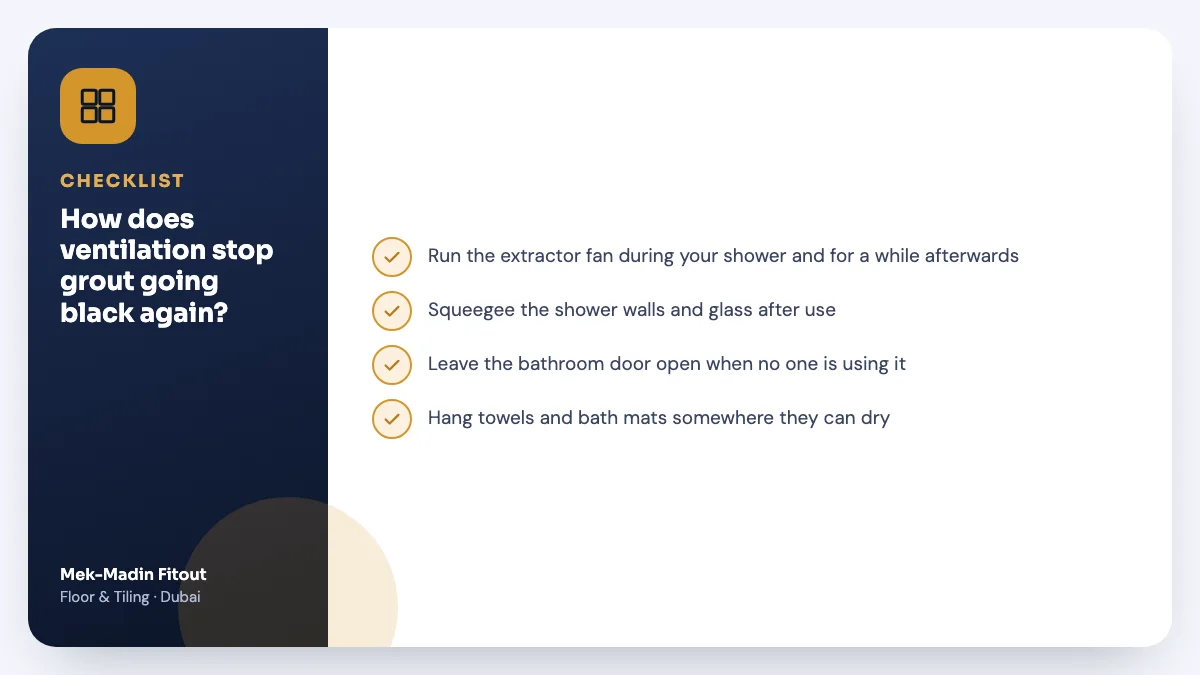
Good ventilation stops grout going black again because mould needs moisture, and grout that never fully dries will darken again however well it is cleaned. Improving airflow is the cheapest way to protect new or cleaned grout, helped by habits such as squeegeeing the walls and running the extractor fan after showers.
Many Dubai apartment bathrooms have no window and rely entirely on an extractor fan. Check yours actually pulls air by holding a sheet of tissue to the grille. If it barely moves, the fan or the duct may need attention. A weak fan also leaves steam on the ceiling, which leads to black mould above the shower.
Simple habits help too:
- Run the extractor fan during your shower and for a while afterwards
- Squeegee the shower walls and glass after use
- Leave the bathroom door open when no one is using it
- Hang towels and bath mats somewhere they can dry
When should you call a professional to regrout?
Cleaning black grout is a reasonable DIY job. Raking out old grout without chipping tiles, choosing and working with epoxy, and replacing silicone neatly take more skill and the right tools. If water is getting behind your tiles, the cause needs to be found before any new grout goes in.
Mek-Madin Fitout offers regrouting and floor tiling across Dubai, including epoxy grout in showers and replacement of cracked or loose tiles. Call or WhatsApp +971 52 884 8916 with a few photos of the grout, and we confirm a visit time when you call.
FAQs
Can you regrout over old grout?
Not well, because new grout needs depth and a clean surface to bond to. Skimming over old, dirty or crumbling grout usually leads to cracking and flaking. The old grout should be raked out first.
Is black mould in grout harmful?
Mould can irritate the eyes, nose and airways, and it can be worse for people with allergies or asthma. Clean it promptly with suitable protection, ventilate well and fix the damp that lets it grow. If mould keeps returning, treat it as a moisture problem.
Can I regrout only part of the bathroom?
Yes, but new grout rarely matches old grout exactly, even in the same colour. Regrouting a whole wall or the full shower area usually gives a more even finish than patching small sections.
Does a darker grout colour help?
A mid-grey or darker grout hides light dirt better than white. It will not stop mould growing, though. Good ventilation, sealing and the right grout type matter more than colour.