

Black mould on a bathroom ceiling is usually caused by condensation, not a leak. Steam from showers settles on a cooler ceiling, the room does not dry out, and mould grows in the damp film. Better extraction, careful cleaning and an anti-mould primer and paint normally solve it. A brown ring or sagging ceiling points to a leak instead.
This guide explains why it happens in Dubai homes, how to tell the two apart, and how to clean the ceiling and keep it clear.
Why does condensation form on bathroom ceilings?
Condensation forms on bathroom ceilings because warm, moist air from hot showers rises and meets a ceiling that is cooler than the air, so water forms on its surface, especially in corners and along edges. In Dubai, air-conditioned homes and windowless bathrooms with weak extract fans make this worse.
Condensation happens when warm, moist air meets a surface colder than itself. The air cannot hold all its moisture, so water forms on that surface. Hot showers fill a small bathroom with exactly that kind of air.
Ceilings collect most of it because warm air rises. Corners and edges stay damp longest, which is why mould often starts there.
Why are Dubai bathrooms so prone to condensation?
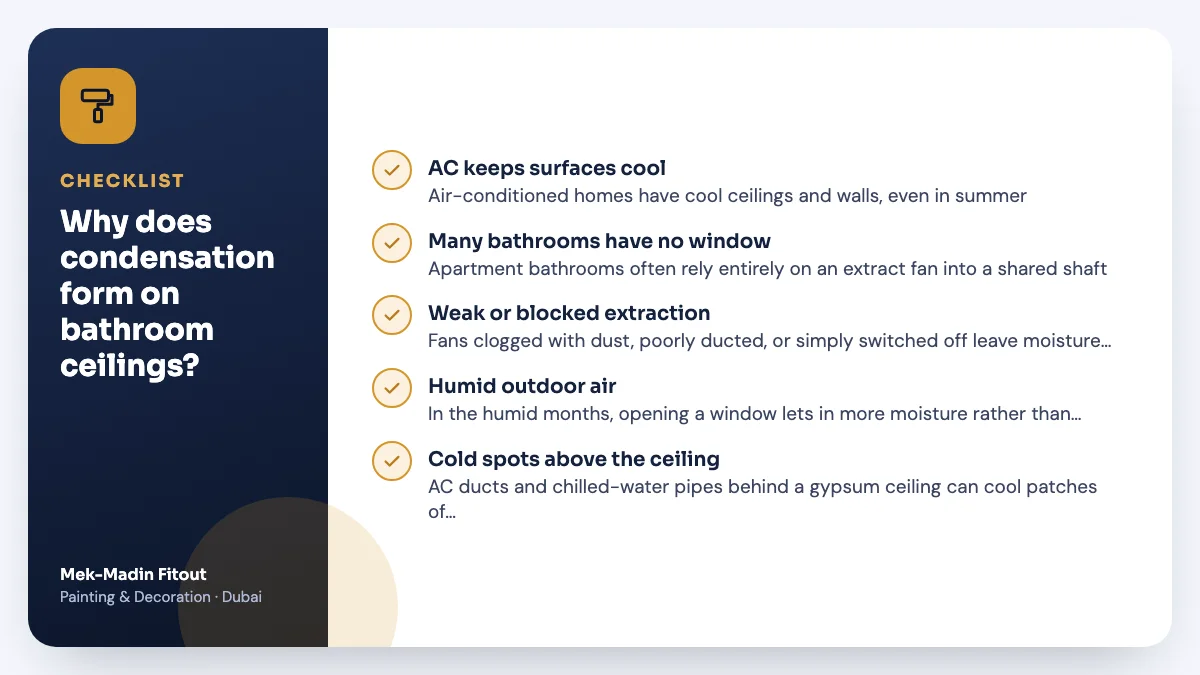
- AC keeps surfaces cool. Air-conditioned homes have cool ceilings and walls, even in summer. Steam meets them and condenses quickly.
- Many bathrooms have no window. Apartment bathrooms often rely entirely on an extract fan into a shared shaft.
- Weak or blocked extraction. Fans clogged with dust, poorly ducted, or simply switched off leave moisture trapped.
- Humid outdoor air. In the humid months, opening a window lets in more moisture rather than drying the room.
- Cold spots above the ceiling. AC ducts and chilled-water pipes behind a gypsum ceiling can cool patches of it.
How can you tell bathroom condensation from a leak?
Bathroom condensation shows as scattered black specks on firm, intact paint that get worse after your own showers. A leak spreads from one point, with brown or yellow rings, bubbling paint or soft gypsum, and can appear or grow even when you have not used the bathroom.
This matters, because the fixes are completely different. Cleaning and repainting will not help if water is coming through from above.
| What you see | Condensation is likely | A leak is likely |
|---|---|---|
| Pattern | Scattered black spots, often in corners or over the shower | One patch that spreads outwards from a point |
| Colour | Black or dark grey speckles | Brown or yellow ring, tide marks, sometimes with mould |
| Surface | Paint intact, ceiling firm | Bubbling paint, soft or sagging gypsum, flaking |
| Timing | Worse after your own showers, better when the room is unused | Appears or grows when you have not used the bathroom |
| Dripping | Droplets across the ceiling after showers | Drips from one spot, sometimes after the flat above uses water |
| Smell | Musty in the bathroom | Musty, sometimes with a sewage smell |
What should you do if it is a leak?
If the signs point to a leak, stop treating it as mould. In an apartment, the source is often the bathroom above, a shared pipe or failed waterproofing under the tiles upstairs. Report it to building management so they can arrange access to the unit above.
On a top-floor flat or a villa, the roof or terrace may be the source. Our guide to the signs your roof needs waterproofing covers that case. Where water is getting through floors or roofs, you need waterproofing services before any repainting.
An AC drain or tray above the ceiling can also drip and leave a stain that looks like a plumbing leak. A damp, dirty tray is also a common source of a musty smell from the AC.
How do you clean mould off a bathroom ceiling safely?
To clean mould off a bathroom ceiling safely, ventilate the room, wear gloves, eye protection and a dust mask, apply a mould remover made for painted surfaces, wipe gently without dry-brushing, bag the used cloths and let the ceiling dry fully. Never mix bleach with ammonia or acid-based cleaners.
Small areas of surface mould can usually be cleaned at home. Large patches, or mould that returns within days, need a closer look.
How should you prepare before cleaning?
- Open the door and run the extract fan.
- Wear rubber gloves, eye protection and a well-fitting dust mask.
- Use a stable step ladder. Do not stand on the edge of the bath.
- Keep children, pets and anyone with asthma or breathing problems out of the room.
What are the cleaning steps?
- Do not dry-brush. Brushing dry mould sends spores into the air.
- Apply a mould remover. Use a product made for mould on painted surfaces, and follow the label for strength and contact time.
- Wipe, do not scrub hard. Use a damp cloth or sponge and rinse it often. Hard scrubbing can damage the paint and gypsum.
- Bag the cloths. Throw away used cloths and sponges in a sealed bag.
- Let it dry fully. Run the fan and leave the door open until the ceiling is completely dry.
Bleach can lift the colour from mould on paint, but it does little inside porous surfaces such as bare plaster or gypsum. If stains return quickly, the mould has gone deeper.
Does anti-mould paint stop bathroom mould coming back?
Anti-mould paint slows mould growth on a bathroom ceiling's surface, but it does not stop condensation, so mould will eventually return if the ventilation stays poor. A proper repaint means treating and drying the ceiling, sealing stains with a stain-blocking primer, then applying two coats of anti-mould bathroom paint.
Cleaning removes what you can see. Repainting with the right products makes it harder for mould to return. For other rooms, our guide on how often to repaint each room gives general timings.
What does a proper repaint involve?
- Clean and treat the ceiling with a fungicidal wash, then let it dry fully.
- Check the gypsum is firm. Soft or crumbling board needs repair or replacement first.
- Seal any remaining stains with a stain-blocking primer so they do not bleed through.
- Apply an anti-mould bathroom paint, usually in two coats. A washable sheen finish is easier to wipe down.
Anti-mould paint contains additives that slow mould growth on the surface. It does not stop condensation. If the ventilation stays poor, mould will eventually come back, just more slowly.
How do you keep mould off the bathroom ceiling for good?
To keep mould off a bathroom ceiling for good, get steam out with an extract fan run during and after showers, let replacement air in under the door, avoid setting the AC so low that the ceiling stays cold, and stop wet surfaces, towels and laundry adding moisture to the room.
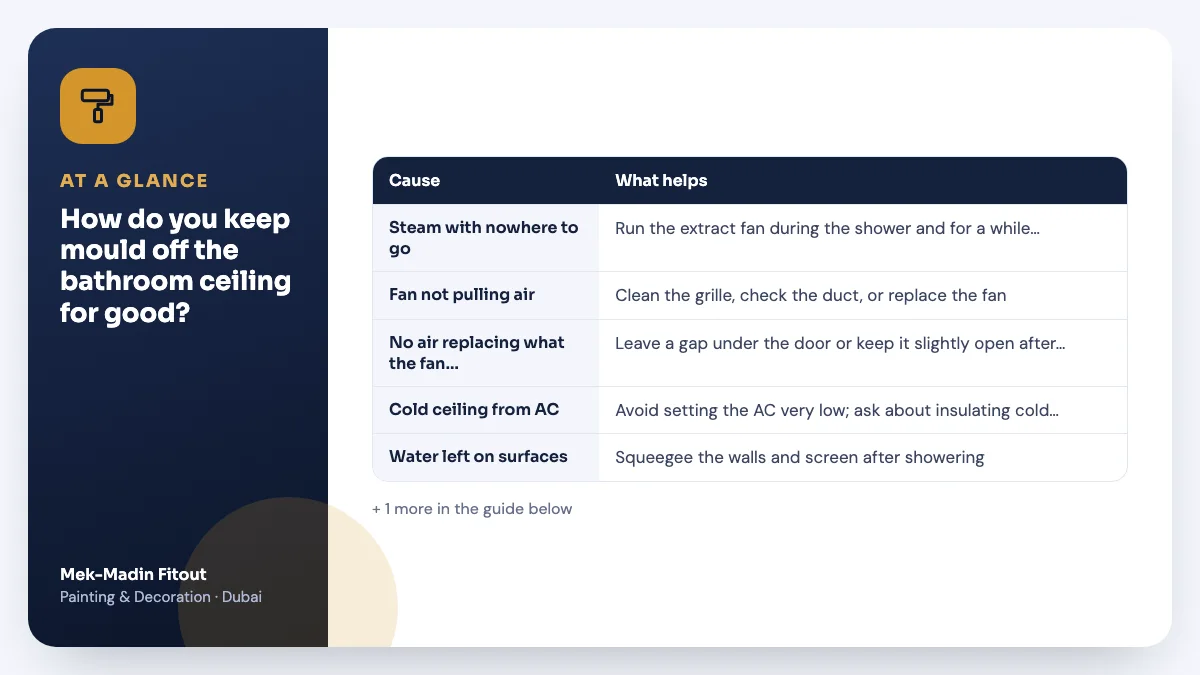
| Cause | What helps |
|---|---|
| Steam with nowhere to go | Run the extract fan during the shower and for a while afterwards |
| Fan not pulling air | Clean the grille, check the duct, or replace the fan |
| No air replacing what the fan removes | Leave a gap under the door or keep it slightly open after showers |
| Cold ceiling from AC | Avoid setting the AC very low; ask about insulating cold ducts above the ceiling |
| Water left on surfaces | Squeegee the walls and screen after showering |
| Wet towels and laundry | Dry them outside the bathroom where possible |
Dubai Municipality's Technical Guidelines for Indoor Air Quality, which apply to residential buildings among other premises, give the same advice on moisture. They say to "Keep relative humidity below 60%", to insulate exterior walls or ceilings "to avoid condensation on cold surfaces", and to "Provide sufficient exhaust in showers or kitchen areas producing steam."
How do you test your extract fan?
Hold a single sheet of toilet tissue against the fan grille while it runs. If the fan does not hold it in place, it is not moving enough air. In apartments, the shaft may also be blocked or shared, so ask building management if a new fan makes no difference.
A fan with a timer or humidity sensor keeps running after you leave the room. That is often the simplest upgrade.
Why do grout and silicone go black as well?
Mould on the ceiling often comes with black grout and silicone lower down. Those joints stay damp longest. Our guide on bathroom tiles for a humid climate covers grout choices that resist it. If the grout is already black, see our guide to cleaning or regrouting black grout.
When should you call a professional about bathroom mould?
Call a professional if mould covers a large area, keeps returning after cleaning, or the gypsum feels soft. The same applies if you are not sure whether you are dealing with condensation or a leak. A wrong guess means paying to repaint twice.
Our painting and decoration team treats mould and repaints bathroom ceilings with stain-blocking primers and anti-mould finishes. If we find signs of a leak, we tell you before painting so the source can be fixed first. Call or WhatsApp +971 52 884 8916 to arrange a visit.
FAQs
Is black mould on a bathroom ceiling dangerous?
Mould can irritate the nose, eyes, throat and lungs, especially for people with asthma or allergies. Small patches are common in bathrooms, but they should be cleaned promptly. If anyone in the home has breathing problems, have it dealt with sooner rather than later.
Can I just paint over the mould?
No, because mould grows back through ordinary paint, often within weeks. Clean and treat it first, let the ceiling dry, seal any stains, then use an anti-mould paint. Fix the ventilation as well, or it will return.
Why does mould come back after I clean it?
Usually because the conditions have not changed. The ceiling still gets wet after showers and does not dry quickly enough. Improving the extract fan, running it for longer and keeping the bathroom door ajar after showers make the biggest difference.
Should I open the bathroom window to stop mould?
In cooler, drier months, a window helps the room dry. In humid weather, outside air carries a lot of moisture, so an open window can make things worse. A working extract fan is more reliable all year round.