

A bad smell from your AC usually points to one of four causes. Musty means mould on a damp coil, tray or duct. Burning suggests an electrical or motor fault. Sewage often means a dry drain trap. A sharp chemical smell can mean overheating parts or, less often, a refrigerant leak.
The type of smell, where it comes from and when it starts tell you most of what you need to know. This guide explains each one and what you can safely check before calling anyone.
What does each AC smell mean, and how urgent is it?
Musty smells point to mould or bacteria, burning to dust or an overheating part, sewage to a dry drain trap, and sharp chemical or sweet smells to overheating parts or a possible refrigerant leak. Switch off for a persistent burning or chemical smell, and book a clean soon for a musty one.
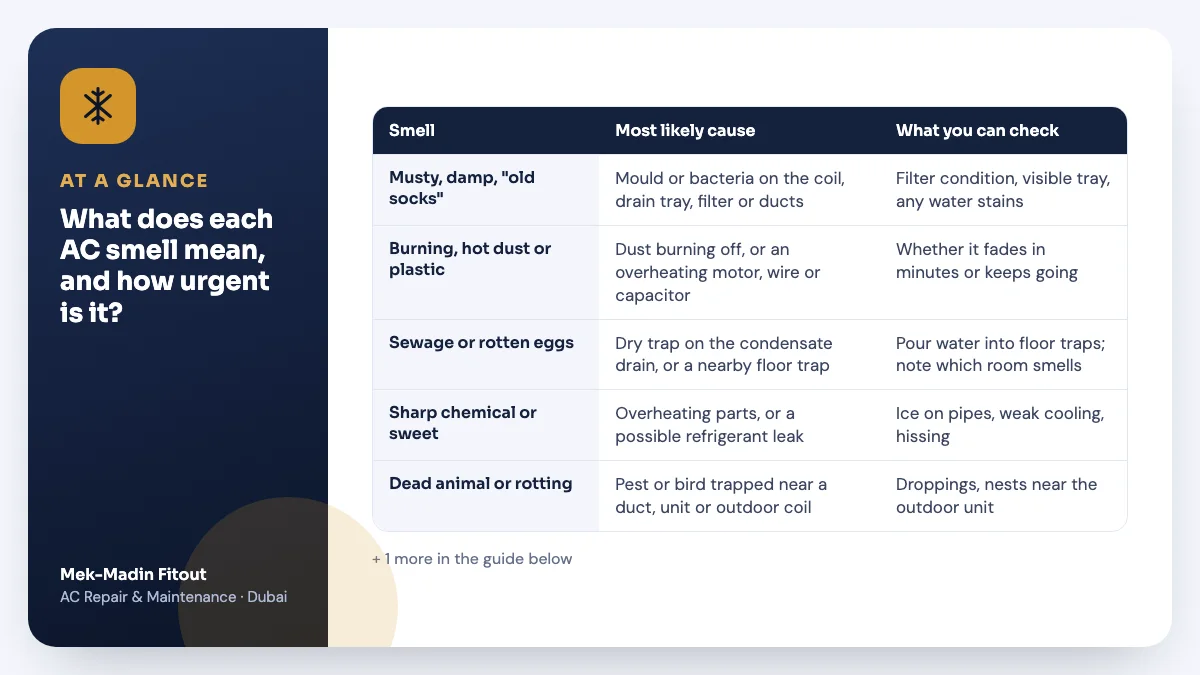
| Smell | Most likely cause | What you can check | How urgent |
|---|---|---|---|
| Musty, damp, "old socks" | Mould or bacteria on the coil, drain tray, filter or ducts | Filter condition, visible tray, any water stains | Book a clean soon |
| Burning, hot dust or plastic | Dust burning off, or an overheating motor, wire or capacitor | Whether it fades in minutes or keeps going | Switch off now if it persists |
| Sewage or rotten eggs | Dry trap on the condensate drain, or a nearby floor trap | Pour water into floor traps; note which room smells | Same week |
| Sharp chemical or sweet | Overheating parts, or a possible refrigerant leak | Ice on pipes, weak cooling, hissing | Switch off and call |
| Dead animal or rotting | Pest or bird trapped near a duct, unit or outdoor coil | Droppings, nests near the outdoor unit | Call soon |
| Smoke, cooking or perfume | Odours absorbed by filters and coil | How long since the last filter clean | Clean filters, then reassess |
Why does my AC smell musty or mouldy?
A musty smell is the most common AC smell in Dubai homes and usually means mould or bacteria growing where condensate sits. The indoor coil pulls moisture from the air, and that water drains through a tray and condensate line. When the tray or line is slow or dirty, standing water sits in a dark, cool space.
Why does Dubai's climate make musty AC smells worse?
Humid coastal air means the coil produces a lot of condensate for much of the year. Fine dust settles on that wet coil and forms a film that mould and bacteria grow on. The smell is often strongest in the first few minutes after the AC switches on. The same mix of cool surfaces and humid air is behind black mould on bathroom ceilings.
Homes left closed up with the AC off, such as during a long summer trip, often come back to a strong musty smell. Warm, damp air sits in the unit and ducts with nothing moving through it.
Where does a musty AC smell usually come from?
- Drain tray: slime and standing water under the coil
- Evaporator coil: dust and moisture trapped between the fins
- Filter: a damp, dirty filter holds odour and spreads it
- Ducts: in ducted villas and larger flats, dust and moisture can build up inside
- Ceiling void: a slow leak from the tray can wet the gypsum around the unit
If the smell comes with water stains or drips, treat it as a leak as well as a smell, and follow our steps for the first hour of an AC leak. Our guide on how often to service your AC in Dubai explains the routine cleaning that helps prevent this.
Dubai Municipality's Technical Guidelines for Indoor Air Quality, which cover residential buildings among other premises, set a benchmark for air-conditioning hygiene. They say cooling coils, condensate pipes and water trays "should be checked regularly for signs of sludge, algae or rust build-up", that coils and condensate pipes "should be cleaned at least every six months", and that trays "should be cleaned at least every one month".
What does a burning smell from the AC mean?
A burning smell from the AC is either dust burning off, which is normal after weeks off and should fade within minutes, or an overheating fan motor, capacitor or wiring connection, which needs the AC switched off at the isolator or breaker until it has been checked.
A faint dusty smell when you first run a unit after weeks off can be normal. Dust on the coil or heater element warms up and burns off. It should fade within a few minutes.
A smell that keeps going, gets stronger, or smells like hot plastic or rubber is different. Common causes include an overheating fan motor, a failing capacitor, a loose wiring connection or a blocked fan. A clogged filter can also make the motor strain.
Do not open the unit's electrical cover yourself. Indoor units in false ceilings and outdoor units on balconies or roofs both hold live parts.
Why does my AC smell like sewage or rotten eggs?
A sewage or rotten-egg smell from the AC usually means the trap on the condensate drain has dried out or was never fitted properly, letting sewer gas travel back up the line for the AC fan to pull into the room. A dry floor trap in a rarely used bathroom can cause a similar smell.
Our guide to bathroom drain smells and dry floor traps explains how to refill, clean and check a trap yourself.
This one surprises people, because AC water is clean condensate. The problem is how the condensate line connects to the drainage. In many homes it runs into a waste pipe or floor drain, often through a trap that should hold a small seal of water.
When that trap dries out, or was never fitted properly, sewer gas can travel back up the line. The AC fan then pulls it into the room. This often happens after a spell when the AC has not been producing much water.
What other drain problems cause sewage smells?
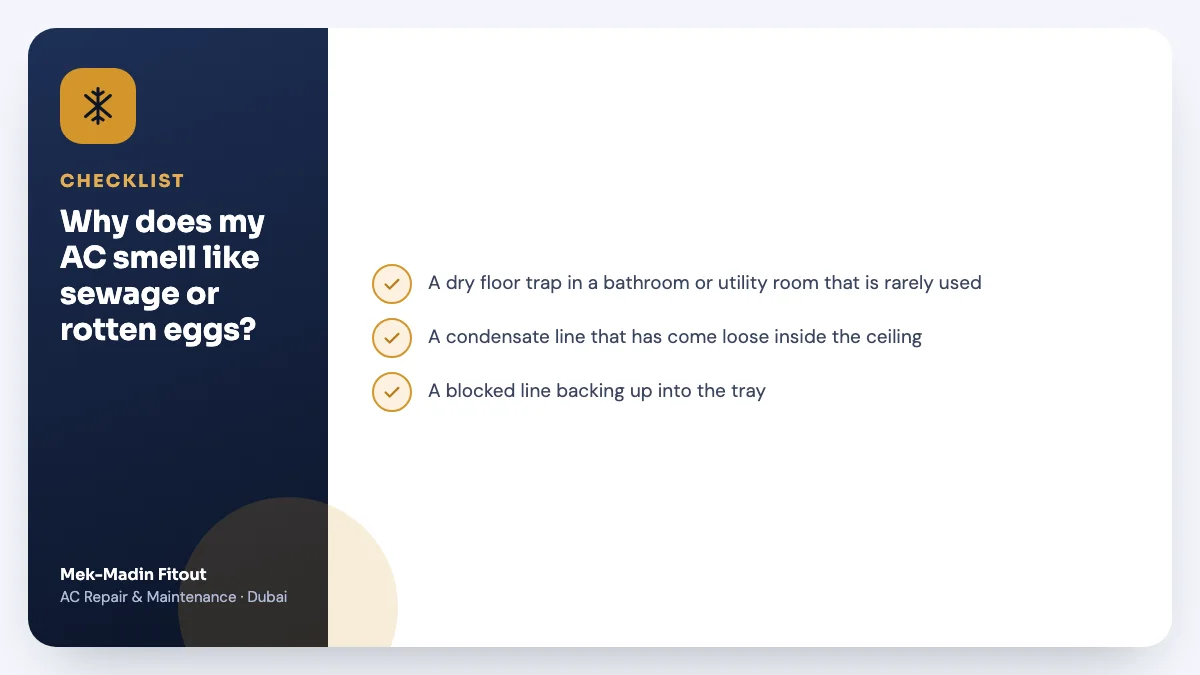
- A dry floor trap in a bathroom or utility room that is rarely used
- A condensate line that has come loose inside the ceiling
- A blocked line backing up into the tray
If the smell is in a bathroom or near a floor drain rather than at the AC grille, the cause may be plumbing rather than the AC. Our plumbing services cover dry traps and drain smells.
What causes a chemical or sweet smell from the AC?
A sharp, acrid smell from the AC can come from overheating electrical parts, while a faint sweet or chemical smell is sometimes linked to a refrigerant leak. Many refrigerants have little smell, so you cannot rely on your nose; weaker cooling, ice on the copper pipes and a hissing sound are better signs.
Signs that point to refrigerant include weaker cooling, ice on the copper pipes or coil, and a hissing sound. Refrigerant work needs a trained technician with the right equipment. Do not try to top it up yourself.
If you smell gas in the kitchen and you have a gas supply, treat that as a gas issue, not an AC issue. Leave the area and contact your gas supplier or building management.
Can fan coil units in district-cooled towers smell too?
Yes, fan coil units in district-cooled towers can smell too. A fan coil unit (FCU) still has a filter, coil, drain tray and condensate line, so it can smell just like a split unit. Many Dubai towers use district cooling from providers such as Empower.
Chilled water reaches each flat, and the FCU in the false ceiling blows air over a coil.
A useful first check is where the smell is:
- Only in your flat, at the AC grilles: usually the FCU, its tray or its drain, which are often the occupant's or landlord's responsibility
- In corridors or several flats: more likely a building system, such as fresh air supply or shared drainage
- Only at certain times of day: note the times, as this helps whoever investigates
In towers in areas such as JLT, the FCU is often reached through a small ceiling access panel. Check your tenancy contract or ask building management who looks after the FCU before booking work.
What can you safely check yourself when the AC smells?
When the AC smells, you can safely clean or replace the filter with the power off, look for drips or ceiling stains, note which rooms smell and when, top up rarely used floor traps with water, and look around the outdoor unit for nests or debris without touching electrical parts.
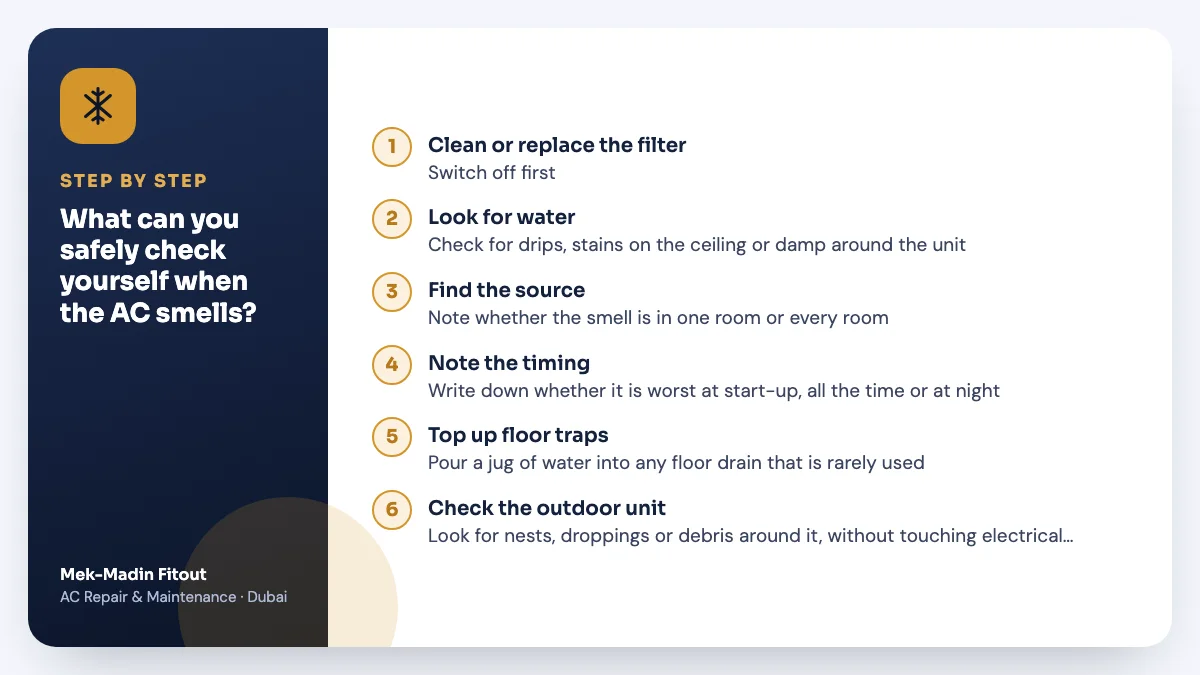
These checks need no tools beyond a torch and a step stool:
- Clean or replace the filter. Switch off first. A dirty filter is often part of the problem.
- Look for water. Check for drips, stains on the ceiling or damp around the unit.
- Find the source. Note whether the smell is in one room or every room.
- Note the timing. Write down whether it is worst at start-up, all the time or at night.
- Top up floor traps. Pour a jug of water into any floor drain that is rarely used.
- Check the outdoor unit. Look for nests, droppings or debris around it, without touching electrical parts.
What should you avoid doing?
- Spraying air freshener or household disinfectant into the unit, which can mask the cause or damage parts
- Removing panels with the power on
- Pouring bleach into the condensate line unless the unit maker says it is safe
- Running a unit that smells of burning in the hope it settles down
When should you call an AC technician about a smell?
Call an AC technician if the smell keeps coming back after a filter clean, if there is water leaking, or if you smell burning or chemicals. A musty smell that fills the room at every start-up usually needs a coil and tray clean, a drain line flush and sometimes a duct inspection.
Mek-Madin Fitout offers AC repair and maintenance across Dubai, covering split units, ducted systems and fan coil units. Tell us what the smell is like and where it comes from. Call or WhatsApp +971 52 884 8916, and we will confirm a visit time when you call.
FAQs
Is it safe to keep using an AC that smells musty?
A mild musty smell is not usually an emergency, but it means mould or bacteria are growing somewhere in the unit. It can bother people with asthma or allergies. Clean the filter now and book a proper clean of the coil, tray and drain line.
Why does my AC smell bad only when it first turns on?
Water left in the tray and on the coil sits still while the unit is off. When the fan starts, it pushes that stale, damp air into the room first. The smell often fades after a few minutes, but the cause is still there.
Can a dirty AC make my whole flat smell?
Yes. In ducted systems, one dirty unit can push odour into every room it serves. If several rooms smell the same and share one system, the indoor unit or the ducts are a likely source.
Who fixes a smelly fan coil unit in a district-cooled building?
The district cooling provider and building usually look after the central plant and shared pipes. The fan coil unit inside your flat is often the occupant's or landlord's job. Check your tenancy contract or ask building management, especially if the smell is also in corridors.