

If your AC is leaking water from the ceiling, switch it off, move electronics and furniture away, and catch the drips with buckets and towels. Then watch whether the dripping stops: if it does, a blocked condensate drain is the usual cause. If water keeps flowing, treat it as a pipe leak and call building management.
Most ceiling leaks from an AC are not emergencies, but water and gypsum do not mix well. What you do in the first hour decides whether you end up with a small stain or a new ceiling.
What should you do in the first 10 minutes of an AC ceiling leak?
In the first 10 minutes of an AC ceiling leak, switch the AC off at the thermostat or remote, move laptops, rugs and furniture out of the drip zone, and catch the water with buckets and towels. If water is dripping near a light fitting or socket, switch off that circuit at the distribution board.
1. Switch the AC off
Turn the unit off at the wall thermostat or remote. This stops the coil making more condensate and stops the fan blowing water out of the diffuser.
If water is dripping near a light fitting, a downlight or a socket, switch off that circuit at the distribution board. Only do this if you can reach the board without standing in water. If you are unsure which breaker it is, switch off the main breaker and use a torch.
2. Protect your belongings
Move laptops, televisions, rugs and anything made of wood or fabric out of the drip zone. Wooden floors and furniture swell quickly when they sit in water. Lift curtains off the floor if water is running down a wall. If water reaches fitted joinery, our guide to repairing swollen kitchen cabinets and wardrobes explains the repair options.
3. Catch and contain the water
Put a bucket or large bowl under each drip point. Lay towels around it to catch splashes. If water is running along the ceiling before it drops, you may need several containers.
Is a sagging ceiling after an AC leak dangerous?
A sagging ceiling after an AC leak can be dangerous, because gypsum softens when wet, and if water pools on top of a board it can bulge and eventually give way. Most Dubai apartments and villas have gypsum board false ceilings, with the AC unit hidden above.
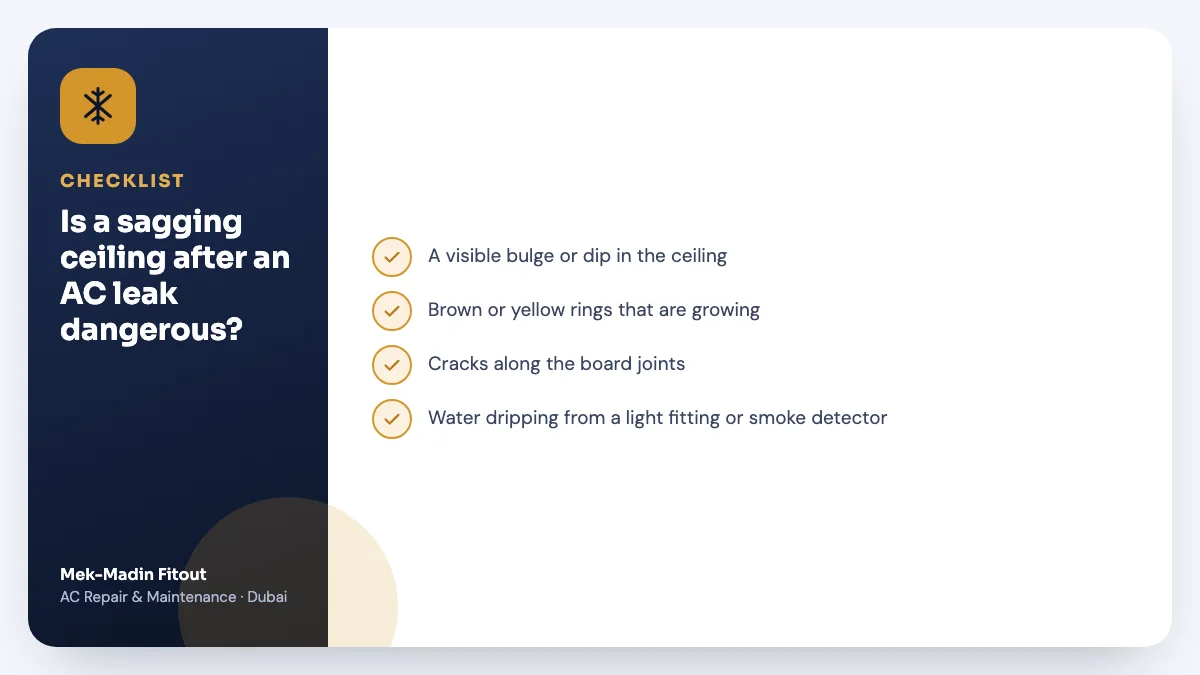
Look for these warning signs:
- A visible bulge or dip in the ceiling
- Brown or yellow rings that are growing
- Cracks along the board joints
- Water dripping from a light fitting or smoke detector
Do not stand directly under a bulging section. If the bulge is large or near a light fitting, leave it alone and call for help. Do not pierce or push on a wet ceiling yourself. If you can reach the distribution board safely, switch off the circuit for that room, then leave the ceiling to a technician.
Is the leak from AC condensate or a chilled water pipe?
If the dripping stops within a few minutes of switching off, a blocked condensate drain or tray is the usual cause. If a steady flow continues with the AC off, suspect a pipe. In district-cooled towers, that usually means a chilled water pipe, valve or fitting, so call building management straight away.
If the room was also warm before the leak started, our guide to an AC that is not cooling explains how a frozen coil forms and what usually causes it.
Once the water is under control, work out where it is coming from. The table below covers the usual suspects.
| What you see | Likely cause | What to do now |
|---|---|---|
| Dripping stops within a few minutes of switching off | Blocked condensate drain line or overflowing tray | Keep the AC off and book a technician |
| Ice on the copper pipes or coil, weak cooling, then a lot of water | Frozen coil, often from a dirty filter or low refrigerant on split units | Leave it off so the ice can melt, keep buckets in place |
| Unit beeps, shows an error, or water comes from a small pump box | Failed condensate pump | Keep the AC off and book a technician |
| Steady flow continues with the AC off | Chilled water pipe, valve or fitting in a district-cooled tower | Call building management straight away |
| Drips along a pipe run, cold to the touch | Torn insulation on a chilled water pipe causing condensation | Keep the AC off, report it, book a check |
| Water appears when someone uses a bathroom or kitchen | Plumbing, possibly from the flat above | Call building management or the neighbour above |
How does a blocked drain line or tray cause a leak?
The indoor coil pulls moisture out of the air. That water collects in a tray and drains away through a small pipe. Dust, slime and mould build up over time, and once the pipe blocks, the tray overflows into the ceiling.
This is the most common cause. It is usually fixed by clearing the line and cleaning the tray.
Dubai's green building system, Al Sa'fat, says that "for all buildings including existing buildings", condensate water produced by air-conditioning equipment "must be collected and disposed appropriately".
Why does a frozen AC coil leak so much water?
When airflow is poor, the coil can get cold enough to freeze, usually because of a clogged filter. On split and DX units, low refrigerant can do the same. When the ice melts, it releases more water than the tray can handle.
DEWA's tips for managing electricity and water use note that "clogged or dirty AC filters can block the normal airflow and reduce the AC's efficiency", and recommend cleaning them "periodically or at least once every three months".
Expect water to keep dripping for a while after you switch off, as the ice melts. Keep the buckets in place.
Failed condensate pump
Some indoor units sit where water cannot drain by gravity, so a small pump lifts it away. If the pump fails, the tray fills and overflows. Many pumps have a safety switch that should shut the AC off, but not all are wired that way.
How do chilled water pipes leak in district-cooled towers?
Many Dubai towers use district cooling from providers such as Empower. Chilled water runs to a fan coil unit above your ceiling, through valves and insulated pipes. A loose fitting, a failed valve or torn insulation can all leak. For new buildings, Al Sa'fat's pipe and duct insulation rule requires that "all pipes carrying refrigerant, hot water or chilled water" and conditioned-air ducts "must be insulated".
A real pipe leak keeps going when the AC is off, because the water is still under pressure. That is the key test.
When should you call building management about an AC leak?
Call building management about an AC leak if water keeps flowing with the AC off, comes from a pipe, valve or fitting rather than the unit's tray, or is passing between flats. Do not operate shared isolation valves yourself, because building management usually has its own procedure for isolating the chilled water supply.
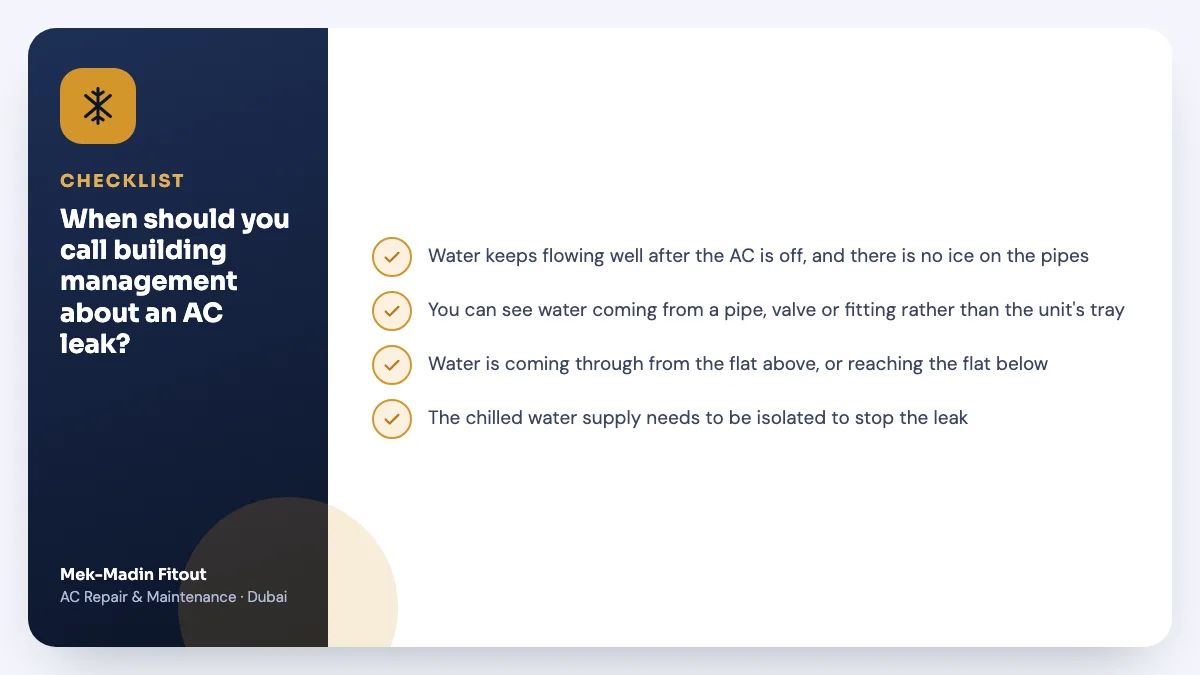
Call building management, or the community management office in a villa community, if any of these apply:
- Water keeps flowing well after the AC is off, and there is no ice on the pipes
- You can see water coming from a pipe, valve or fitting rather than the unit's tray
- Water is coming through from the flat above, or reaching the flat below
- The chilled water supply needs to be isolated to stop the leak
In many towers, the isolation valves for each flat sit in a corridor cupboard or a riser. Do not operate shared valves yourself. Building management usually has a procedure and may need to send their own team. If the water turns out to come from a bathroom above, our guide to bathroom leaks between flats explains how the source is traced.
If you rent, tell your landlord or agent in writing as soon as you can. Include photos and the time the leak started. Check your tenancy contract for who is responsible for the AC unit, as this varies.
Before you clean up, photograph the drip points, ceiling stains, damaged belongings and any error code on the thermostat. Note when the leak started. These records help the technician, your landlord and any insurance claim.
What will an AC technician do to fix a ceiling leak?
An AC technician fixing a ceiling leak should go further than emptying the tray. A proper visit clears the drain line, cleans and treats the tray, checks the drain fall, condensate pump, filter, coil and pipe insulation, and runs the AC to watch the tray drain before closing up.
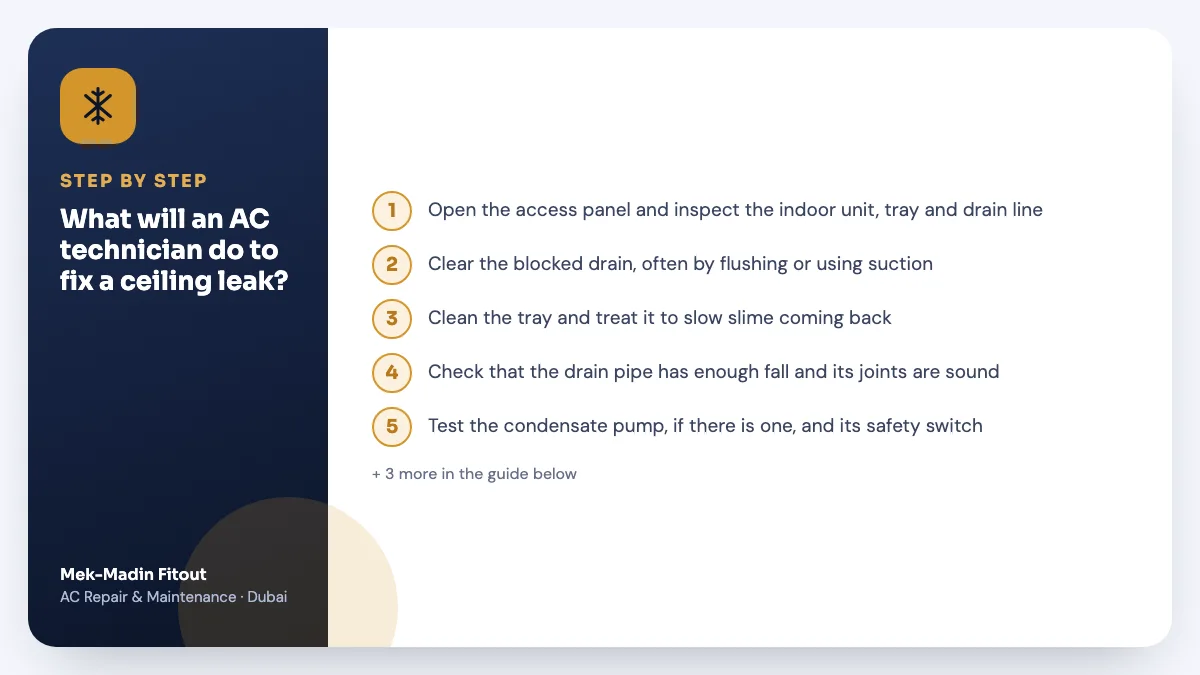
You can expect the technician to:
- Open the access panel and inspect the indoor unit, tray and drain line
- Clear the blocked drain, often by flushing or using suction
- Clean the tray and treat it to slow slime coming back
- Check that the drain pipe has enough fall and its joints are sound
- Test the condensate pump, if there is one, and its safety switch
- Check the filter, coil and airflow for signs of freezing
- Inspect pipe insulation and valves on fan coil units
- Run the AC and watch the tray drain before closing up
How do you dry out a ceiling after an AC leak?
To dry out a ceiling after an AC leak, leave the access panel open and the room ventilated, as a ceiling void closed up while damp can grow mould. Gypsum that was only damp often dries out, though a stain may remain, while boards that sagged or crumbled usually need replacing.
If a musty smell lingers once the AC is back on, our guide to musty AC smells and their causes explains what to check.
Once it is fully dry, stains can be sealed and repainted. A painter can then repair the ceiling once the leak is fixed.
How can you stop your AC leaking through the ceiling again?
Most AC ceiling leaks trace back to skipped maintenance. Clean filters regularly, have the drain line and tray cleaned at every service, and report small stains early. Our guide on how often to service your AC in Dubai sets out a schedule that suits most homes.
Leaks also have local patterns. In some newer buildings in JVC, drain lines have too little slope. In Dubai Marina towers, torn insulation on chilled water pipes is a common cause of drips.
When should you call an AC technician?
Call an AC technician if water keeps coming back after you restart the AC, if you see ice on the pipes, or if the unit shows an error. Do not open electrical covers or keep running a unit that is leaking into the ceiling.
Mek-Madin Fitout provides AC repair and maintenance across Dubai, including drain clearing, tray cleaning and fan coil unit repairs. We are open Saturday to Thursday, 8am to 2am: call or WhatsApp +971 52 884 8916 and we will confirm a visit time when you call.
On Friday, when we are closed, you can still WhatsApp us photos of the leak, and we will reply when we reopen.
FAQs
Is it safe to use the AC after it has leaked?
Not until the cause is fixed. Running it again refills the tray and can soak the ceiling further, and a coil that froze once can freeze again. Keep it off and use a fan in the meantime.
Why is my AC leaking only at night?
Often the unit runs longest overnight, so it produces more condensate. A partly blocked drain can cope during short daytime cycles but overflow after hours of steady running. A night-time leak is still worth fixing quickly.
Who pays for an AC leak in a rented apartment?
It depends on your tenancy contract and the cause. Routine maintenance and wear are often handled differently from damage caused by misuse. Tell your landlord or agent in writing straight away, with photos, and check what your contract says.
Can a blocked AC drain damage the flat below?
Yes. If water pools above your ceiling for long enough, it can find its way into walls, floor slabs and the flat below. That is why it is worth switching off quickly and telling building management if water is spreading.