
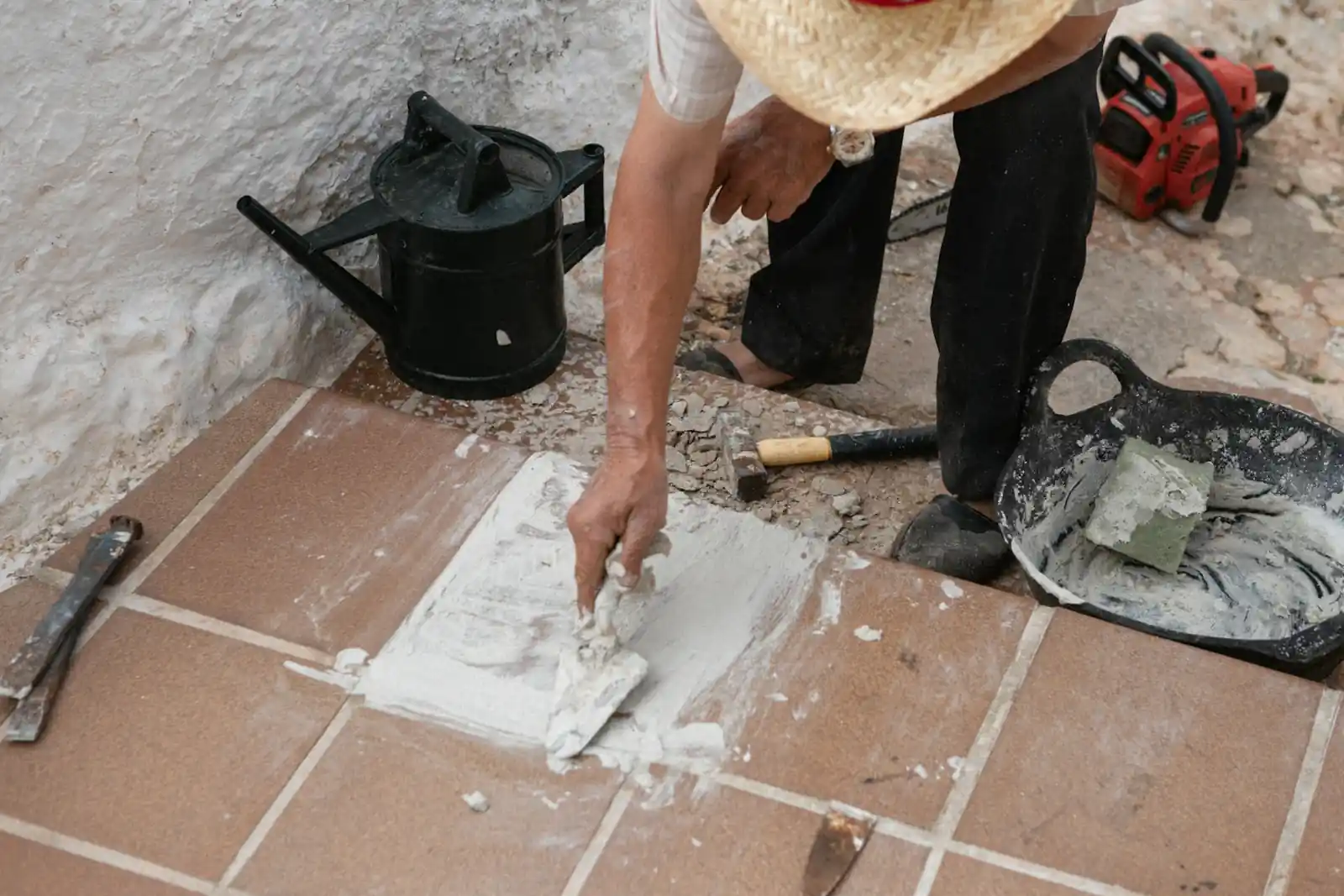

Hollow floor tiles sound drummy because there is a gap between the tile and the floor beneath. A small, stable hollow patch with no cracks or movement can usually be left and watched. Tiles that crack, rock, lift or sit in a wet area should be repaired, because the hollow area tends to spread.
This guide explains how to test your floor, what causes the problem and which repair suits which situation.
What does a hollow-sounding floor tile mean?
A hollow-sounding floor tile has air underneath it, either from voids left when it was laid or because it has since come away from its adhesive bed, which is called debonding. Voids from installation may stay stable for years, while debonding usually means something under the floor is moving or getting wet.
A well-laid tile sits on a solid bed of adhesive with almost no air underneath. When you tap it, the sound is dull and solid. A hollow tile gives a higher, papery or drum-like note.
That note means one of two things. Either the tile never had full adhesive contact in the first place, leaving voids underneath. Or it was bonded once and has since come away, which is called debonding.
Voids from installation may stay stable for years. Debonding usually means something is moving or getting wet.
How do you test floor tiles for hollow spots?
To test floor tiles for hollow spots, tap each tile near its centre and corners with a coin or small rubber mallet and listen for a higher, drum-like note instead of a dull, solid one. Mark the hollow tiles on a sketch or with tape, photograph them and repeat the test after a few weeks.
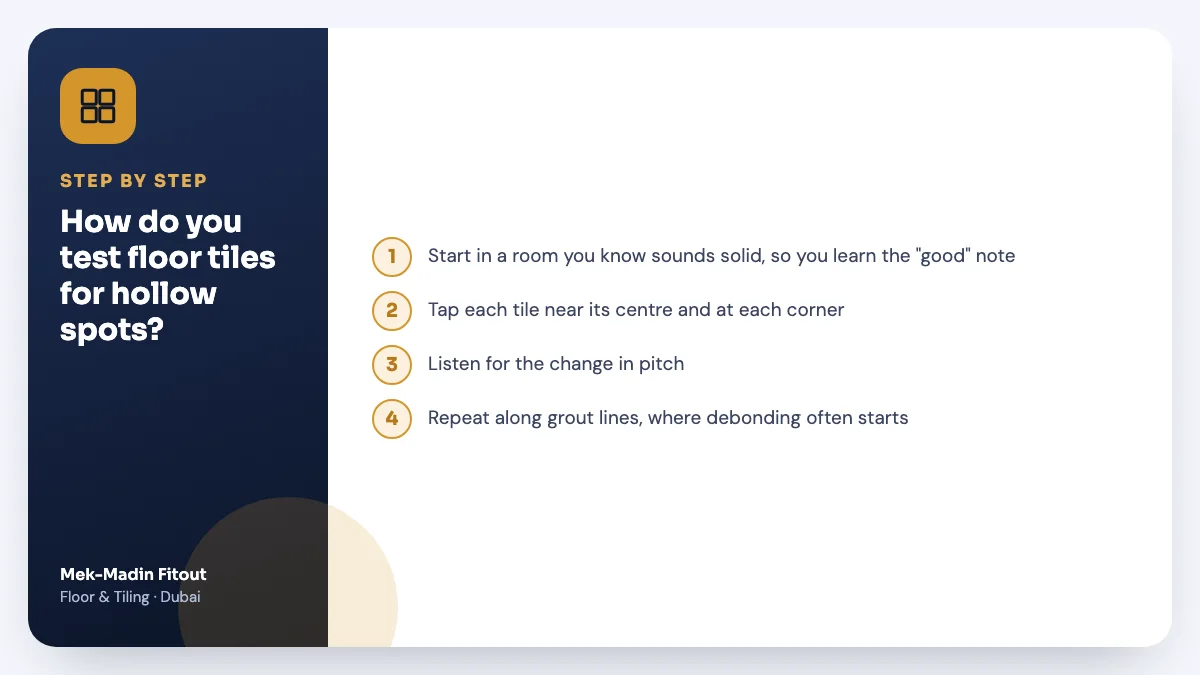
How do you do a tap test?
A coin or a small rubber mallet works well. Tap firmly but gently, never hard enough to chip the glaze.
- Start in a room you know sounds solid, so you learn the "good" note.
- Tap each tile near its centre and at each corner.
- Listen for the change in pitch. Hollow areas often cover part of a tile, not all of it.
- Repeat along grout lines, where debonding often starts.
Why should you map the hollow tiles?
Mark hollow tiles on a sketch of the room or with removable tape, and take a dated photo. Repeat the test after a few weeks.
A map tells you far more than a single test. A patch that stays the same size is a different problem from one that grows each month.
What causes floor tiles to sound hollow?
Floor tiles usually sound hollow because of spot-bonding instead of full adhesive coverage, the wrong or poorly mixed adhesive, missing movement joints, daily heat swings from sun and AC, a screed that shrinks or cracks, large tiles laid on an uneven floor, or water getting under the tiles through cracked grout or a leak.
Spot-bonding instead of full coverage
Some tiles are fixed with a few dabs of adhesive at the corners and centre, sometimes called "dot and dab" or spot-bonding. It is quick, but it leaves large air gaps. Good practice for floors is full adhesive coverage under the whole tile, especially in wet areas.
Spot-bonded tiles often sound hollow from day one and crack more easily under heavy point loads.
Wrong adhesive or poor mixing
Adhesive has to suit the tile type, size and base. Adhesive that skinned over before the tile went down, or was mixed too wet, will not grip properly.
Missing movement joints
Tiles, adhesive and the screed below all expand and contract by slightly different amounts. Movement joints are flexible gaps, usually at the room edges, at doorways and across large open areas. Without them, the stress has nowhere to go.
Heat and temperature swings
Dubai floors go through big temperature changes. Sun through large windows heats tiles during the day, and strong AC cools them quickly in the evening. On terraces and balconies the swing is greater still.
That daily cycle slowly breaks weak bonds, especially near glass doors.
Substrate movement
The screed or slab underneath can shrink, settle or crack. If tiles were laid before the screed had fully dried, it may shrink away from the adhesive later. A line of hollow tiles following a straight path often points to a crack in the base.
Large-format tiles
Big porcelain tiles need a very flat base and careful back-buttering. Any dip in the floor leaves a void under the middle of the tile.
Water getting under the tiles
Cracked grout, failed silicone or a slow leak can let water reach the adhesive. Over time it weakens the bond. In bathrooms and kitchens, hollow tiles can be an early sign of a waterproofing or plumbing issue, not just a tiling one. Our guide to cracked or black bathroom grout explains when regrouting is the better fix.
Should you leave, monitor or repair hollow floor tiles?
Small, stable hollow patches in a dry room can be left or monitored. Growth, cracks, rocking, tenting, crumbling grout or hollow tiles in wet areas call for repair. A long line of hollow tiles across a room usually points to movement in the base and needs a professional assessment of the screed.
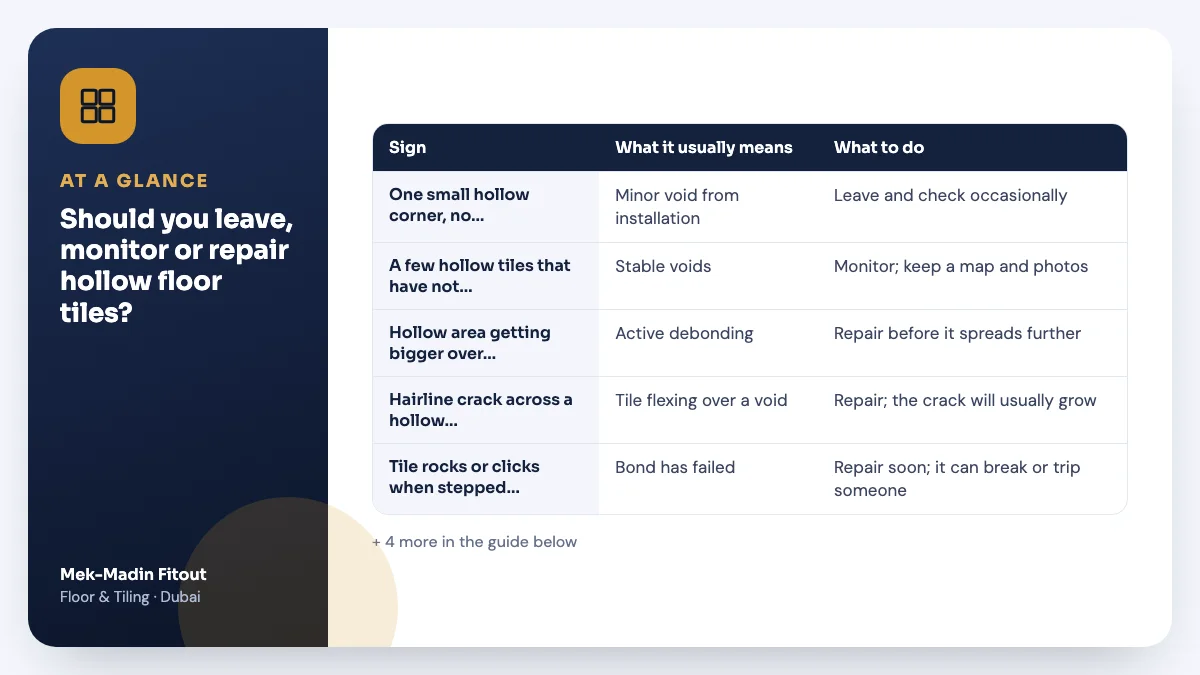
| Sign | What it usually means | What to do |
|---|---|---|
| One small hollow corner, no cracks, dry room | Minor void from installation | Leave and check occasionally |
| A few hollow tiles that have not changed in months | Stable voids | Monitor; keep a map and photos |
| Hollow area getting bigger over time | Active debonding | Repair before it spreads further |
| Hairline crack across a hollow tile | Tile flexing over a void | Repair; the crack will usually grow |
| Tile rocks or clicks when stepped on | Bond has failed | Repair soon; it can break or trip someone |
| Tiles rising into a ridge (tenting) | Expansion with no movement joints | Repair promptly; stop using the area if raised |
| Grout cracking or crumbling around hollow tiles | Tiles moving independently | Repair and regrout |
| Hollow tiles in a shower, bathroom or near a sink | Possible water under the tiles | Investigate the cause, then repair |
| Long line of hollow tiles across a room | Likely crack or movement in the base | Professional assessment of the screed |
When is it safe to leave a hollow tile alone?
A small hollow patch under an intact floor tile, with sound grout, can often be left alone. Many floors have a few drummy spots that never change. Lifting a sound tile can cause more problems than it solves, especially without spares.
Act sooner if you see cracks, rocking, tenting, crumbling grout or a patch that grows on your map. Treat any hollow tile in a bathroom, kitchen, laundry or balcony as worth investigating, because water may be travelling underneath. If a neighbour below reports a leak, our guide to tracing a bathroom leak to its source covers the next steps.
How are hollow floor tiles repaired?
Hollow floor tiles are repaired in two main ways. Small, stable voids can sometimes be filled by injecting resin or adhesive through a grout joint, while cracked, rocking or lifting tiles are usually lifted, the base is cleaned and checked, and the tiles are re-laid with full adhesive coverage and fresh grout.
When does adhesive injection work?
For a small, stable void under an otherwise sound tile, a resin or adhesive can sometimes be injected through a small hole drilled in a grout joint. The tile is weighted while it sets. It avoids lifting the tile, so it keeps the original finish.
Injection is not a fix for widespread debonding, moving screed or water damage. It treats the gap, not the cause.
When do tiles need lifting and re-laying?
For cracked, rocking or lifting tiles, the usual repair is to cut out the grout, lift the tile and clean the old adhesive off the base. The base is checked and repaired, and the tile is re-laid with full adhesive coverage and fresh grout. If the area tented, movement joints should be added at the same time.
Hollow tiles in wet areas often need the waterproofing checked before re-laying. Our guide to choosing bathroom tiles for a humid climate explains why the membrane under the tiles matters as much as the tiles themselves.
What if a lifted tile breaks and cannot be matched?
Tiles often break when lifted. Matching them years later is hard, because colours and batches change, so keep a box of spares from any new floor.
Without spares, a common approach is to take tiles from a hidden spot, such as under a fitted unit, and use a near-match there instead. Where a floor has many hollow areas, re-laying the whole room may be the more sensible option. That is often handled as part of wider renovation services.
Why do tiled floors need movement joints?
Tiled floors need movement joints because tiles, adhesive and screed expand and contract by slightly different amounts. Movement joints let the floor move without pushing tiles off their bed. They are filled with a flexible sealant rather than grout, and they are essential on large open-plan floors and terraces.
Older villas, such as those in Arabian Ranches, often have large tiled ground floors and glass doors onto the garden. That combination of sun, AC and wide floor areas makes missing movement joints show up as tenting or hollow patches.
What should tenants do about hollow floor tiles?
If you rent, report hollow, cracked or lifting tiles to your landlord or property manager in writing, with photos and your map. Do not try to lift tiles yourself. Our guide on tenant and landlord repair responsibilities explains how repair costs are commonly split.
Article (16) of Law No. (26) of 2007, as published in the Dubai Land Department's real estate legislation, makes the landlord responsible for "repairing any defect or damage that may affect the Tenant's intended use of the Real Property", unless the parties agree otherwise. Article (19) of the same law says the tenant may not "carry out any restoration or maintenance works" to the property unless the landlord permits it.
For landlords, an early repair is usually simpler than replacing a larger section after the damage spreads.
What should you ask a contractor before tile repairs?
Before tile repairs, ask the contractor how they will find the cause rather than just the hollow tiles, whether they will lift or inject and why, which adhesive they will use for full coverage, and how they will handle movement joints, waterproofing in wet areas and tiles that break without spares.
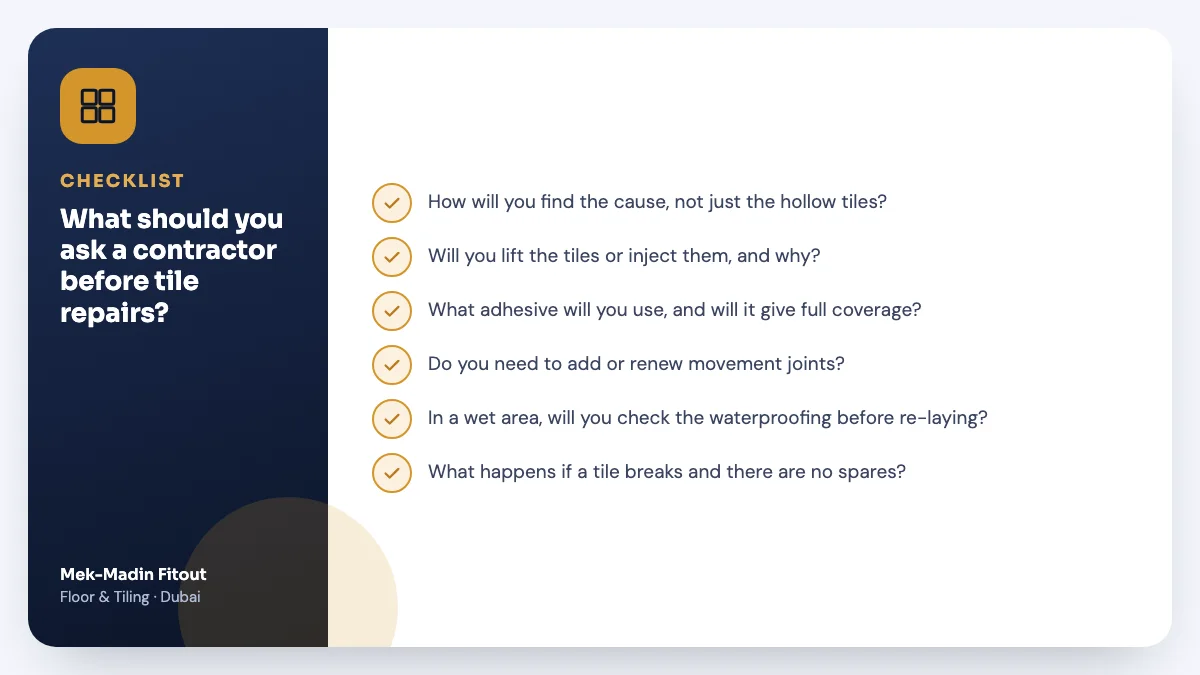
- How will you find the cause, not just the hollow tiles?
- Will you lift the tiles or inject them, and why?
- What adhesive will you use, and will it give full coverage?
- Do you need to add or renew movement joints?
- In a wet area, will you check the waterproofing before re-laying?
- What happens if a tile breaks and there are no spares?
When should you call a professional about hollow tiles?
Call a professional if hollow tiles are cracking, rocking, lifting, spreading or sitting in a wet area. A line of hollow tiles across a room also needs the base checked. Our floor tiling and hollow tile repair service covers testing, lifting, base repair, re-laying and movement joints.
Call or WhatsApp +971 52 884 8916 to arrange a visit. We confirm a visit time when you call.
FAQs
Are hollow floor tiles dangerous?
Usually not at first. They become a risk when they crack, rock or lift, because sharp edges and raised tiles can cause trips and cuts. Tenting tiles can also pop up suddenly in hot weather.
Will hollow tiles eventually crack?
Not always. Some stable voids never cause trouble. Tiles over a large void, under heavy loads or in areas with temperature swings are more likely to crack over time.
Can I fix a hollow tile myself?
You can tap-test and map them yourself. Lifting a tile without breaking it, or neighbouring tiles, takes the right tools and some practice. Injection repairs also need care to avoid staining the tile face.