

In most Dubai tenancies, the landlord pays for major and structural repairs and for the main building systems, such as plumbing, electrics and the AC. The tenant usually covers minor day-to-day upkeep and any damage they or their guests cause. Your Ejari-registered tenancy contract sets the detail, so read it before you pay for anything.
This guide is general information, not legal advice. Contracts differ and rules can change. Check your own contract and the official guidance from Dubai Land Department before you act.
How are repairs usually split between tenant and landlord?
In Dubai rentals, landlords commonly cover major and structural repairs and the main building systems, such as plumbing, electrics and the AC, while tenants cover minor day-to-day upkeep and any damage they or their guests cause. The Ejari-registered tenancy contract sets the detail and can change this broad pattern.
Fixtures you add yourself, such as a wall-mounted TV, are usually your responsibility too, so check the wall first with our guide to fixing a TV to a plasterboard partition.
Most arguments about repairs come down to one question: is this a big repair to the property, or small upkeep that comes with living there? The broad pattern below is common, but it is not a rule that overrides your contract.
Who pays for major and structural repairs?
Problems with the fabric of the property are commonly the landlord's responsibility. That includes cracks in walls or slabs, roof and terrace leaks, failed waterproofing and damage from water coming in from outside. These are faults the tenant did not cause and cannot reasonably fix. Leaks between flats raise their own questions, covered in our guide to a bathroom leaking into the flat below.
Who repairs building systems such as AC and plumbing?
The systems that make a home usable are also commonly the landlord's to repair when they fail through age or normal use. Think of the AC unit, the water heater, hidden pipework, wiring, the distribution board and fixed appliances supplied with the property. If a pipe bursts inside a wall, that is rarely the tenant's cost.
Who handles minor, day-to-day maintenance?
Small upkeep is usually the tenant's job. Replacing light bulbs, clearing a sink blocked by food or hair and keeping the place clean all fall here. So does looking after anything you brought into the home yourself.
Who pays for damage caused by the tenant?
If you, your family, your guests or your pets cause damage, you will usually be expected to pay for it. A cracked tile from a dropped pan, a door forced off its hinges or holes from heavy wall fixings all count. This applies whether the damage is accidental or not.
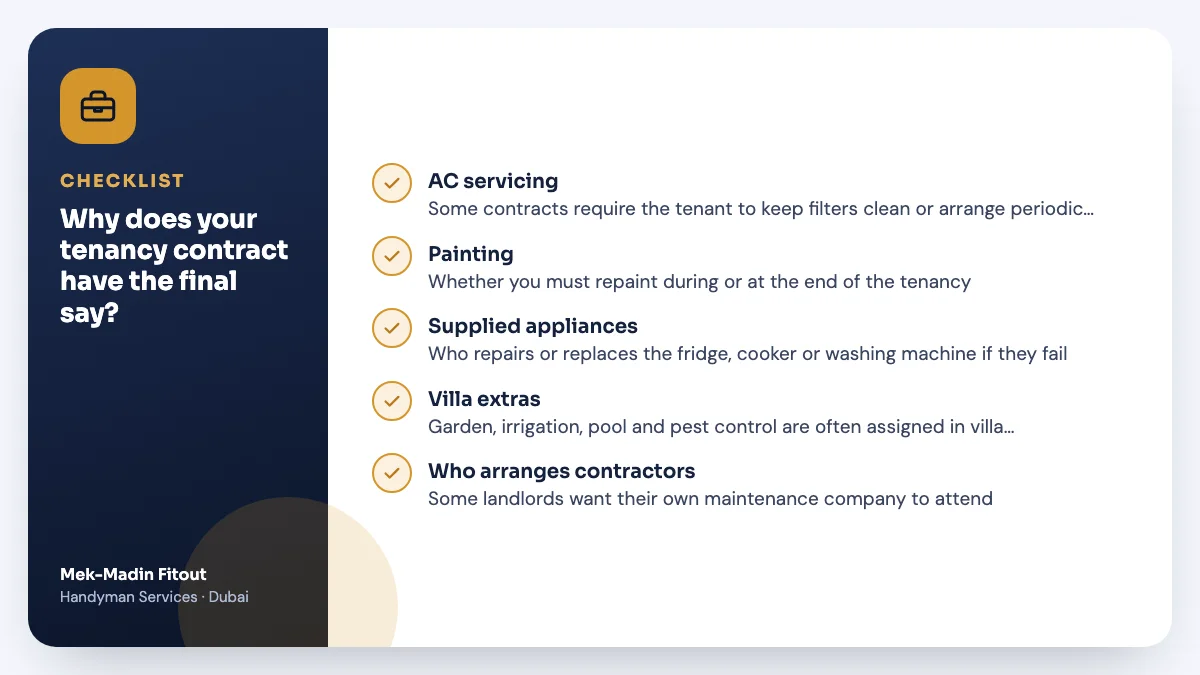
Why does your tenancy contract have the final say?
The tenancy contract is the document that sets who does what. In Dubai, residential tenancy contracts are registered through Ejari, the system run by Dubai Land Department. The registered contract, plus any addendum you both signed, is what you will be held to.
Dubai's tenancy law leaves room for this. Article 16 of Law No. (26) of 2007 regulating the relationship between landlords and tenants in Dubai says that, "unless otherwise agreed by the parties", the landlord is responsible during the lease for maintenance works and for "repairing any defect or damage that may affect the Tenant's intended use" of the property. Article 19 of the same law requires the tenant to maintain the property "in such a manner as an ordinary person would maintain his own property".
Many contracts include a maintenance clause. Some put all maintenance on the landlord. Others say the tenant covers minor repairs, sometimes up to a stated amount per job, and the landlord covers the rest.
Look for clauses on these points in particular:
- AC servicing. Some contracts require the tenant to keep filters clean or arrange periodic servicing.
- Painting. Whether you must repaint during or at the end of the tenancy. Our guide on how often a Dubai apartment needs repainting gives general ranges by room.
- Supplied appliances. Who repairs or replaces the fridge, cooker or washing machine if they fail.
- Villa extras. Garden, irrigation, pool and pest control are often assigned in villa contracts.
- Who arranges contractors. Some landlords want their own maintenance company to attend.
If a clause is unclear, ask the landlord or agent to confirm what it means in writing. Do not rely on a verbal answer.
Who usually pays for common repairs in a Dubai rental?
In a Dubai rental, hidden leaks, ageing water heaters, roof leaks, wiring faults and AC failures through normal use are commonly the landlord's cost, while bulbs, blocked drains and accidental damage are commonly the tenant's. AC servicing, supplied appliances, pest control, repainting and villa upkeep depend on the contract.
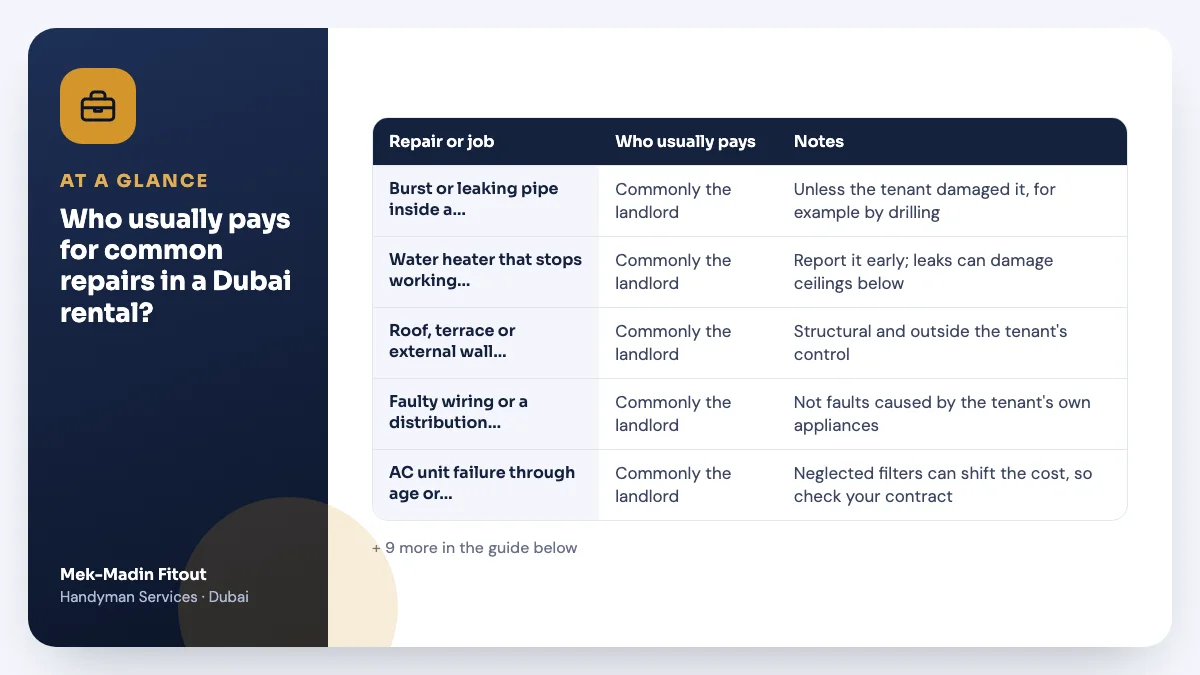
This table shows how repairs are often treated. It is a starting point for a conversation with your landlord, not a ruling. The contract and the cause of the fault can change the answer.
| Repair or job | Who usually pays | Notes |
|---|---|---|
| Burst or leaking pipe inside a wall | Commonly the landlord | Unless the tenant damaged it, for example by drilling |
| Water heater that stops working through age | Commonly the landlord | Report it early; leaks can damage ceilings below |
| Roof, terrace or external wall leak | Commonly the landlord | Structural and outside the tenant's control |
| Faulty wiring or a distribution board fault | Commonly the landlord | Not faults caused by the tenant's own appliances |
| AC unit failure through age or normal use | Commonly the landlord | Neglected filters can shift the cost, so check your contract |
| Replacing light bulbs and batteries | Commonly the tenant | Routine upkeep |
| Drain blocked by hair, grease or wipes | Commonly the tenant | A blockage deep in the building stack is a different matter |
| Damage from an accident or misuse | Commonly the tenant | Broken glass, chipped tiles, damaged doors |
| Holes from TV mounts and shelves at move-out | Commonly the tenant | Usually expected to be filled and touched up |
| Routine AC filter cleaning and servicing | Depends on the contract | Many contracts mention it specifically |
| Supplied appliances breaking down | Depends on the contract | Often the landlord if the failure is from normal use |
| Pest control | Depends on the contract | Sometimes split by cause or by season |
| Garden, irrigation and pool upkeep in a villa | Depends on the contract | Often assigned to the tenant in villa leases |
| Repainting | Depends on the contract | A common source of deposit disputes |
Faults in shared areas, such as corridors, lifts, the building's main plant or the lobby, are normally dealt with by building management or the owners' association. Report them to building management and let your landlord know.
How should you report a repair to your landlord?
Tenants in Dubai should report every repair to the landlord or agent in writing, by email or message, with dated photos and clear details of the fault, even after a phone call. In an emergency, such as water pouring through a ceiling, make the property safe first and deal with the paperwork straight afterwards.
The way you report a fault can matter as much as who pays for it. A clear written record helps both sides.
Why should repairs be reported in writing?
Report every repair by email or a message to your landlord or agent, even if you also call. Keep the thread. A dated written request shows when the landlord was told and what they were told.
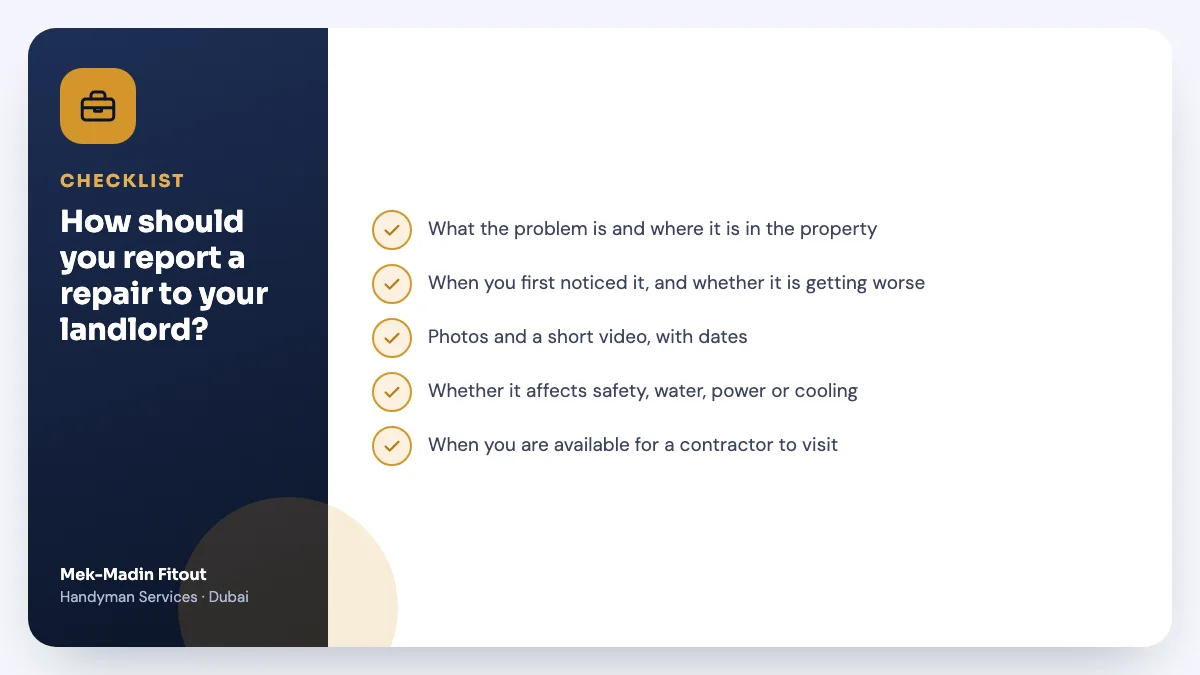
What should a repair message include?
- What the problem is and where it is in the property
- When you first noticed it, and whether it is getting worse
- Photos and a short video, with dates
- Whether it affects safety, water, power or cooling
- When you are available for a contractor to visit
Why take photos before and after a repair?
Photograph the fault as soon as you see it, then again before and after any repair. Keep these with your move-in report. Date-stamped photos are the simplest evidence you can have.
What should you do first in a repair emergency?
If water is pouring through a ceiling or a socket is sparking, make it safe first. Turn off the water at the isolation valve or switch off the circuit. Then tell building management if neighbours could be affected, and report it to your landlord straight away. If the water is coming from an AC unit, our guide to handling an AC ceiling leak covers the next steps.
Should a tenant pay for a repair and claim it back?
Sometimes a Dubai landlord asks the tenant to arrange a repair and be reimbursed. If you agree, get the agreement in writing first, including who chooses the contractor, and keep the itemised invoice and photos of the finished work. Without that written agreement, paying for a repair and deducting it from rent is risky.
Avoid deducting repair costs from rent or withholding rent on your own decision. That can create a separate dispute and may put you in breach of your contract. Take proper advice before doing anything like that.
The landlord's side deserves a fair hearing too. A landlord can only fix what they have been told about, so a fault reported late can become a bigger repair, and some landlords reasonably want their own maintenance company to attend. The law also protects the landlord: Article 19 of Law No. (26) of 2007 says the tenant may not "make any changes or carry out any restoration or maintenance works" without the landlord's permission and the required licences. Article 20 lets the landlord take a security deposit "to ensure maintenance of the Real Property upon the expiry of the Lease Contract", and damage the tenant causes is usually the tenant's to put right.
What records should a tenant keep from move-in to move-out?
Keep your move-in inspection report, because it is the baseline for every later argument. If you did not get one, take your own photos of every room in the first days of the tenancy. Our guide to move-out repairs and your security deposit covers the other end of the tenancy.
Keep a simple folder of every repair request, reply, invoice and photo. Landlords running short-term lets can keep a similar log with our holiday home turnover checklist.
What can you do if you and your landlord cannot agree?
Most repair disagreements between Dubai tenants and landlords end with a calm conversation and the evidence on the table. Share your messages, photos and any contractor report, and offer a practical way forward, such as an independent inspection. When talking does not settle it, the next step is the Rental Disputes Centre at Dubai Land Department.
Rental disputes in Dubai are handled by the Rental Disputes Centre, which is part of Dubai Land Department. Check the current process and requirements on the official site. For anything complicated, speak to a qualified legal adviser.
How does a technician's report help tenants and landlords?
A clear report from a technician helps whoever is paying for a repair, whether that is the tenant or the landlord. A good report shows what failed, why it failed and what was done. Mek-Madin Fitout can photograph the fault and give you an itemised invoice, which helps if the cause is ever questioned.
Mek-Madin Fitout offers handyman services for rental repairs across Dubai, from door and cupboard fixes to silicone, wall patching and small fittings. For leaks and blocked drains, our plumbing team can trace the cause. Tenants and landlords can call or WhatsApp +971 52 884 8916, and we confirm a visit time when you call.
FAQs
Does the landlord have to pay for AC repairs in Dubai?
Major AC faults from age or normal use are commonly the landlord's cost. Routine filter cleaning and servicing are often placed on the tenant by the contract. If the unit failed because it was never serviced as the contract required, the cost may shift, so check the wording.
Can I deduct repair costs from my rent?
Doing this on your own decision is risky and can lead to a separate dispute. If your landlord agrees in writing that you arrange a repair and get reimbursed, keep the invoice and photos. If there is no agreement, take advice before withholding anything.
Who pays if a leak from the flat above damages my apartment?
The cause is traced first. A leak from a neighbour's flat is normally their responsibility, while building pipework is handled by building management. Report it to your landlord and building management in writing, with photos, as soon as you notice it.
Is the tenant responsible for normal wear and tear?
Generally, no. Gradual wear from normal living, such as light scuffs or faded paint, is usually accepted as part of renting. Damage beyond that, or anything your contract specifically puts on you, is a different matter.