
You can mount a TV on a gypsum wall in a Dubai home, as long as the bracket is fixed into the metal studs or into heavy-duty cavity anchors rated for the load. Plain plastic wall plugs are not enough. Heavier screens and full-motion arms usually need stud fixings or a plywood backing inside the wall.
This guide explains how to check the wall, choose fixings and bracket type, avoid hidden cables and pipes, and decide when the job needs a professional.
Can you mount a TV on a gypsum wall?
Yes, most gypsum walls can hold a TV if the fixings are right for the wall and the weight. Gypsum board on its own is soft and crumbles under a concentrated load. The strength comes from the metal studs behind it, from cavity anchors that spread the load, or from timber or plywood backing fitted inside.
What matters most is the combined weight of the TV and bracket, and how far the screen sits from the wall. A slim fixed bracket puts far less strain on the fixings than an arm that pulls the screen out into the room.
If a wall cannot safely hold the TV, a floor stand or a different wall is the better choice.
How can you tell if your wall is gypsum or block?
Knock along the wall: gypsum partitions sound hollow between studs and solid where a stud sits behind the board, while block or concrete walls sound dull and solid everywhere. A small test hole in a spot the bracket will cover confirms it. Gypsum dust is white and soft, block dust is grey and gritty.
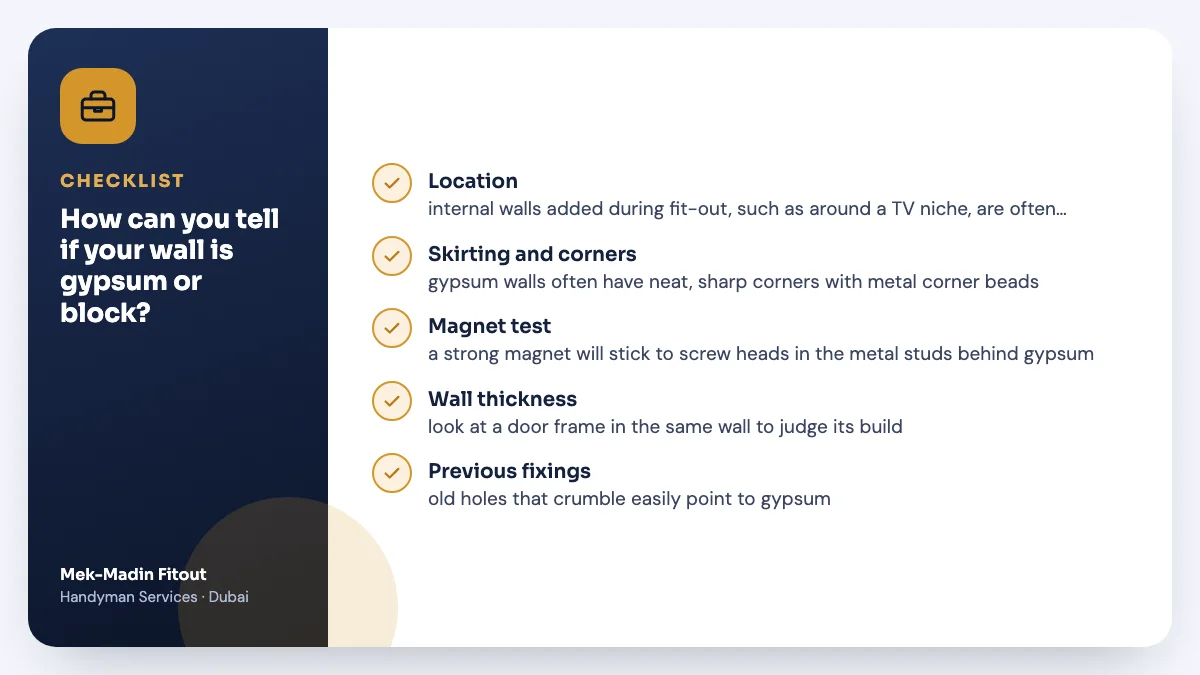
Other clues help too:
- Location: internal walls added during fit-out, such as around a TV niche, are often gypsum
- Skirting and corners: gypsum walls often have neat, sharp corners with metal corner beads
- Magnet test: a strong magnet will stick to screw heads in the metal studs behind gypsum
- Wall thickness: look at a door frame in the same wall to judge its build
- Previous fixings: old holes that crumble easily point to gypsum
Many Dubai apartments mix the two. External and party walls are often block, while partitions inside the flat may be gypsum on metal studs.
What is hidden inside a gypsum wall?
A gypsum partition is usually a frame of light steel studs and tracks with board screwed to each side. The hollow cavity between studs often carries electrical cables, data cables and sometimes water pipes or AC drain lines. Knowing what is inside before you drill matters as much as choosing the right fixing.
Things you may find in the cavity include:
- Metal studs, running from floor to ceiling at regular spacing
- Electrical cables feeding sockets, switches and lights
- TV, satellite and data cables for the media wall
- Water pipes where the wall backs onto a kitchen or bathroom
- AC condensate lines near indoor units or fan coil units
- Insulation, which can make drilling feel different from an empty cavity
Cables often run straight up or down from sockets and switches, but not always. Use a cable and pipe detector before drilling, and avoid drilling directly above or below any socket or switch.
Which fixings work in a gypsum wall?
The best fixing is a screw into a metal stud, or a heavy-duty cavity anchor where no stud is in the right place. Light plastic gypsum plugs suit pictures and small shelves, not televisions. Always check the rated load on the fixing packet, and allow a generous margin for the bracket and any pull from an arm.
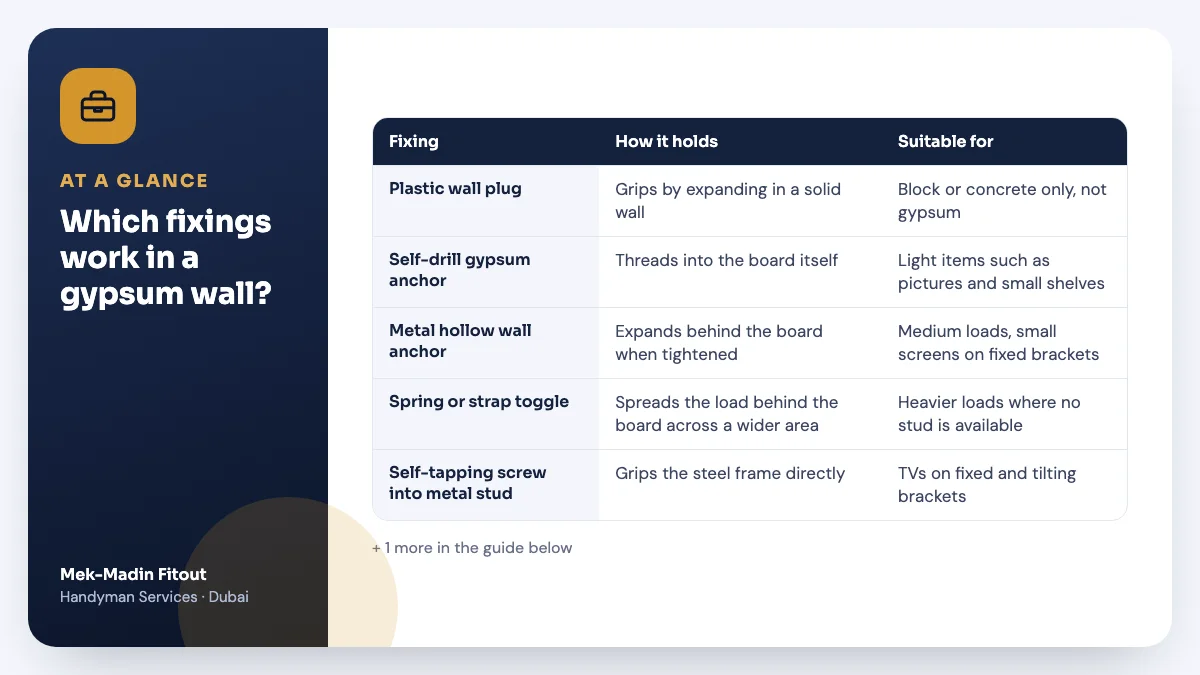
| Fixing | How it holds | Suitable for |
|---|---|---|
| Plastic wall plug | Grips by expanding in a solid wall | Block or concrete only, not gypsum |
| Self-drill gypsum anchor | Threads into the board itself | Light items such as pictures and small shelves |
| Metal hollow wall anchor | Expands behind the board when tightened | Medium loads, small screens on fixed brackets |
| Spring or strap toggle | Spreads the load behind the board across a wider area | Heavier loads where no stud is available |
| Self-tapping screw into metal stud | Grips the steel frame directly | TVs on fixed and tilting brackets |
| Plywood backing inside the wall | Gives a solid timber layer to screw into | Large TVs and full-motion arms |
We often find TVs hanging on light plastic anchors that were never meant to carry that weight. The board slowly crumbles around them until the bracket pulls away from the wall. If you are unsure which fixing suits your wall, a handyman who mounts TVs on gypsum and block walls can check what is behind the board first.
Does the type of TV bracket matter?
Yes, because the further a bracket holds the screen from the wall, the more leverage it puts on the top fixings. A fixed bracket keeps the TV close and the load mostly downward. A full-motion arm, extended and angled, tries to pull the top screws out of the wall, which gypsum resists poorly.
- Fixed bracket: lowest strain, ideal for gypsum walls when the viewing angle is straight on
- Tilting bracket: slightly more leverage, still suitable for most gypsum walls with good fixings
- Full-motion arm: highest strain when extended, usually needs studs or plywood backing
- Ceiling or floor-standing mount: useful when a wall cannot safely carry the load
Check that the bracket matches the hole pattern on the back of your TV, often called the VESA pattern. Make sure its rated load covers your screen's weight.
How do you mount a TV on a gypsum wall, step by step?
Check the weight and bracket, scan the wall, find the studs, mark the position, drill pilot holes, fit the fixings, level the bracket and hang the screen with a helper. Take your time over the scanning and marking. Most problems come from drilling in the wrong place, not from the bracket itself.
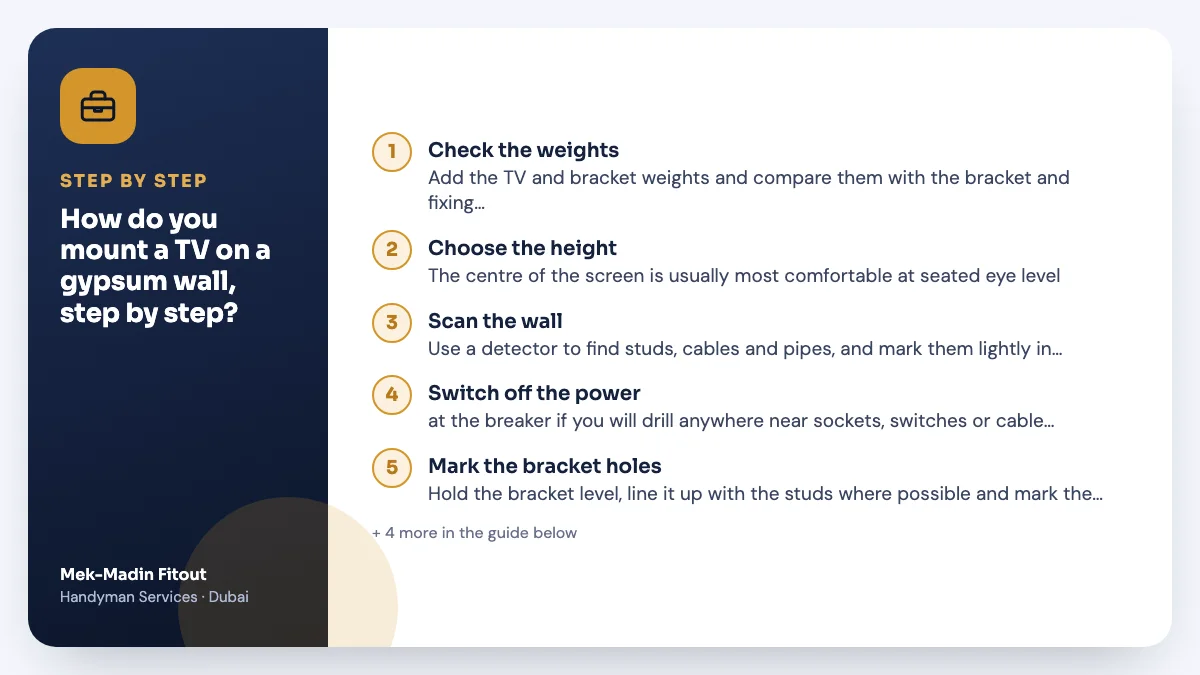
- Check the weights. Add the TV and bracket weights and compare them with the bracket and fixing ratings.
- Choose the height. The centre of the screen is usually most comfortable at seated eye level.
- Scan the wall. Use a detector to find studs, cables and pipes, and mark them lightly in pencil.
- Switch off the power at the breaker if you will drill anywhere near sockets, switches or cable runs.
- Mark the bracket holes. Hold the bracket level, line it up with the studs where possible and mark the holes.
- Drill pilot holes at the size the fixing maker gives, keeping the drill square to the wall.
- Fit the fixings and tighten them as the packet says, without over-tightening and crushing the board.
- Fix the bracket and check it is level before hanging anything on it.
- Hang the TV with a second person, lock any safety catches and test the bracket gently.
If any fixing spins, feels soft or pulls through the board, stop. Move to a stud or use a stronger fixing.
How do you hide TV cables in a gypsum wall?
Low-voltage cables, such as HDMI and aerial leads, can often run inside the cavity using a cable pass-through kit or a brush plate. A mains power cable or extension lead should never be pushed through the wall. If you want a socket behind the screen, have one installed properly by a qualified electrician.
A surface cable channel painted to match the wall is a tidy option if you cannot open the board. It also avoids drilling more holes near hidden services.
Do you need permission to drill walls in a Dubai apartment?
Usually not for a TV in your own flat, but your building and tenancy contract can set rules. Many towers limit drilling and noisy work to set hours, and some ask contractors to register with building management. Tenants should check the contract and ask the landlord before fixing anything heavy to the walls.
In tower communities such as Dubai Marina, building management often controls contractor access, lifts and working hours, so check before booking a visit. If you rent, you may need to fill and paint the holes before you leave. Our guide to move-out repairs in Dubai covers what landlords usually check, and our guide on who pays for repairs as tenant or landlord explains how small fixtures are usually treated.
When should you call a professional to mount a TV?
Call a professional if the TV is large or heavy, you want a full-motion arm, you cannot find the studs, or the wall carries cables or pipes near the mounting spot. Get help too if fixings feel soft, the board is damaged, or you want a new socket or concealed cables behind the screen.
A professional can check what is behind the board, choose fixings rated for the load and hang the screen level. If the wall cannot safely carry it, they should tell you and suggest another wall or a stand.
Our handyman services in Dubai cover TV mounting, shelves, curtain rails and other small jobs in one visit. Send us the TV size, the bracket type and a photo of the wall. Call or WhatsApp +971 52 884 8916, and we will confirm a visit time when you call.
FAQs
How much weight can a gypsum wall hold?
It depends on the board, the stud frame and the fixings, not the gypsum alone. A screw into a stud or a heavy-duty toggle holds far more than a plastic plug. Always go by the rated load on the fixing and bracket.
Can I mount a TV on gypsum without studs?
Sometimes, for a lighter screen on a fixed bracket, using heavy-duty cavity anchors rated for the load. For larger screens or arms, use studs, plywood backing or a floor stand instead.
Will mounting a TV damage the gypsum wall?
Fixing holes are small and can be filled and painted when the TV comes down. Damage happens when the wrong fixings pull through the board. Using the right fixing from the start avoids that.
Can I put a TV on a gypsum wall in a rented flat?
Usually yes, with your landlord's agreement. Check your tenancy contract first. Ask whether you need to fill and paint the holes before you move out.