

A good holiday home maintenance checklist in Dubai has three layers: quick checks at every turnover, deeper checks monthly and planned servicing every quarter. Focus on AC, water, doors and locks, appliances and safety devices. Log each visit with dated photos, so slow faults show up early and you have a record of condition.
Short-term guests use a property harder than most long-term tenants, and they rarely report small faults. A dripping tap or a sticking balcony door often shows up first in a review, not a message. This guide is for hosts and operators running apartments and villas across Dubai.
Why does turnover maintenance matter more in Dubai?
Heat, humidity and fine dust work on a Dubai holiday home all year. AC units run almost constantly, drains collect condensation and sand, and sealant ages faster in bathrooms that are rarely aired. In waterfront towers in places like Dubai Marina and JBR, sea air also adds salt to balcony sliders and outdoor fittings.
Gaps between bookings can be short, so the turnover checklist must fit into the time a cleaner already spends in the unit. Bigger jobs then go into planned gaps.
What permits and building rules apply to Dubai holiday homes?
Holiday homes in Dubai need a valid holiday home permit from Dubai's Department of Economy and Tourism (DET). Hosts are expected to follow DET's standards and their building's own rules. Check the current requirements directly with DET, as they can change.
DET's holiday home permit service page states that "All apartments and villas must be registered and approved by DET prior to listing", and notes that "By law, holiday homes permits must be displayed in the unit."
Building management also sets rules on contractor access, work hours and noise. Many towers ask for a work permit or notice before any maintenance visit. Build those lead times into your plans.
What should you check between every guest?
Between guests in a Dubai holiday home, check the air conditioning, water and plumbing, doors, locks and windows, appliances and lighting, and surfaces and furniture. Look especially for AC drips or smells, running cisterns, sticking balcony sliders and any new damage left by the last guest.
Floor traps in rarely used showers can dry out between stays, as our guide on why floor traps dry out and cause drain smells explains.
These checks take a few minutes each. Your cleaner or housekeeper can do most of them if you give them a printed list.
Air conditioning
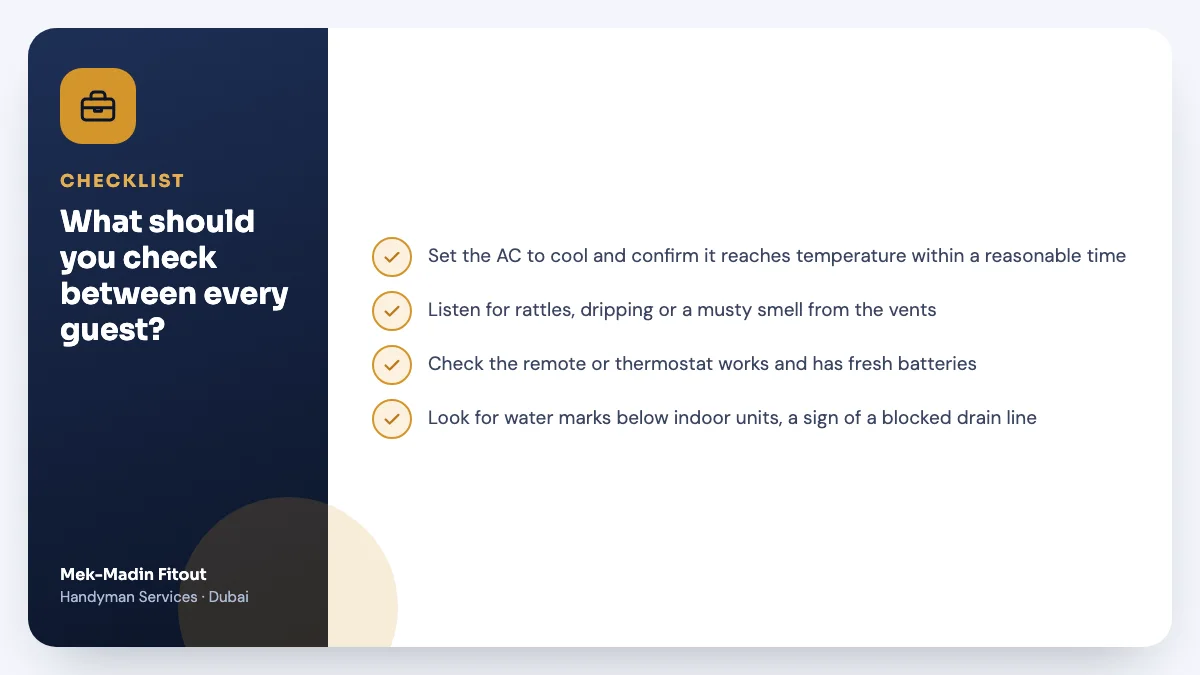
- Set the AC to cool and confirm it reaches temperature within a reasonable time
- Listen for rattles, dripping or a musty smell from the vents
- Check the remote or thermostat works and has fresh batteries
- Look for water marks below indoor units, a sign of a blocked drain line
Water and plumbing
- Run every tap and shower and check flow and hot water (if flow is weak, see our guide to low water pressure in a Dubai apartment)
- Flush each toilet and listen afterwards for a running cistern
- Look under sinks and around the washing machine for damp or drips
- Check that basins, showers and the kitchen sink drain quickly
Doors, locks and windows
- Test the main door lock, smart lock or keypad, and key safe if you use one
- Open and close balcony sliders fully; check they lock and do not grind
- Make sure bedroom and bathroom doors latch and do not catch the floor
Appliances and lighting
- Switch on every light, including bedside lamps, cooker hood and mirror lights
- Run the dishwasher, washing machine and microwave briefly if time allows
- Check the fridge is cold and the freezer seal closes cleanly
Surfaces and furniture
- Look for new scuffs, chips or marks on walls and skirting
- Wobble chairs, bar stools, bed frames and dining tables to check fixings
- Note any damage left by the last guest and photograph it
Which holiday home checks should be monthly or quarterly?
Every month, a Dubai holiday home host should rinse AC filters, look for silent leaks, clear drains, check sealant, clean slider tracks and test smoke detectors. Every quarter, flush AC drain lines, check the water heater and tighten doors, furniture and fixings, adjusting the rhythm for very high occupancy or long empty spells.
Some jobs do not need doing at every turnover but cannot wait for a fault. The table below sets out a sensible rhythm; adjust it for very high occupancy or long empty spells.
| Task | Every turnover | Monthly | Quarterly |
|---|---|---|---|
| AC cooling, noise and smell check | Yes | ||
| Clean or rinse AC filters | Yes | ||
| Flush AC drain lines and check trays | Yes | ||
| Running cisterns and dripping taps | Yes | ||
| Check under sinks and behind toilets for silent leaks | Yes | ||
| Water heater temperature and pressure valve check | Yes | ||
| Shower and basin drains cleared of hair | Yes | ||
| Silicone and grout in wet areas | Yes | ||
| Balcony slider tracks cleaned and lubricated | Yes | ||
| Smoke detector test button | Yes | ||
| Door hinges, handles and closers tightened | Yes | ||
| Wall touch-ups in high-traffic areas | Yes | ||
| Furniture fixings and wall anchors checked | Yes |
Plan AC servicing around Dubai's long cooling season. Our guide on how often to service your AC in Dubai covers timing in more detail.
Which areas of a holiday home need a closer look?
The areas of a Dubai holiday home that need a closer look are the AC filters and drains, the water heater, running cisterns, sealant and grout, balcony sliders, smoke detectors and, for villas, pools and outdoor areas. Small faults in these spots, such as a dripping tap or a sticking door, often show up first in a guest review.
Why do AC filters and drains need extra attention?
Filters clog quickly in a busy holiday let, especially with balcony doors opened often. A blocked filter means weaker cooling and more strain on the unit. A blocked drain line can leak through a ceiling, which is a problem in towers with units below. If it happens, our guide to an AC drain leaking through the ceiling covers the first hour.
How do you check the water heater?
Guests notice lukewarm showers at once. Check that hot water arrives within a normal wait and stays steady. Look for rust or damp around the tank and the pressure relief valve.
How can you spot a silently running cistern?
A cistern that runs on wastes water and pushes up DEWA bills without anyone noticing. Put a few drops of food colouring in the tank and wait. If colour appears in the bowl without flushing, the flush valve needs attention.
When should sealant and grout be replaced?
Silicone around showers and basins splits or turns black over time. Once water gets behind it, it can damage tiles and the unit below. Replace it as soon as it starts to lift rather than waiting for a stain.
Why do balcony sliders and locks get stiff?
Sand and salt build up in sliding door tracks, making doors heavy and locks hard to engage. Vacuum the track and wipe it clean, or guests may force the lock or leave it open. If a door still drags, our guide to sliding doors clogged by sand and salt explains when rollers need replacing.
How often should smoke detectors be tested?
Press the test button on each detector every month and replace batteries on a fixed schedule. Check that any fire blanket or extinguisher supplied is in place and in date. Follow your building's fire safety rules and do not cover or move ceiling detectors.
What extra checks do villa pools and outdoor areas need?
Villa hosts have more to cover. Check pool water clarity, pump noise and the safety cover or gate. Inspect garden lighting, irrigation, outdoor furniture and barbecue gas fittings, and clear sand from terraces and drains. If a dust storm turns the water green, follow our steps for recovering a green pool after a dust storm.
What should a host keep in an on-site quick-fix kit?
A holiday home host's on-site quick-fix kit should hold spare bulbs for each fitting, batteries for remotes, smoke detectors and locks, spare AC filters cut to size, a plunger, basic tools, labelled touch-up paint and silicone lubricant spray, so small faults can be fixed during a turnover.
A small locked cupboard with basic supplies saves call-outs for minor jobs. Keep it out of reach of guests.
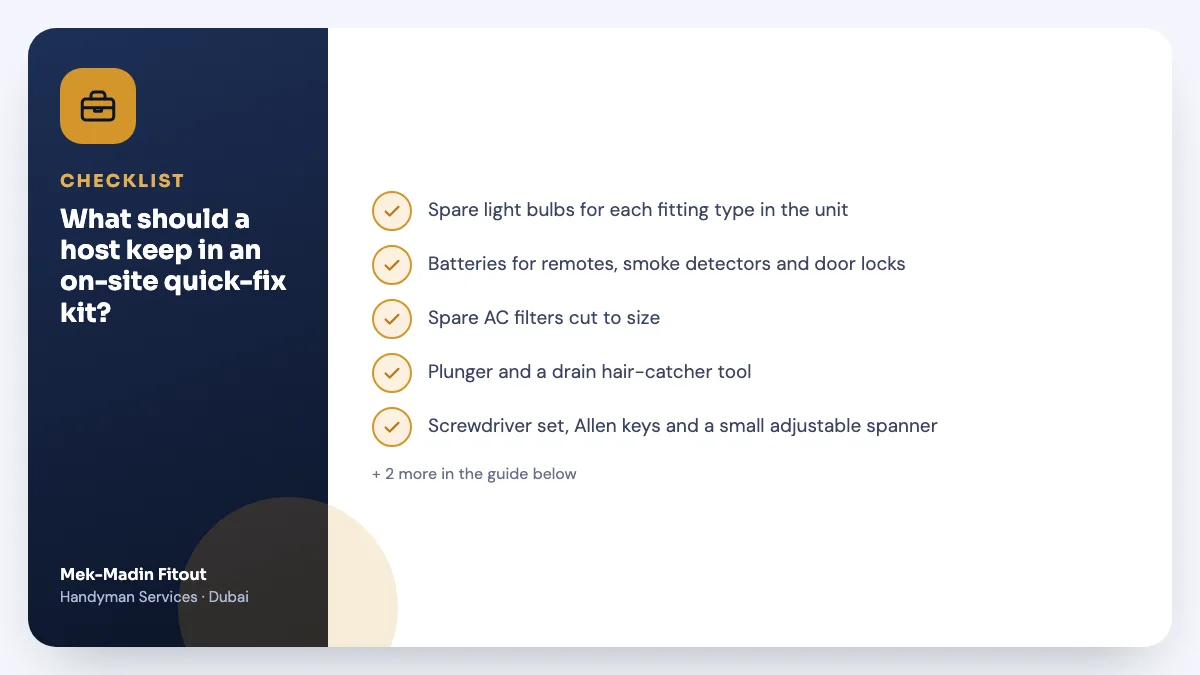
- Spare light bulbs for each fitting type in the unit
- Batteries for remotes, smoke detectors and door locks
- Spare AC filters cut to size
- Plunger and a drain hair-catcher tool
- Screwdriver set, Allen keys and a small adjustable spanner
- Touch-up paint labelled by room, with a small brush
- Silicone lubricant spray for door tracks and locks
When should you schedule deeper maintenance?
Use natural gaps in your holiday home calendar for maintenance jobs that take more than an hour. Block one or two nights each quarter for servicing, especially before the busy winter season. That way you are not forced to cancel a booking when something fails.
Jobs that need noise, drying time or contractor access usually belong in these gaps. Examples include resealing a shower, repainting a wall or servicing every AC unit. Book building permits early, as some towers need several days' notice.
Why keep a maintenance log for a holiday home?
A simple maintenance log turns scattered notes into useful records. It helps you see patterns, such as the same AC unit dripping every few weeks. It also helps when you need to show the condition of the unit to an owner, insurer or guest platform.
Record these for every visit:
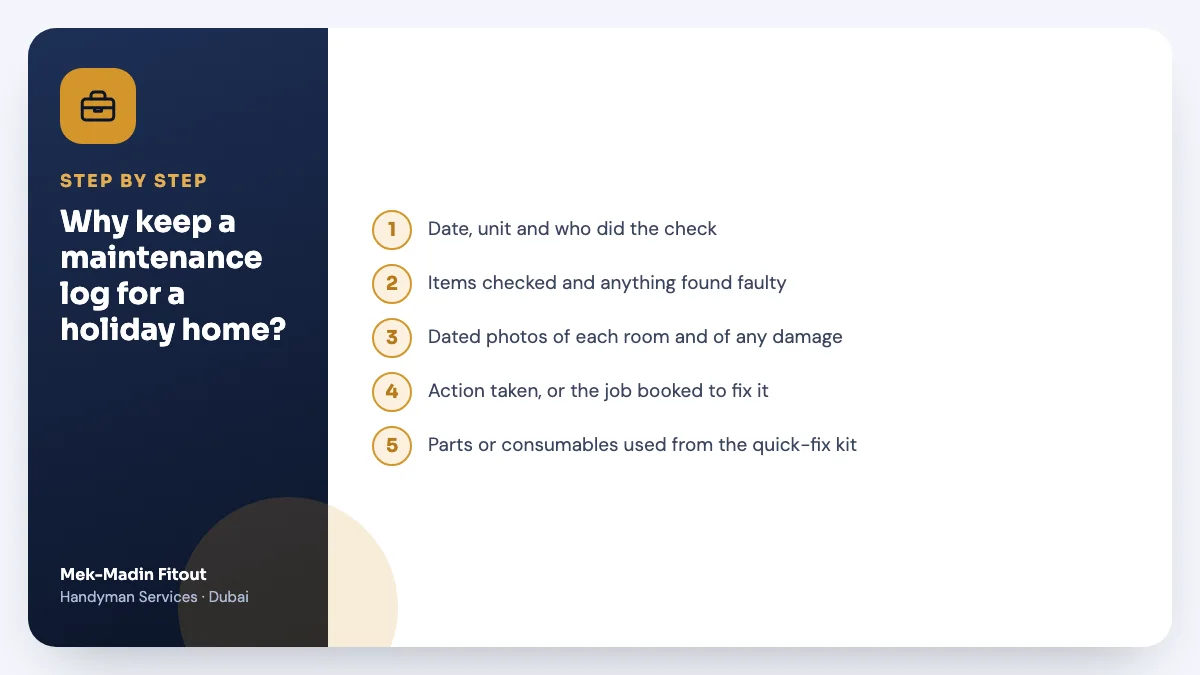
- Date, unit and who did the check
- Items checked and anything found faulty
- Dated photos of each room and of any damage
- Action taken, or the job booked to fix it
- Parts or consumables used from the quick-fix kit
A shared spreadsheet with photo folders is enough for most hosts. Use the same photo angles each time. If the unit goes back to long-term letting, see our guides on who pays for repairs in a Dubai rental and move-out repairs that protect your deposit.
When should a holiday home host call a professional?
Your cleaning team can handle the turnover checks and swap bulbs or batteries. Anything involving water, electrics, sealant or door mechanisms is better left to a trained technician. A careful repair now usually costs less than a cancelled booking or a leak into the flat below.
Mek-Madin Fitout provides handyman services for holiday homes across Dubai, from door and lock adjustments to resealing, touch-ups and furniture fixings. For leaks, cisterns and water heaters, see our plumbing services. Call or WhatsApp +971 52 884 8916 with your turnover list, and we will confirm a visit time when you call.
FAQs
How long should a turnover maintenance check take?
For a one or two-bedroom apartment, the quick checks in this guide usually fit within a normal turnover clean. Give your cleaner a printed list and ask them to report faults with photos. Bigger jobs go into planned gaps between bookings.
How often should AC filters be cleaned in a holiday home?
In a busy short-term let, cleaning or rinsing filters monthly is a sensible starting point. If guests often leave balcony doors open or you notice dust on the vents, check them more often. Drain lines and full servicing are usually planned less often.
Who is responsible for repairs in a managed holiday home?
It depends on your agreement with the owner or operator. Most management contracts set out who handles routine maintenance and who approves larger repairs. Building management usually covers common areas, but not fittings inside the unit.
Should I tell guests about maintenance visits?
Avoid scheduling contractors during a stay unless it is urgent. If a repair cannot wait, give guests clear notice and a time window, and follow your platform's rules. Planned work is easier to fit into gaps between bookings.