A pool turns green after a sandstorm because dust and debris use up the chlorine, bring in nutrients that feed algae and clog the filter. To recover it, remove the debris, brush every surface, test and balance the water, shock it at dusk, run and clean the filter, then clear what settles and retest until the readings hold.
Most storm-green pools can be brought back without draining. The key is working in the right order and not rushing the chemicals.
Why does a pool turn green after a sandstorm?
A dust storm does not add algae to a pool on its own. The storm changes the water so that algae, which is always present in small amounts, can take over: dust and debris use up the chlorine, organic matter feeds the algae, and fine dust clogs the filter while heat burns off the chlorine that is left.
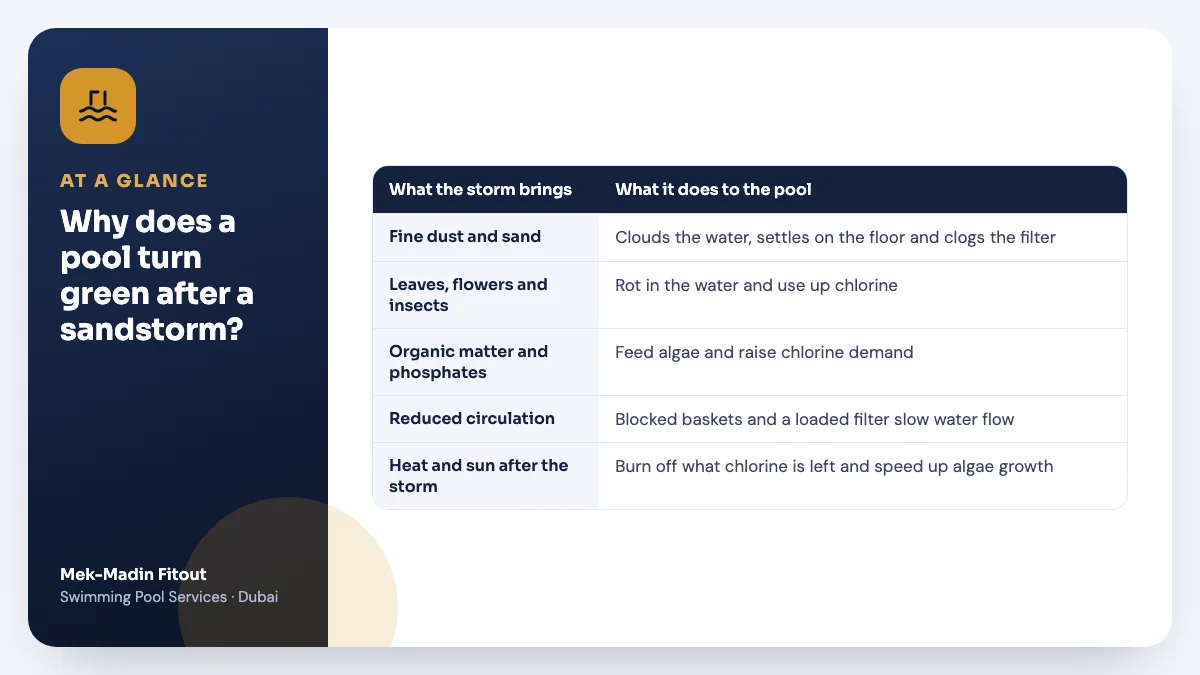
Several things happen at once.
| What the storm brings | What it does to the pool |
|---|---|
| Fine dust and sand | Clouds the water, settles on the floor and clogs the filter |
| Leaves, flowers and insects | Rot in the water and use up chlorine |
| Organic matter and phosphates | Feed algae and raise chlorine demand |
| Reduced circulation | Blocked baskets and a loaded filter slow water flow |
| Heat and sun after the storm | Burn off what chlorine is left and speed up algae growth |
Why does the chlorine run out so fast?
Chlorine works by attacking organic matter and germs. A storm drops a large load of both into the water in a few hours. The chlorine gets used up faster than it is replaced, and once it falls too low, algae can bloom within days in warm water.
How does storm dust clog the pool filter?
Fine dust passes into the skimmers and loads the filter quickly. As the filter clogs, pressure rises and flow drops. Less water passes through the filter, so the pool cannot clean itself, even if the pump is running.
How do you handle pool chemicals safely?
To handle pool chemicals safely, follow every label, never mix chemicals, add chemicals to water one at a time and never water to chemicals, wear gloves and eye protection, and keep children, pets and swimmers away until the water is safe. Store pool chemicals in a shaded, dry place, away from each other.
Pool chemicals are strong and some react badly with each other. Take these precautions every time:
- Read and follow the product label for every chemical, including dose and swimming wait times
- Never mix chemicals together, in a bucket or in the pool
- Add chemicals to water, never water to chemicals
- Add one chemical at a time and let the pump circulate before adding the next
- Wear gloves and eye protection, and work in a well-ventilated space
- Keep children, pets and swimmers away until the water is safe
- Store chemicals in a shaded, dry place, away from each other
Dubai Municipality's Private Swimming Pools Safety Guidelines also say pool chemicals should be stored, handled and used in line with the manufacturer's instructions and Safety Data Sheet, and kept in "a dedicated storage area with a locking device".
How do you clear a green pool, step by step?
To clear a green pool after a sandstorm, remove the debris, brush every surface, test the water, balance pH and shock at dusk, run the pump and clean the filter, clear what settles with a clarifier or flocculant, then retest and rebalance. Most storm-green pools can be brought back this way without draining.
Salt pools need a manual shock too after a storm, as our guide to salt water and chlorine pools explains.
Step 1: Remove the debris
Skim leaves, insects and floating dust from the surface. Empty the skimmer baskets. Switch the pump off before emptying the pump strainer basket, then switch it back on.
Remove as much as you can before adding chemicals. Every leaf left in the water uses up chlorine you are about to add.
Step 2: Brush every surface
Brush the walls, floor, steps and waterline, working towards the main drain. Pay attention to corners, behind ladders and around lights. Brushing breaks up algae and lifts settled dust so the filter and the chemicals can reach it.
Step 3: Test the water
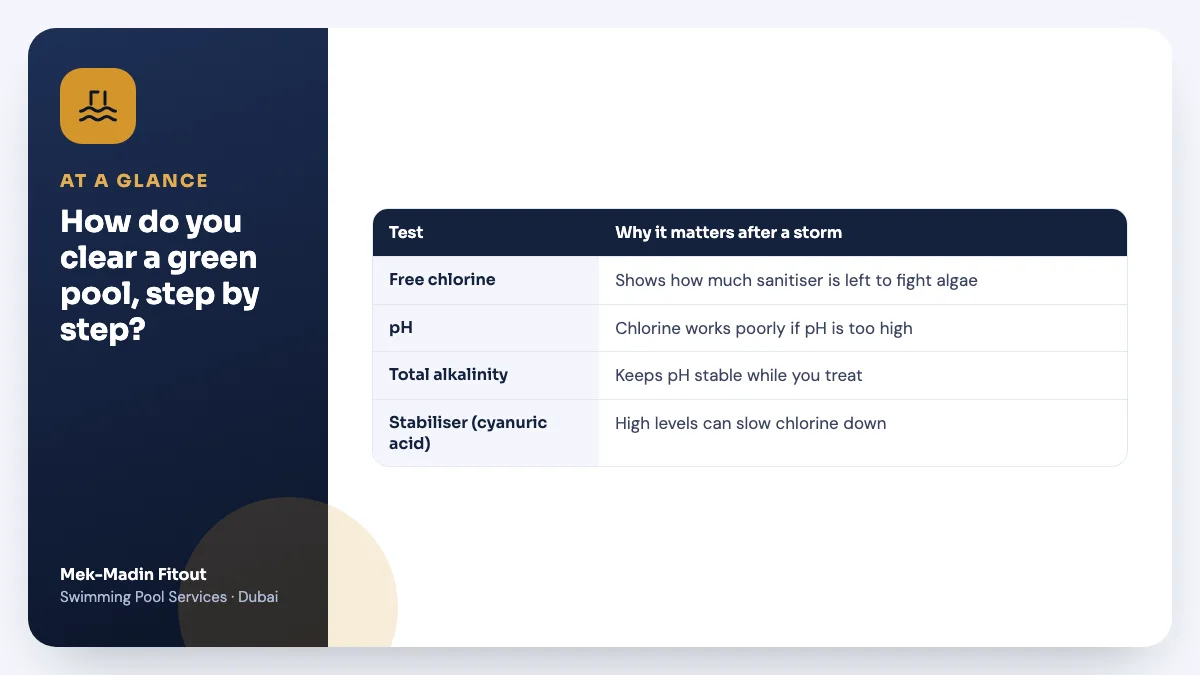
Test free chlorine, pH and total alkalinity before you add anything, as a storm can shift all three. Aim for the Dubai Municipality ranges of 7.4 to 7.6 for pH and 1 to 2 mg per litre (ppm) of free chlorine. Your test kit or equipment maker may give slightly different targets.
For private villa pools, Dubai Municipality's Private Swimming Pools Safety Guidelines give acceptable ranges of 1 to 2 mg/litre for free chlorine and 7.4 to 7.6 for pH. The same guidelines say water quality should be tested daily, before use, for pH, chlorine and temperature, with the readings recorded in a logbook.
| Test | Why it matters after a storm |
|---|---|
| Free chlorine | Shows how much sanitiser is left to fight algae |
| pH | Chlorine works poorly if pH is too high |
| Total alkalinity | Keeps pH stable while you treat |
| Stabiliser (cyanuric acid) | High levels can slow chlorine down |
Step 4: Balance pH, then shock
Adjust pH first, as chlorine works better when pH is in range. Then shock the pool at dusk, so the sun does not burn off the chlorine before it works. Follow the label dose for algae, which is usually higher than a routine shock.
Keep the pump running overnight. Brush again the next morning. A green pool often needs more than one shock before the colour shifts to blue-grey or cloudy white.
Step 5: Run the pump and clean the filter
Run the pump continuously until the water is clear. Watch the pressure gauge. As dead algae and dust load the filter, pressure will rise quickly.
- Sand or glass media filter: backwash when pressure rises noticeably above its clean level, then rinse
- Cartridge filter: remove and hose down the cartridge, or swap it for a clean spare
- Heavy loads: you may need to clean the filter several times in the first day or two
If the filter has been struggling for a while, it may need a deeper clean or a media check once the pool is clear.
Step 6: Clear what settles
After shocking, the water often turns cloudy as dead algae and fine dust hang in it. There are two general approaches.
A clarifier clumps fine particles so the filter can catch them. It is gentler and works through the filter, but takes longer.
A flocculant makes particles clump and sink to the floor, usually with the pump off. You then vacuum the settled layer to waste, so it leaves through the waste line rather than going back through the filter.
Vacuuming to waste removes water, so top up afterwards. Check your community rules on where pool water can be discharged. If the level keeps dropping once the pool is clear, a bucket test for pool leaks shows whether it is more than evaporation.
Follow the product label closely for either one, as the method varies by product and filter type.
Step 7: Retest and rebalance
Once the water looks clear, test again. Bring pH, alkalinity and chlorine back into range. Check stabiliser and calcium hardness too, as topping up after vacuuming to waste changes the balance.
Only swim when the water is clear, readings are in range and the label waiting time has passed.
What does the colour of a green pool tell you?
The starting colour of a green pool gives a rough idea of how much work is ahead. Cloudy water with no colour usually means suspended dust and an overloaded filter, a light green tinge means early algae, and dark green or swampy water means a heavy algae load that often needs repeated treatment and professional help.
| Water condition | What it usually means | Approach |
|---|---|---|
| Cloudy, no colour | Dust in suspension, filter overloaded | Clean filter, run pump, clarifier if needed |
| Light green tinge | Early algae, low chlorine | Brush, balance pH, shock at dusk |
| Mid green, floor not visible | Established algae | Repeated shock and brushing, frequent filter cleaning |
| Dark green or swampy | Heavy algae and organic load | Repeated treatment, floc and vacuum to waste, often professional help |
How do you prepare a pool before a forecast dust storm in Dubai?
Before a forecast dust storm in Dubai, clean or backwash the pool filter, empty the skimmer and pump baskets, bring free chlorine towards the top of its usual range, fit and secure a cover, tidy loose garden waste and keep the pump running during and after the storm.
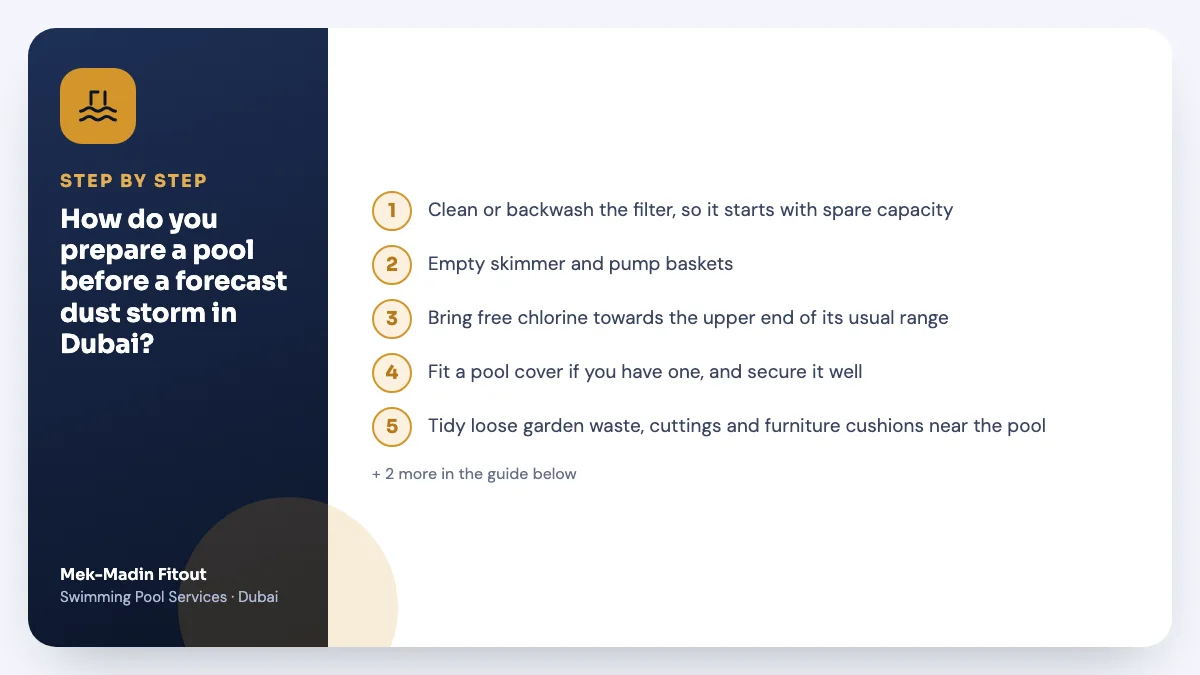
Dust storms are often forecast a day or two ahead. A little preparation makes the clean-up much shorter.
- Clean or backwash the filter, so it starts with spare capacity
- Empty skimmer and pump baskets
- Bring free chlorine towards the upper end of its usual range
- Fit a pool cover if you have one, and secure it well
- Tidy loose garden waste, cuttings and furniture cushions near the pool
- Keep the pump running during and after the storm
- Start skimming and brushing as soon as it is safe to go outside
For the routine that keeps water stable through the hot months, see our guide to pool care in a Dubai summer.
How do storms affect pools in different villa communities?
Location changes how hard storms hit. Pools in DAMAC Hills often sit in open, sunny gardens near building work, so fine dust is a frequent problem. In Arabian Ranches, mature trees mean storms also bring a heavy load of leaves and flowers.
When should you call a pool professional?
Call a pool professional if the pool is still green after two or three rounds of shocking, if the filter pressure stays high after cleaning, or if the pump is struggling. Get advice too if you are unsure about any chemical, or the pool is so dark you cannot see the floor.
Our swimming pool services include green pool recovery, filter cleaning, equipment checks and regular maintenance visits across Dubai. Call or WhatsApp +971 52 884 8916, and we will confirm a visit time when you call.
FAQs
Can I swim in a green pool?
No. Green water means the sanitiser has failed, so germs can grow alongside the algae, and cloudy water hides the floor. Wait until the water is clear, readings are in range and any label waiting time has passed.
Why is my pool cloudy after I shocked it?
Cloudiness after shocking is common. It is usually dead algae and fine dust hanging in the water. Keep the pump running, clean the filter when pressure rises, and use a clarifier or floc if the cloud does not clear.
Should I drain a green pool after a sandstorm?
Usually not, as most storm-green pools recover with debris removal, shocking and good filtration. Draining an outdoor pool in Dubai's heat can also stress the shell and tiles. It is mainly worth considering when the water has other problems, such as very high stabiliser or minerals.
Does a pool cover stop sand getting in?
A well-fitted cover keeps out most debris and much of the dust. Some fine dust still settles on top and can slide in when you remove it. Clean the cover before rolling it back, and check the water after any storm.