

The quickest way to tell a pool leak from evaporation is the bucket test: set a bucket of pool water on the pool step, mark both water levels and compare them after 24 hours. Both lose water to evaporation at a similar rate, so if the pool drops noticeably more than the bucket, a leak is likely.
Every outdoor pool in Dubai loses some water to heat and wind. The question is whether yours is losing more than that. This guide explains how to check, where leaks usually hide and what to note down before anyone visits.
Why do pools in Dubai lose so much water?
Pool evaporation depends on water temperature, air temperature, humidity, wind and sun. In a Dubai summer, several of those work against you at once. The amount varies from pool to pool and week to week, so there is no single "normal" figure to compare with.
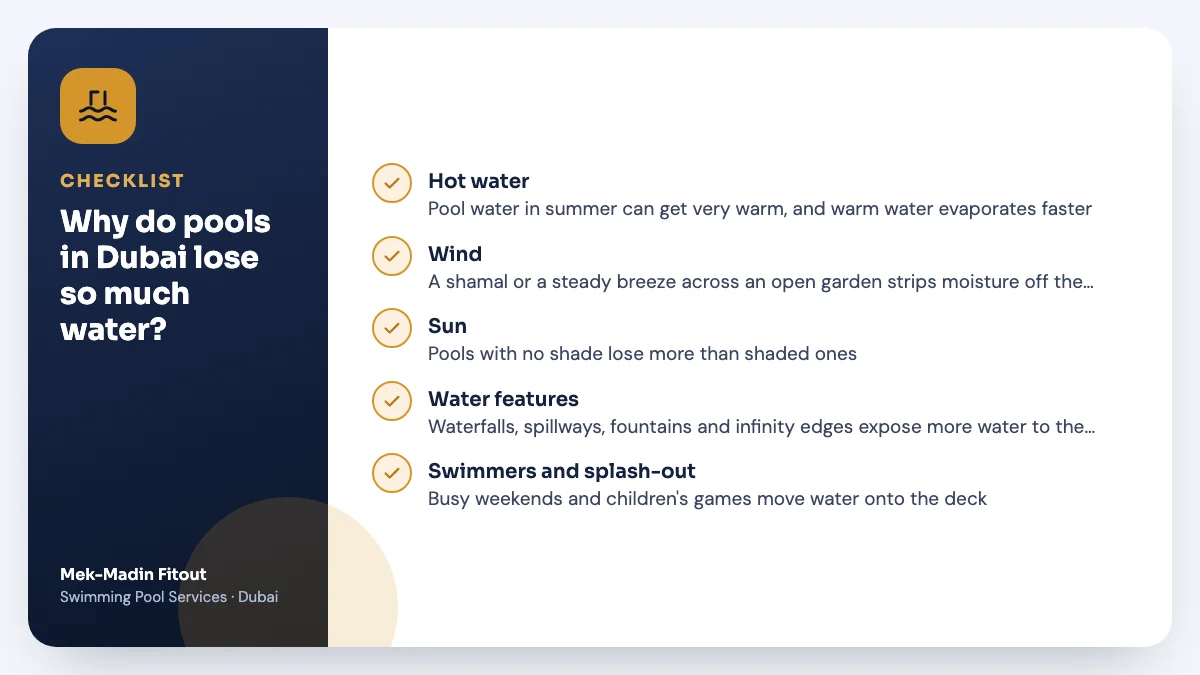
What speeds up pool evaporation?
- Hot water. Pool water in summer can get very warm, and warm water evaporates faster.
- Wind. A shamal or a steady breeze across an open garden strips moisture off the surface.
- Sun. Pools with no shade lose more than shaded ones.
- Water features. Waterfalls, spillways, fountains and infinity edges expose more water to the air.
- Swimmers and splash-out. Busy weekends and children's games move water onto the deck.
A pool cover, shade structures and turning off water features when not in use all reduce loss. DEWA's tips for managing electricity and water use also advise owners to "cover your swimming pool to reduce water losses due to evaporation". For a full summer routine, see our guide to pool care in a Dubai summer.
What are the signs your pool has a leak?
A level that drops just as fast on calm, cooler days, damp ground near the pool, water in the plant room or rising water use all point to a leak. Evaporation is steady and follows the weather. A leak tends to show itself in other ways too. Look for these:
- The level drops at a similar rate on calm, cooler days as on hot, windy ones
- The level keeps falling and then stops at the same point each time
- Wet patches, soft ground or unusually green grass near the pool or pipe runs
- Water in the plant room, or damp around the pump, filter or valves
- Cracks in the shell, loose tiles or gaps around the coping
- Air bubbles in the return jets, or the pump losing prime
- Your DEWA water use rising without more topping up from a hose
- An automatic top-up valve that seems to run more than it used to
DEWA says its High-Water Usage Alert, described on its smart services and tips page, is there "to help customers detect leakages in water connections after the meter".
How do you do a bucket test on a swimming pool?
The bucket test compares your pool with a sample of the same water in the same conditions: a bucket of pool water stands on the pool step, both levels are marked, and the drops are compared after 24 hours. Repeating it with the pump off means the test takes two or three days to do properly.
What do you need for the bucket test?
- A clean bucket, ideally a sturdy 20-litre type
- A waterproof marker or strips of tape
- A few stones or bricks to weigh the bucket down if needed
Step by step
- Bring the pool to its normal operating level.
- Turn off any automatic top-up valve, so it cannot hide the loss.
- Fill the bucket with pool water to roughly the same height as the pool level outside it.
- Stand the bucket on the first or second step, so it sits at the same temperature as the pool.
- Mark the water level inside the bucket and the pool level on the outside of the bucket.
- Run the pump on its usual schedule and do not swim for 24 hours.
- Compare the drop inside the bucket with the drop in the pool.
Why run the bucket test twice?
Repeat the test for another 24 hours with the pump switched off. Comparing the two results gives you a rough clue about where the water is going.
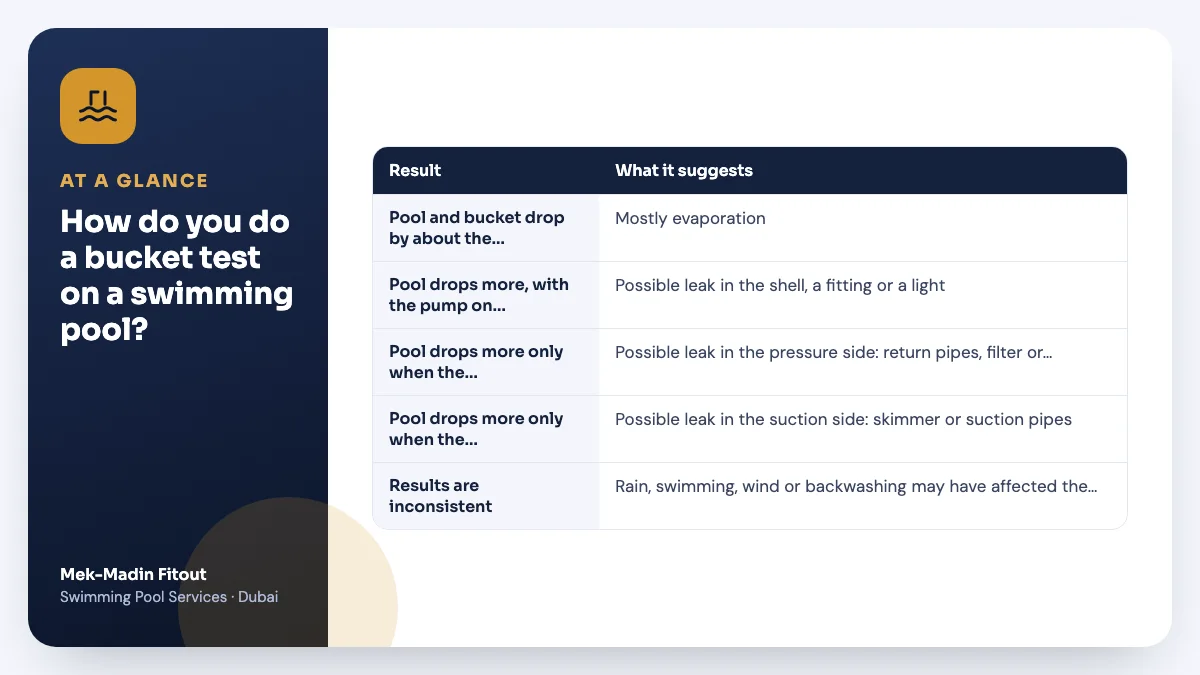
| Result | What it suggests |
|---|---|
| Pool and bucket drop by about the same amount | Mostly evaporation |
| Pool drops more, with the pump on and off alike | Possible leak in the shell, a fitting or a light |
| Pool drops more only when the pump runs | Possible leak in the pressure side: return pipes, filter or valves |
| Pool drops more only when the pump is off | Possible leak in the suction side: skimmer or suction pipes |
| Results are inconsistent | Rain, swimming, wind or backwashing may have affected the test; repeat it |
Treat these as clues, not a diagnosis. A professional leak check confirms the exact point.
Where do swimming pools usually leak?
Swimming pools usually leak at the skimmers, return jets and wall fittings, pool lights, underground pipework, the equipment and backwash line, and cracks in the shell or tiles. Where the water level stops falling is often a clue, because a level that settles at the skimmer or the light points to that fitting.
Skimmers
The joint between the skimmer box and the pool shell is a common weak point. Movement, heat and age can open a gap. If the level stops falling around the bottom of the skimmer opening, the skimmer is a likely suspect.
Return jets and wall fittings
Return jets, cleaner points and main drains pass through the shell. The seal around each fitting can crack or shrink over time. A few drops of pool dye released close to a fitting, with the pump off, will be drawn into a gap if there is one.
Pool lights
Light niches have a cable conduit that runs back to a junction box. Water can escape through a failed seal or along the conduit. If the level settles at the height of the light, check there first.
Underground pipework
Pipes between the pool and the plant room run under the deck and garden. Joints can fail with ground movement, tree roots or poor original work. These leaks often show as damp patches or a pump that struggles.
Equipment and the backwash line
Leaks at the pump, filter, chiller or chlorinator are easier to see, as water collects in the plant room. A multiport valve that lets water pass to waste can quietly drain the pool through the backwash line. Check whether that line is wet when it should be dry. Vacuuming to waste after a dust storm also lowers the level, a step covered in our guide to clearing a green pool after a sandstorm.
Shell cracks and tiles
Cracks in the concrete shell, failed grout and lifted tiles let water behind the finish. Some cracks are only on the surface, while others go through the structure. When patch repairs no longer hold, a pool may need relining by a waterproofing team.
What should you record before a pool leak check?
Before a pool leak check, log the daily water level, pump hours, every top-up, backwashing, weather, swimming and any damp patches or bubbles. A simple record makes any leak check faster and more accurate. Keep a notebook or phone note for at least a week, noting where the level stops if it stops.
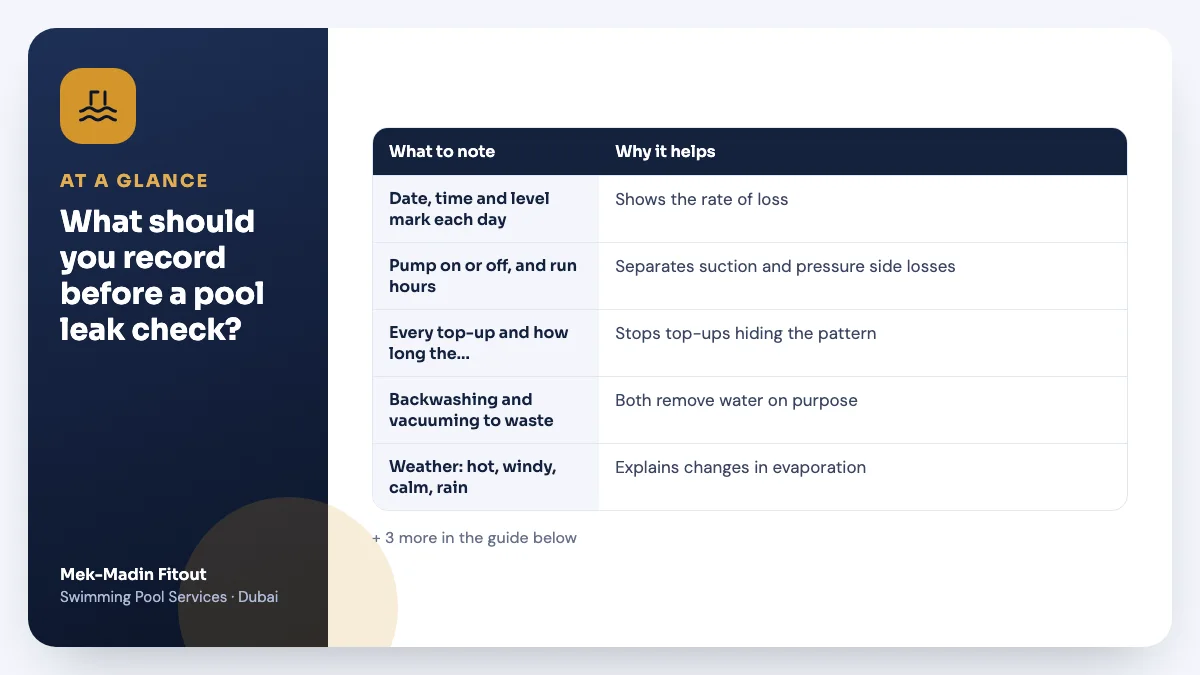
| What to note | Why it helps |
|---|---|
| Date, time and level mark each day | Shows the rate of loss |
| Pump on or off, and run hours | Separates suction and pressure side losses |
| Every top-up and how long the hose ran | Stops top-ups hiding the pattern |
| Backwashing and vacuuming to waste | Both remove water on purpose |
| Weather: hot, windy, calm, rain | Explains changes in evaporation |
| Swimming and parties | Splash-out can look like a leak |
| Where the level stops, if it stops | Points to skimmer, light or fitting height |
| Damp patches, bubbles or pump noises | Narrows down the search area |
Photos of wet ground, the plant room and the water line help too.
Can garden irrigation hide or mimic a pool leak?
Many villa pools in communities such as Palm Jumeirah and the newer Dubailand developments sit very close to gardens. Irrigation can wet the ground around the pool and make a leak look worse or hide one. Switch off sprinklers near the pool for a day or two while you test.
If you need to lower or drain the pool for a repair, check the rules with your community management or master developer first. Some communities have guidance on where pool water may be discharged.
When should you call in a pool leak specialist?
Call a pool leak specialist if the bucket test shows the pool losing more than the bucket, if you see damp ground or plant room leaks, or if the pump keeps losing prime. Leaks rarely fix themselves, and water escaping under the deck can affect the ground and the shell.
Our swimming pool services include leak checks, fitting and light seal repairs, plumbing repairs and equipment servicing across Dubai. Send us your log and photos to speed things up. Call or WhatsApp +971 52 884 8916, and we will confirm a visit time when you call.
FAQs
How much water loss is normal for a pool in Dubai?
It depends on the season, the weather, shade, wind and whether you use a cover or water features. That is why a fixed figure is not much help. The bucket test compares your pool with the same water in the same conditions, which is a fairer check.
Can I do the bucket test with the automatic top-up on?
No. An automatic top-up valve refills the pool as it drops, which hides any loss. Turn it off for the test, or isolate it, and remember to switch it back on afterwards.
Does a pool leak always show as wet ground?
Not always, because water can drain away into sandy ground without showing on the surface. A leak in a skimmer, fitting or light may also leave no visible sign outside the pool. Your level log and the bucket test are often the first clues.
Should I drain the pool to find a leak?
Usually not. Draining can stress the shell and is often not needed to find a leak. Many leaks can be traced with the pool full, using dye, pressure tests on the pipes and listening equipment.