Pool care in a Dubai summer comes down to three habits: test and balance the water at least twice a week, skim and empty baskets daily, and top up evaporation often. Heat and sun burn off chlorine quickly, while dust and sand arrive constantly. Run the pump longer, and use a four-week cycle for the deeper tasks.
Below is a routine you can follow from June to September, plus the reasons behind each step.
Why is summer so hard on pools in Dubai?
Summer is hard on Dubai pools because strong UV burns off unstabilised chlorine, warm water speeds up algae and uses up sanitiser, daily dust and sand cloud the water, fast evaporation keeps changing the chemistry, and heavy holiday use adds sunscreen and sweat. Knowing why helps you spot problems early.
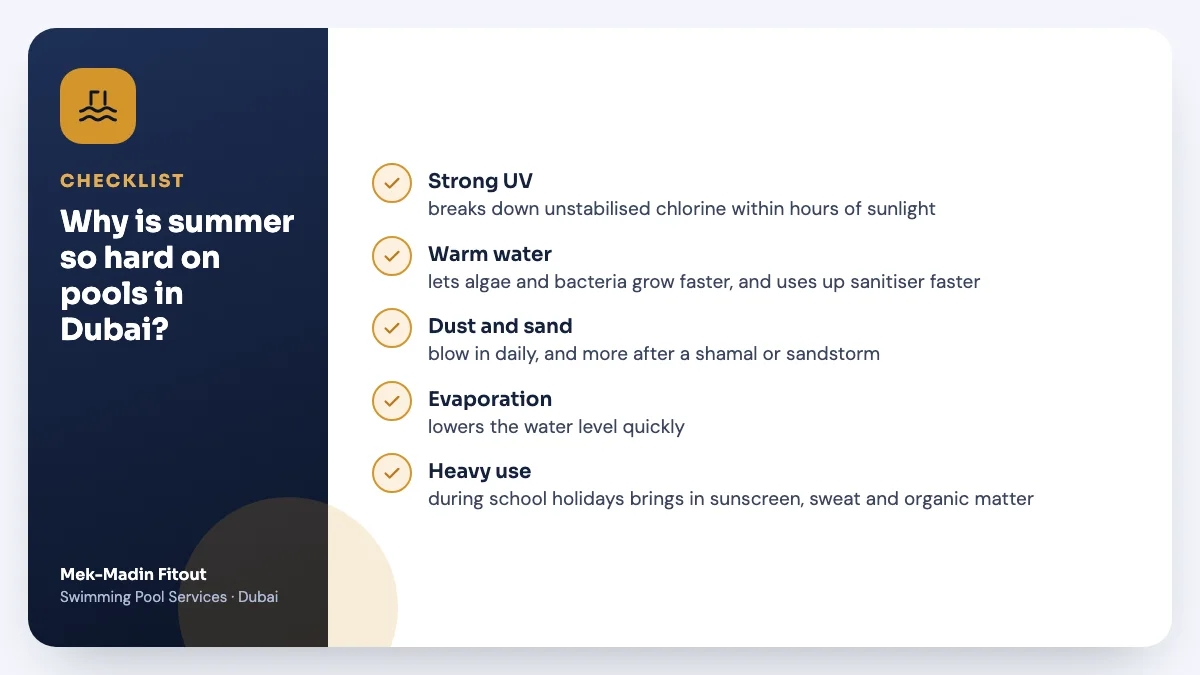
- Strong UV breaks down unstabilised chlorine within hours of sunlight.
- Warm water lets algae and bacteria grow faster, and uses up sanitiser faster.
- Dust and sand blow in daily, and more after a shamal or sandstorm. They cloud the water and load the filter.
- Evaporation lowers the water level quickly. Topping up changes the chemistry each time.
- Heavy use during school holidays brings in sunscreen, sweat and organic matter.
What chlorine and pH levels should a pool have in summer?
Free chlorine of about 1 to 3 ppm and pH of about 7.2 to 7.6 are commonly recommended for residential outdoor pools, with alkalinity, calcium hardness and stabiliser kept in range too. In summer, free chlorine burns off faster in sun and heat, so these readings need checking more often than in the cooler months.
If you are weighing up a salt system against manual dosing, our comparison of a salt water pool vs chlorine in Dubai explains how each copes with the heat.
Your test kit or equipment manufacturer gives the ranges for your pool. The figures below are commonly recommended for residential outdoor pools. Treat them as a general guide, not a rule.
| Test | Commonly recommended range | Why it matters in summer |
|---|---|---|
| Free chlorine | About 1–3 ppm | Burns off faster in sun and heat |
| pH | About 7.2–7.6 | Drifts up with heavy use and some chlorine types |
| Total alkalinity | About 80–120 ppm | Keeps pH from swinging |
| Calcium hardness | About 200–400 ppm | Low levels can etch surfaces; high levels cause scale |
| Cyanuric acid (stabiliser) | About 30–50 ppm | Shields chlorine from UV in outdoor pools |
Salt chlorinator pools follow the same balance, plus a salt level set by the chlorinator maker. Always follow the product label when dosing chemicals.
For comparison, Dubai Municipality's Private Swimming Pools Safety Guidelines give an acceptable range of "1 to 2 mg/liter" for free chlorine and "7.4 to 7.6" for pH. The same guidelines say pool water "shall be tested daily (before use) for pH, chlorine and temperature levels".
What pool tasks should you do every day in summer?
Every day in a Dubai summer, spend about 10 minutes on the pool: skim leaves, insects and floating dust, empty the skimmer baskets, check that the water level sits around the middle of the skimmer opening, glance at the clarity and make sure the pump is running normally.
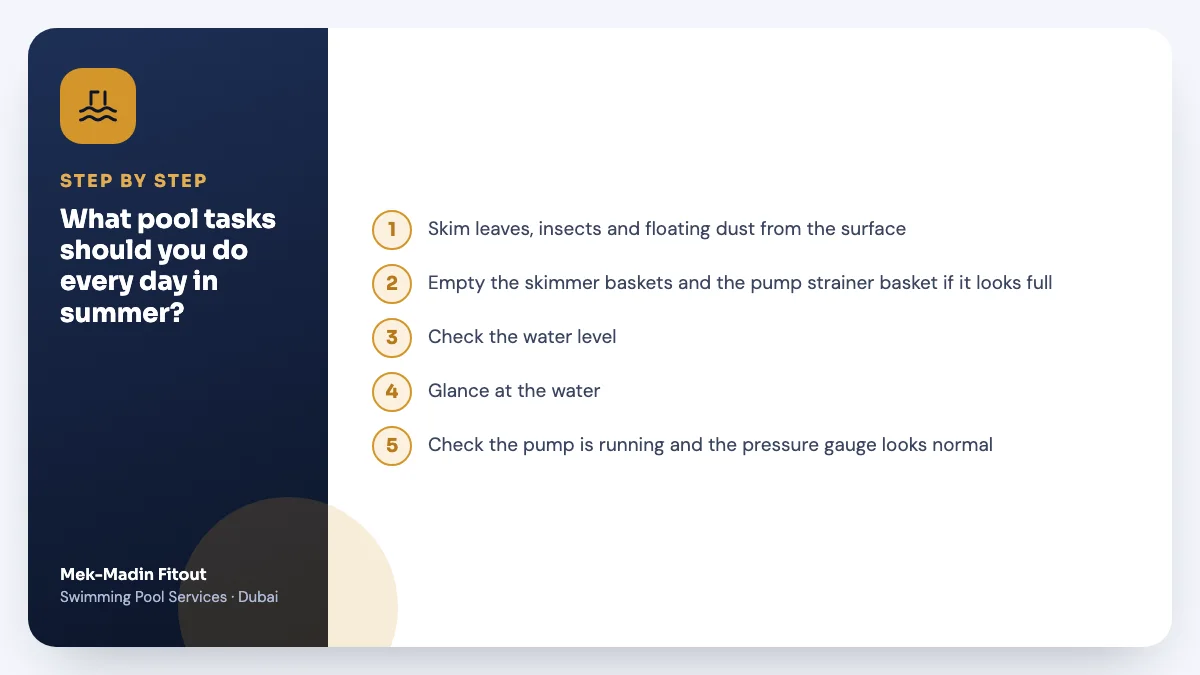
- Skim leaves, insects and floating dust from the surface.
- Empty the skimmer baskets and the pump strainer basket if it looks full.
- Check the water level. It should sit around the middle of the skimmer opening.
- Glance at the water. Cloudiness or a green tinge means test straight away.
- Check the pump is running and the pressure gauge looks normal.
What should you do twice a week to keep a pool clear?
Twice a week in summer, test free chlorine and pH and adjust them, correcting pH first because chlorine works better at the right pH. Brush the walls, steps and floor on the same days, paying attention to corners and lights, where circulation is weakest and early algae can take hold.
How should you test and adjust the water?
Test free chlorine and pH at least twice a week in summer. Test more often after parties, sandstorms or heavy rain. Adjust pH first, then chlorine, because chlorine works better at the right pH.
Why brush the walls, steps and floor?
Brushing loosens dust and early algae before they take hold. Pay attention to steps, corners, behind ladders and around lights, where circulation is weakest.
Which pool jobs need doing every week in summer?
Each week in summer, vacuum sand and debris off the pool floor, shock or oxidise the water at dusk to break down sweat and sunscreen, check the filter pressure gauge and backwash or rinse when needed, and test total alkalinity so it does not let pH swing.
Vacuum the pool
Vacuum sand and debris that has settled on the floor. In dusty weeks you may need to do this more than once.
When should you shock a pool in summer?
A weekly shock treatment breaks down sweat, sunscreen and other organic waste. Add it at dusk, so the sun does not burn it off before it works. Keep swimmers out for as long as the product label says.
When does a pool filter need backwashing?
Watch the pressure gauge. When pressure rises noticeably above its clean level, backwash a sand or glass filter, or rinse a cartridge filter. Summer dust can shorten the time between cleans.
How often should you test alkalinity?
Check total alkalinity once a week. Correct it before it lets pH swing up and down.
How should you spread deeper pool tasks across a month?
Spread the deeper summer pool tasks across a four-week cycle: a full water test in week one, an equipment check in week two, surfaces and tiles in week three, then surroundings and safety in week four. Some tasks do not need doing every week, and a cycle makes sure nothing is missed.
Week 1: full water test
Test all the readings in the table above, including calcium hardness and stabiliser. Take a sample to a pool shop if your kit does not cover everything.
Week 2: equipment check
Look at the pump, filter, valves and pipe joints for leaks, drips or unusual noise. On salt pools, inspect the cell for scale. Check that timers still match your summer run schedule.
Week 3: surfaces and tiles
Clean the waterline tiles to remove scale and sunscreen marks. Check grout, coping stones and the edge of the pool deck for cracks or loose tiles.
Week 4: surroundings and safety
Trim plants that drop leaves into the water. Check fencing, gates, covers and pool alarms. Review your chemical stock and store it somewhere shaded and ventilated.
How does summer pool care differ from winter?
Summer pool care in Dubai differs from winter mainly in frequency. Skimming moves from every few days to daily, testing from weekly to at least twice a week, and shock treatment from every two weeks to weekly. Pump runs are longer, and topping up happens several times a week rather than occasionally.
| Task | Summer (June–September) | Cooler months |
|---|---|---|
| Skimming and baskets | Daily | Every few days |
| Testing chlorine and pH | At least twice a week | Weekly |
| Brushing | Twice a week | Weekly |
| Shock treatment | Weekly | Every two weeks or as needed |
| Pump run time | Longer each day | Shorter |
| Topping up water | Several times a week | Occasionally |
How long should you run a pool pump in a Dubai summer?
Many Dubai pool owners run the pump longer in summer than in winter, because water needs to pass through the filter more often to stay clear in the heat and dust. Your pool size and pump will decide the right number of hours, so reset the timers at the start of summer.
Running the pump at night can make sense, because chlorine lasts longer without sun. Some Dubai villas also use pool chillers in summer, since the water can get uncomfortably warm. A chiller adds equipment to maintain, so include it in your monthly check.
How do you fix cloudy, green or scaly pool water in summer?
To fix cloudy, green or scaly pool water, start by testing and balancing the water, then brush, shock or backwash as needed. If the level is falling fast, compare it with a bucket test. Our guide to telling a pool leak from evaporation explains how to run one.
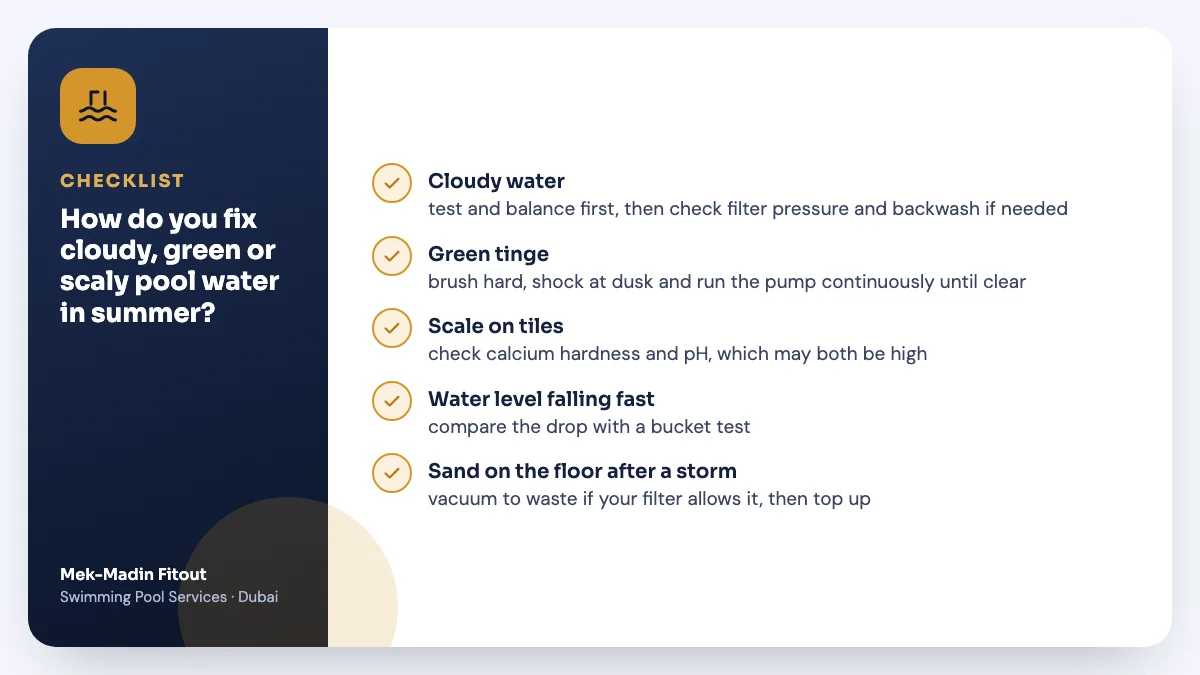
- Cloudy water: test and balance first, then check filter pressure and backwash if needed.
- Green tinge: brush hard, shock at dusk and run the pump continuously until clear. Our green pool recovery steps after a sandstorm go into more detail.
- Scale on tiles: check calcium hardness and pH, which may both be high.
- Water level falling fast: compare the drop with a bucket test. Losing more than normal evaporation may mean a leak.
- Sand on the floor after a storm: vacuum to waste if your filter allows it, then top up.
How do gardens affect pools in Dubai villa communities?
In communities such as Arabian Ranches and Dubai Hills Estate, many private pools sit close to gardens. Irrigation runoff, grass cuttings and fertiliser can upset water balance. Keep sprinklers aimed away from the pool, and check community rules on draining pool water before you empty or lower it.
When should you call a pool technician?
A regular summer pool routine handles most of the season in Dubai. Call in a pool technician if the water will not clear after balancing and shocking, if you suspect a leak, or if the pump, filter, chiller or chlorinator is not working properly.
Our swimming pool services cover regular maintenance visits, equipment repairs and leak checks across Dubai. Call or WhatsApp +971 52 884 8916, and we will confirm a visit time when you call.
FAQs
How often should I test pool water in a Dubai summer?
Test free chlorine and pH at least twice a week. Test more often after heavy use, sandstorms or rain. Check alkalinity weekly and do a full test, including calcium hardness and stabiliser, once a month.
Why does my pool lose chlorine so quickly in summer?
Sunlight breaks down chlorine, and warm water uses it up faster. Heavy swimming adds organic waste that consumes it too. Keeping stabiliser in the recommended range and dosing in the evening both help chlorine last longer.
Is it normal for my pool level to drop fast in summer?
Some loss is normal, as evaporation is high in Dubai's heat and wind. If the level drops much faster than usual, try a bucket test beside the pool. If the pool loses more than the bucket, a leak is likely.
Should I cover my pool in summer?
A cover reduces evaporation, keeps out dust and leaves, and cuts chemical use. In very hot months it can also warm the water further. Many owners use a cover when the pool is not in use and remove it during swimming hours.