
Low water pressure in a Dubai apartment usually comes from one of three places. If it is one tap, the cause is often a scaled aerator, shower head or cartridge; if it is the whole flat, look at a part-closed isolation valve, a blocked strainer or the pressure-reducing valve. If neighbours have it too, it is a building issue.
Working out which of these applies saves time and money. This guide walks you through the checks in order, from the simplest to the ones that need building management.
How do you tell if it is one tap, the whole flat or the building?
To tell whether low water pressure in a Dubai apartment affects one tap, the whole flat or the building, test every outlet before you change anything. Run the kitchen tap, each basin, each shower and the toilet cisterns, on both hot and cold, then ask a neighbour on your floor whether they have the same problem.
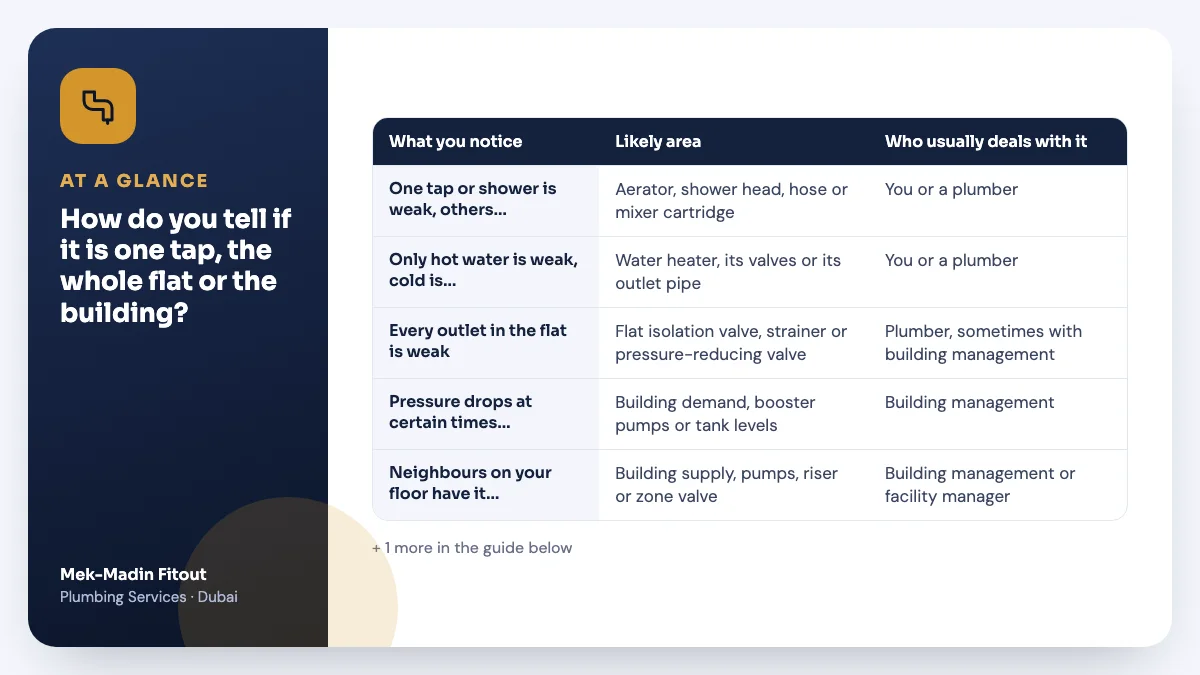
| What you notice | Likely area | Who usually deals with it |
|---|---|---|
| One tap or shower is weak, others are fine | Aerator, shower head, hose or mixer cartridge | You or a plumber |
| Only hot water is weak, cold is fine | Water heater, its valves or its outlet pipe | You or a plumber |
| Every outlet in the flat is weak | Flat isolation valve, strainer or pressure-reducing valve | Plumber, sometimes with building management |
| Pressure drops at certain times of day | Building demand, booster pumps or tank levels | Building management |
| Neighbours on your floor have it too | Building supply, pumps, riser or zone valve | Building management or facility manager |
| Water is off or dribbling across the building | Planned works, tank cleaning or a pump fault | Building management |
Asking a neighbour, or the building's concierge or security desk, can answer this in a few minutes.
Why is the pressure low at just one tap or shower?
Low pressure at just one tap or shower usually means something at that outlet is restricting the flow: a scaled aerator or shower head, a worn mixer cartridge, a kinked flexible hose or a blocked cistern fill valve. Dubai's mostly desalinated tap water still carries minerals that leave scale on fittings over time.
How do you clear scaled aerators and shower heads?
Dubai's tap water is mostly desalinated and treated. It still carries minerals that leave white scale on fittings over time. The small mesh aerator on a tap outlet and the holes in a shower head clog first.
Unscrew the aerator, rinse out any grit and soak it in white vinegar to loosen scale. Do the same with the shower head, or clean the holes with a soft brush. If the flow returns, you have found the cause.
Could the mixer cartridge or flexible hose be the problem?
If the aerator is clear, the problem may be inside the tap. Mixer taps use a cartridge that can scale up or wear. Flexible hoses under basins can kink or collapse inside, especially cheaper ones.
Why does a toilet cistern fill slowly?
A cistern that fills slowly usually has a blocked or scaled fill valve. The small filter at its inlet can also collect grit.
Why is only the hot water pressure low?
If cold water runs well but hot water is weak at several taps, the problem sits between the water heater and the outlets. Likely causes are a part-closed heater valve, scale and sediment in the heater or its outlet pipe, a faulty non-return valve or a failing mixing valve.
Common causes include:
- A part-closed valve on the heater's inlet or outlet
- Scale and sediment inside the heater or its outlet pipe
- A faulty non-return valve on the inlet
- A failing mixing valve, where one is fitted
Check that the valves near the heater are fully open. If that does not help, flushing or servicing the heater may be needed. Our guide on why water heaters fail early in Dubai explains scale and sediment in more detail.
Why does the whole flat have low water pressure?
Low water pressure across a whole Dubai flat usually comes from a part-closed isolation valve, a blocked strainer or filter on the incoming line, or a pressure-reducing valve (PRV) that is set too low, scaled up or failed. Any of these can cut pressure to every outlet, and a valve left part-closed after plumbing work is a common culprit.
Are the isolation valves fully open?
Most apartments have a main isolation valve for the flat. It is often in a utility cupboard, under the kitchen sink, near the heater or in a service shaft outside the door. Individual angle valves also sit under basins and behind toilets.
After any plumbing work, a valve can be left part-closed. Check each one is fully open. Turn gently, as old valves can stiffen or start to drip if forced.
Is a strainer or filter blocked?
Some flats have a Y-strainer or a filter on the incoming line. Grit and scale from the building supply collect there. A blocked strainer cuts pressure to every outlet.
If you have a whole-flat filter, check when the cartridge was last changed. A clogged cartridge has the same effect.
What does a pressure-reducing valve do?
In many towers, water is supplied in pressure zones, and each flat or floor may have a pressure-reducing valve (PRV). The PRV protects fittings from too much pressure. If it is set too low, has scaled up or has failed, the whole flat suffers.
Adjusting or replacing a PRV is a job for a plumber. In some buildings the PRV is part of the building's system, so check with building management before anyone touches it.
How can the building cause low pressure in a Dubai tower?
A Dubai tower can cause low pressure across many flats through failing or undersized booster pumps, gravity-fed floors near a roof tank, high demand at busy times such as early mornings, and planned works such as tank cleaning or pump servicing. If neighbours on your floor have the problem too, contact building management.
How do booster pumps and tanks affect pressure?
Towers store water in tanks and use pumps to move it to each floor. Upper floors often depend on booster pumps to keep pressure up. Floors close to a roof tank may get lower pressure if they rely on gravity alone.
A pump that is failing, switching off or undersized for the building's demand shows up as weak or uneven pressure. Pressure may also dip at busy times, such as early mornings.
Could planned works or tank cleaning be the cause?
Buildings shut off or reduce the supply for tank cleaning, pump servicing and repairs. Notices usually go up in the lobby, lifts or on a residents' app. If the drop is sudden and widespread, check for a notice first. In a villa, the tanks are usually the owner's job, as our guide on how often to clean a villa water tank explains.
Who should you contact about a building supply problem?
If several flats are affected, contact your building management or facility manager. In freehold towers this is usually the owners' association management company. Tenants can also tell their landlord or agent.
Give them the details: which floors, which times and whether hot, cold or both are affected. Towers in areas such as Business Bay often have a facility management desk that logs these reports.
It also helps to know where the utility's role stops. In a July 2023 notice to customers, DEWA said its responsibility "is limited to connections and maintenance until the meter only", while internal connections after the meter are the customer or owner's responsibility.
What quick checks can you do yourself today?
The low water pressure checks you can do yourself are simple: test every outlet, hot and cold, ask a neighbour, look for notices about water works, clean the aerators and shower heads, make sure the flat's main valve and the heater valves are fully open, and check any strainer or filter on the incoming line.
- Test every outlet, hot and cold, and write down which are weak.
- Ask a neighbour on your floor whether they have the same problem.
- Check the lobby or residents' app for notices about water works.
- Clean the aerators and shower heads on the weak outlets.
- Make sure the flat's main valve and the heater valves are fully open.
- Look for a strainer or filter on the incoming line and note its condition.
What should you avoid doing?
- Do not fit a booster pump to your flat's supply without written approval from building management
- Do not adjust valves in shared risers or corridors
- Do not force stiff valves, as they can snap or leak
When should you call a plumber about low water pressure?
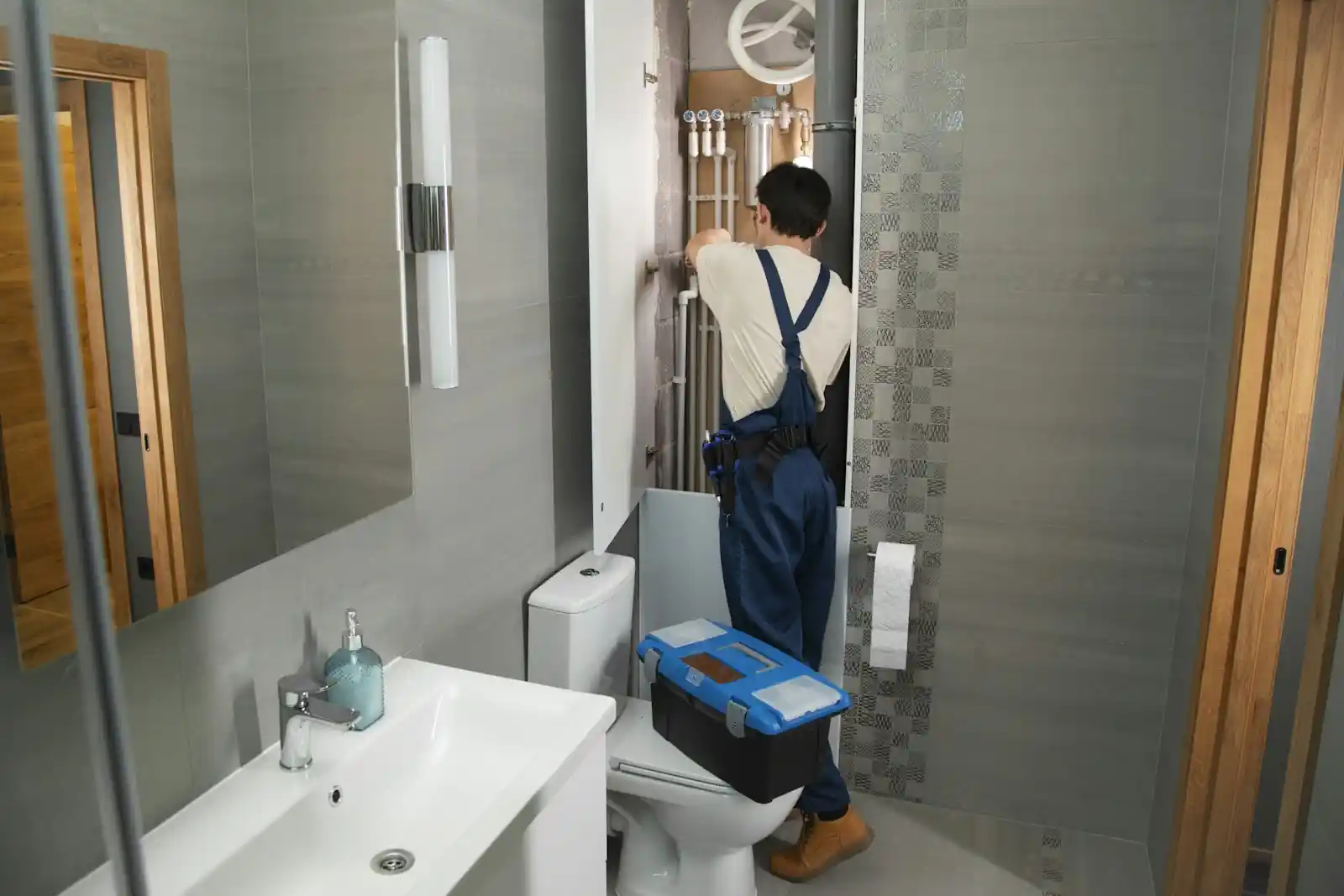
Call a plumber if cleaning aerators does not help, if the whole flat is weak but neighbours are fine, or if hot water stays weak after you check the valves. These point to cartridges, strainers, the PRV or the heater, which need tools and some care to work on.
Mek-Madin Fitout provides plumbing services across Dubai, including pressure problems, valve and cartridge replacement, and water heater servicing. If the issue turns out to be in the building's system, we will tell you so you can raise it with building management. Call or WhatsApp +971 52 884 8916, and we will confirm a visit time when you call.
FAQs
Why is my water pressure fine in the kitchen but weak in the shower?
That usually points to the shower itself. A scaled shower head, a kinked hose or a worn mixer cartridge are the common causes. Clean the head first, then check the hose and cartridge if the flow is still weak.
Can I install a booster pump in my apartment?
Not without permission, because in towers the supply is part of a shared system, and a private pump can affect neighbours and the building's equipment. Ask building management or your facility manager before planning one. Many pressure problems can be fixed without a pump.
Is low water pressure the landlord's responsibility?
It depends on the cause and your tenancy contract. Building-wide supply problems are usually for building management, while faults inside the flat, such as valves or heaters, are often the landlord's to repair. Basic cleaning of aerators may fall to the tenant, so check your contract and ask your landlord or agent.
Why did my pressure drop after a plumber visited?
A valve may have been left part-closed, or grit dislodged during the work may have blocked an aerator or strainer. Check the isolation valves are fully open and clean the aerators. If that does not fix it, ask the plumber to come back and check their work.