Most water heater problems in Dubai come down to scale, heat and constant use. Minerals coat the element, hot lofts and cupboards bake the controls, and many heaters stay on all year. Regular flushing, anode checks and a lower summer setting help an electric storage heater last longer.
This guide covers conventional electric storage heaters, often called geysers: what goes wrong, what you can safely check, and when to replace.
How does an electric storage water heater work?
A storage heater is an insulated steel tank with an element inside, switched on and off by a thermostat. A sacrificial anode rod corrodes slowly so the tank lining does not. A pressure and temperature relief valve releases water if pressure or heat climbs too high.
Why do water heaters wear out faster in Dubai?
Water heaters wear out faster in Dubai because dissolved minerals in the tap water form scale and sediment, villa lofts and cupboards bake the controls and seals in summer, many heaters stay switched on all year, and units hidden above false ceilings can leak unnoticed until the ceiling below stains.
Minerals and sediment
Dubai's tap water is mostly desalinated and treated before it reaches homes. It still carries dissolved minerals, which drop out as scale when heated. Water stored in roof tanks can also bring in fine sediment, which is one reason to clean a villa water tank regularly.
Scale makes the element run hotter and longer to heat the same water. Sediment settles at the bottom and traps heat against the steel.
High ambient heat
Villa lofts, roof spaces and enclosed cupboards get very hot in summer. Thermostats, wiring terminals and rubber seals age faster when heated from outside as well as inside.
Switched on all year
In many homes the heater is never turned off. It keeps reheating water nobody uses, and every cycle adds scale and wear.
Hidden locations
Apartment heaters often sit above a false ceiling, where a slow drip goes unnoticed until the ceiling stains. Older apartment buildings, such as many in Al Karama, often have heaters tucked into these tight spaces.
What are the most common water heater problems?
The most common water heater problems in Dubai homes are scale and sediment build-up, burnt-out elements, faulty thermostats, tripping breakers, leaking fittings or tanks, dripping relief valves, spent anode rods and rusty or smelly hot water. Many of these faults start with scale, which makes the element run hotter and longer.
Scale and sediment build-up
The heater takes longer to heat and runs out sooner. You may hear popping or rumbling as water boils under the sediment layer. Scale in the heater or its outlet pipe can also cause low hot water pressure in an apartment.
Why do heating elements fail?
Elements burn out, often because scale has made them overheat. The sign is no hot water, or water that only gets lukewarm.
Thermostat faults
A faulty thermostat may not switch the element on, giving cold water. Or it may not switch off, so the water gets far too hot.
Why does the water heater breaker keep tripping?
If the heater's breaker or earth leakage switch trips, water may be reaching the electrics. A cracked element or damp terminal is a common cause.
Leaking tank or fittings
Leaks at connections, valves or hoses can usually be repaired. Once the tank body itself has corroded through, it cannot be reliably fixed.
Why is the relief valve dripping?
An occasional drip may be the valve doing its job. A steady drip suggests high incoming pressure, overheating, or a valve seat clogged with scale.
Corroded anode rod
Many units are never opened after fitting, so the anode is forgotten. Once it is used up, the tank starts to corrode instead.
What causes rusty or smelly hot water?
Brown hot water can mean the anode is spent and the tank is rusting. A rotten-egg smell usually comes from a reaction between the anode and bacteria in water that sits warm for long periods.
What does each water heater symptom mean?
No hot water usually points to the element, thermostat or breaker, while noises, rust and smells point to sediment, a spent anode or a corroding tank. Hot water that runs out quickly suggests scale or a failing element, and a relief valve that drips constantly suggests high pressure, overheating or a scaled valve.
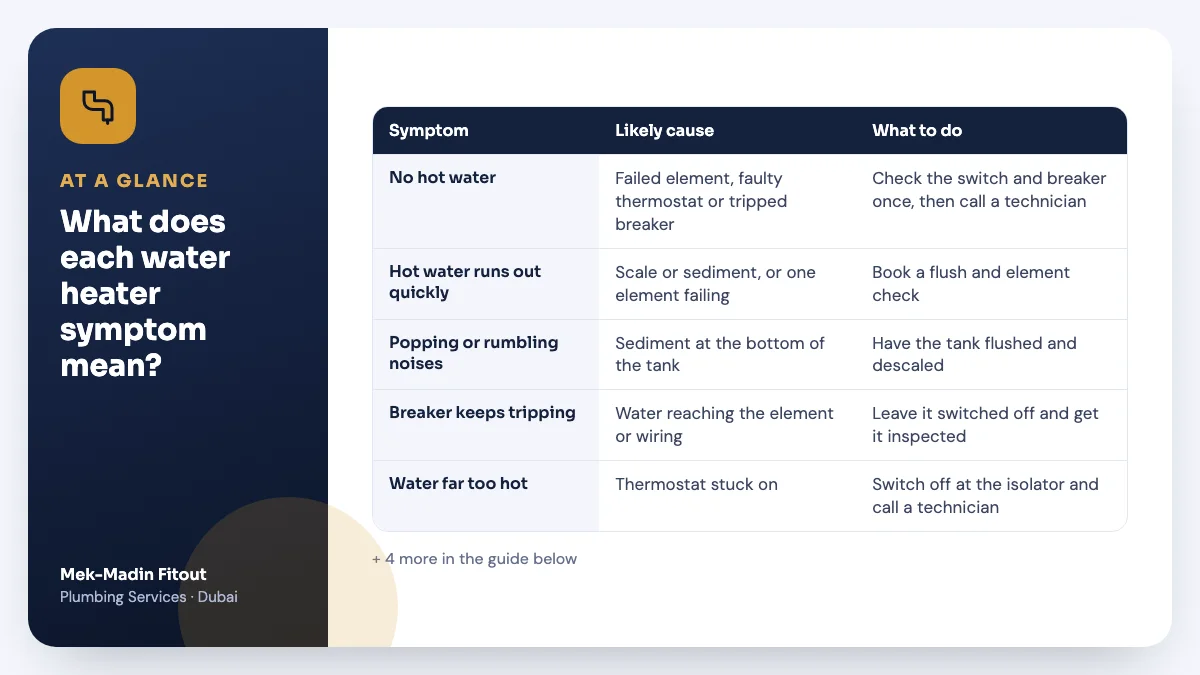
| Symptom | Likely cause | What to do |
|---|---|---|
| No hot water | Failed element, faulty thermostat or tripped breaker | Check the switch and breaker once, then call a technician |
| Hot water runs out quickly | Scale or sediment, or one element failing | Book a flush and element check |
| Popping or rumbling noises | Sediment at the bottom of the tank | Have the tank flushed and descaled |
| Breaker keeps tripping | Water reaching the element or wiring | Leave it switched off and get it inspected |
| Water far too hot | Thermostat stuck on | Switch off at the isolator and call a technician |
| Relief valve dripping constantly | High pressure, overheating or a scaled valve | Get the valve and pressure checked |
| Water dripping from the casing | Fitting leak or tank corrosion | Isolate power and water, then call a plumber |
| Rusty or brown hot water | Spent anode or corroding tank | Have the anode and tank inspected |
| Rotten-egg smell | Anode reaction with bacteria in the water | Flush the tank and review the anode type |
How do you know a water heater is about to fail?
The main warning signs that a water heater is about to fail are slow heating, hot water running out mid-shower, popping or banging noises, rust, bulging or damp on the casing, a relief valve that drips most of the time, a breaker that trips more than once, and discoloured or smelly water.
- It takes longer to heat, or runs out mid-shower.
- It pops or bangs while heating.
- There is rust, bulging or damp on the casing.
- The relief valve drips most of the time.
- The breaker trips more than once.
- The hot water is discoloured or smells.
What water heater checks can you safely do yourself?
With the heater switched off at its isolator and breaker, you can safely look for water under it and on the ceiling below, check the casing for rust or scorch marks, reset a tripped breaker once and watch the relief valve outlet. Anything involving the element, thermostat, wiring or tank needs a technician.
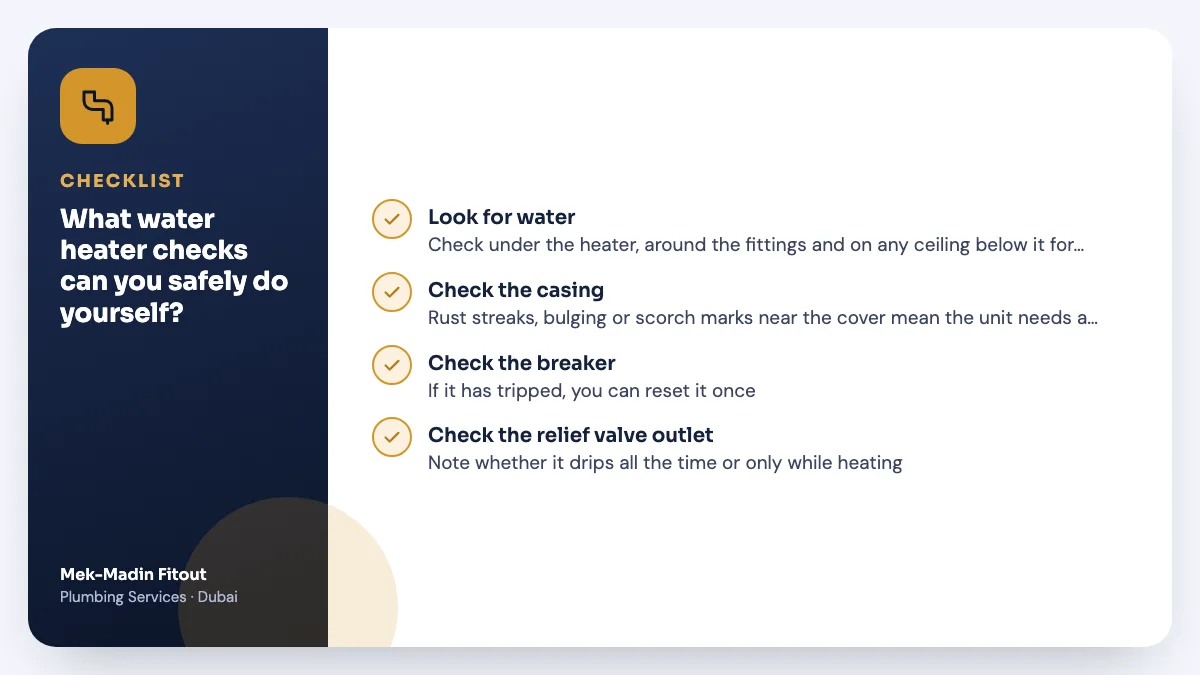
With the power off, these checks are safe:
- Look for water. Check under the heater, around the fittings and on any ceiling below it for stains or drips.
- Check the casing. Rust streaks, bulging or scorch marks near the cover mean the unit needs a professional.
- Check the breaker. If it has tripped, you can reset it once. If it trips again, leave it off.
- Check the relief valve outlet. Note whether it drips all the time or only while heating.
Anything involving the element, thermostat, wiring or tank needs a trained technician. Hot water under pressure can scald.
How do you maintain a water heater so it lasts longer?
To make a water heater last longer in Dubai, check it visually every few months for drips, rust and ceiling stains. Then have a professional periodically flush and descale the tank, inspect the anode rod, test the relief valve and check fittings and hoses, replacing worn parts before they cause water damage.
- Visual check every few months. Look for drips, rust and ceiling stains as described above.
- Flush the tank periodically. A professional drains it to clear sediment and descales it. Homes with heavy scale on taps benefit from more frequent flushing.
- Inspect the anode rod. Have it checked during a flush and replaced when worn.
- Test the relief valve. A technician confirms it opens and reseats, and that the discharge pipe runs somewhere safe.
- Check fittings and hoses. Replacing worn hoses early is far easier than repairing water damage.
Follow the manufacturer's manual for intervals, as they vary between models.
Should you turn the water heater down in summer?
Turning a water heater down in summer usually makes sense in Dubai. From late spring to early autumn, the cold supply in many Dubai homes already runs warm. Turning the thermostat down, or adding a timer, cuts heating cycles and can help lower your DEWA bill.
Do not set it too low for long periods. Many manufacturers advise keeping stored water hot enough to limit bacteria growth, so check your manual first. If you switch the heater off while travelling, run the hot taps for a few minutes once it has reheated.
Should you repair or replace a water heater?
Repairing a water heater usually makes sense when the tank itself is sound, because elements, thermostats, relief valves, anodes and fittings are normal service parts. Replacement is usually better when the tank leaks or is visibly corroded, rusty water persists after a new anode, faults keep returning, or the unit is old, unserviced or the wrong size.
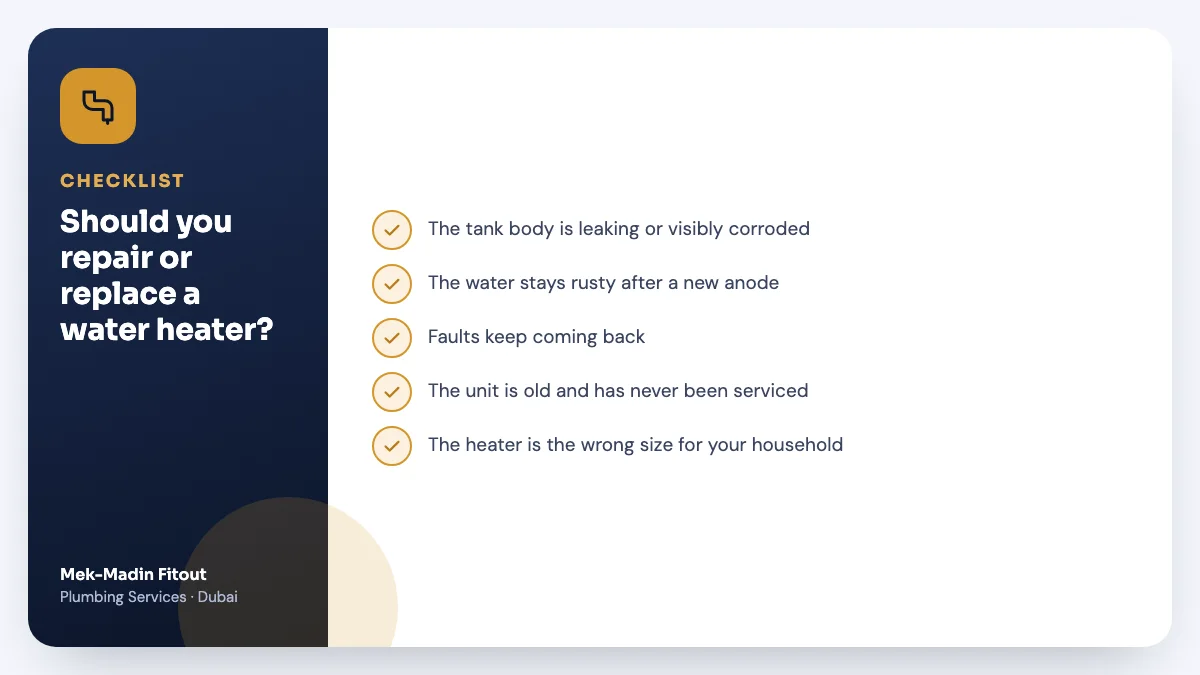
Replacement is usually the better choice when:
- The tank body is leaking or visibly corroded.
- The water stays rusty after a new anode.
- Faults keep coming back.
- The unit is old and has never been serviced.
- The heater is the wrong size for your household.
If you own a villa and are replacing heaters anyway, it is worth reading whether a solar water heater is worth it in Dubai before you decide. For new builds and extensions, our guide to Dubai's green building rules on solar hot water explains how the requirements usually apply.
For new buildings, Al Sa'fat, the Dubai Green Building System, says hot water systems "shall be configured utilizing a sustainable hot water heating technology, such as solar hot water", with some exceptions, and that "all hot water storage vessels and distribution pipework shall be insulated".
When should you call a water heater technician?
Call a water heater technician for anything beyond a visual check, including no hot water, a tripping breaker, overheated water, a constant relief valve drip, rusty water or any leak. Act quickly with apartment heaters above false ceilings, because leaks there can soon stain the ceiling and damage the flat below.
Our plumbing services in Dubai include water heater repair, flushing, descaling, anode and valve replacement, and full replacement when needed. Call or WhatsApp +971 52 884 8916 with a photo of the heater and its label, and we will confirm a visit time.
FAQs
Is it safe to leave my water heater on all the time?
A working heater with a sound thermostat and relief valve is designed to stay on. In Dubai, though, many households do not need it on all day, especially in summer. A timer or lower setting reduces wear and wasted electricity.
Why is my hot water brown?
Brown hot water often means the anode is used up and the tank is rusting, though old galvanised pipes can cause it too. If only the hot tap is affected, the heater is the likely source.
Who is responsible for the water heater in a rented flat?
It depends on your tenancy contract and the cause of the fault. Many landlords cover repairs from normal wear, while damage from misuse may fall to the tenant. Check your contract and tell your landlord or property manager as soon as a problem appears.