A solar water heater is usually worth it in Dubai for villas and townhouses with a sunny, unshaded roof and steady hot water use. Strong year-round sun means the sun does most of the heating. It is rarely practical for individual apartments, and the payback depends on your household's usage, your system and your electricity bill.
The rest of this guide explains how these systems work, where they fit best, and the questions to ask before you decide.
How does a solar water heater work?
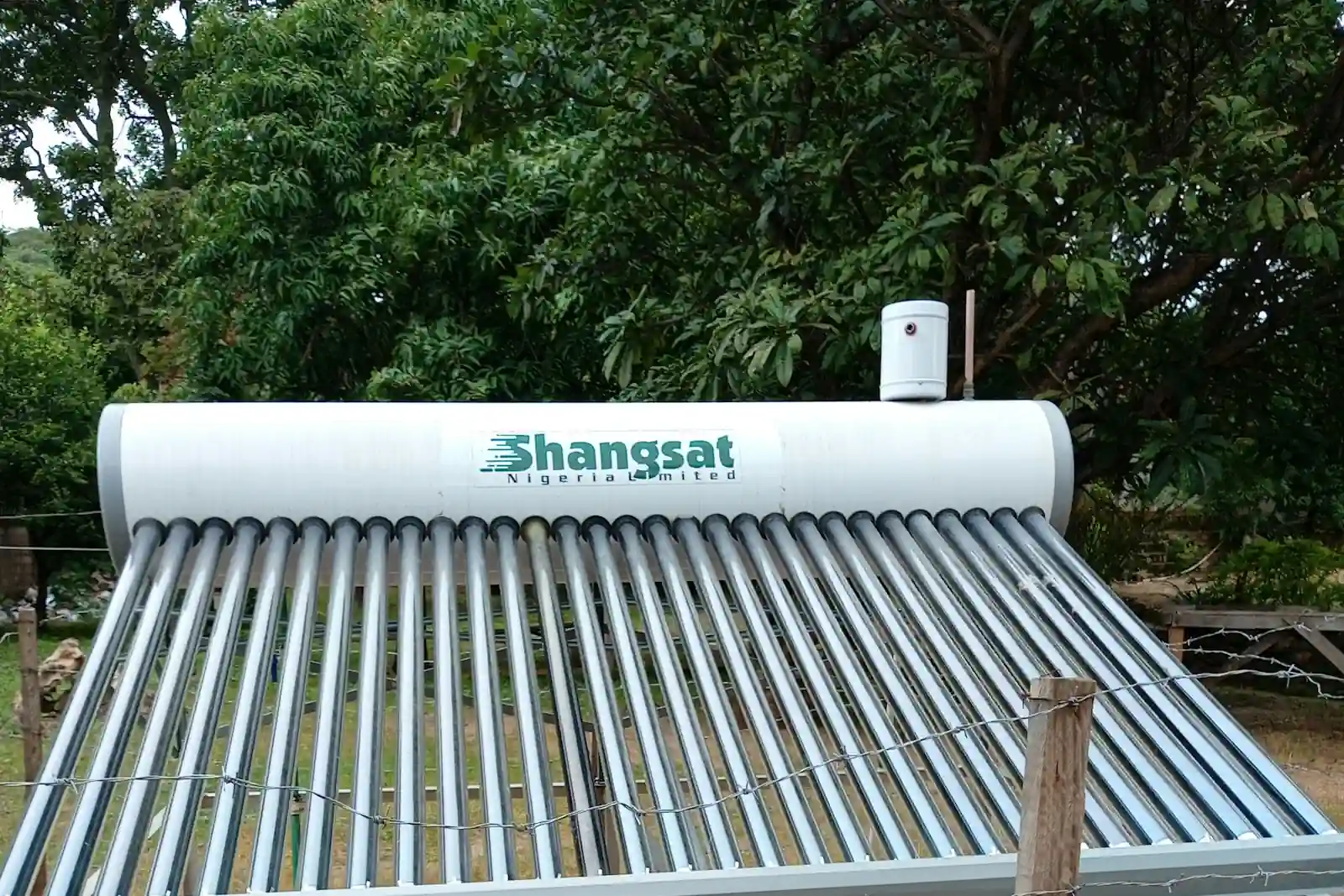
A solar water heater uses collectors on the roof to absorb heat from the sun. That heat warms water, which is stored in an insulated tank until you need it. Most systems also have an electric backup element for cloudy days or heavy use.
There are two main collector types and two main ways of moving the water.
What are flat-plate collectors?
These are flat, glazed panels with a dark absorber plate inside. They are simple, robust and easy to clean. They work well in a sunny climate like Dubai's.
What are evacuated-tube collectors?
These use rows of glass tubes with a vacuum layer that reduces heat loss. They hold heat well in cooler weather. In Dubai's summer they can overheat the water, so the system needs good temperature control.
Should you choose a thermosiphon or a pumped system?
In a thermosiphon system, the tank sits above the collectors on the roof. Hot water rises naturally into the tank, so no pump is needed. In a pumped (forced circulation) system, the tank can sit indoors or in a plant room, and a small pump moves the water.
Thermosiphon units are simpler. Pumped systems give more freedom over where the tank goes, but add a pump and controller to maintain.
Why does Dubai's climate suit solar water heating?
Dubai's climate suits solar water heating because the city gets long, clear days for most of the year, which makes solar collectors productive in every season, not only in summer. The real benefit shows in the cooler months, when people want hot showers and electric heaters work hardest, as summer mains water is often already warm.
In the hottest months, though, mains cold water is often already warm, especially where tanks sit on the roof. Many households need little heated water from June to September. The real benefit shows in the cooler months, when people want hot showers and electric heaters work hardest. Hot rooftop tanks also need more frequent cleaning, as our guide on villa water tank cleaning explains.
How does solar compare with electric and heat pump water heaters?
A solar water heater with electric backup takes most of its running energy from the sun, while an electric storage heater runs entirely on electricity and a heat pump uses electricity efficiently. Solar costs more upfront and needs roof space, so it best suits Dubai villas and townhouses with open roofs.
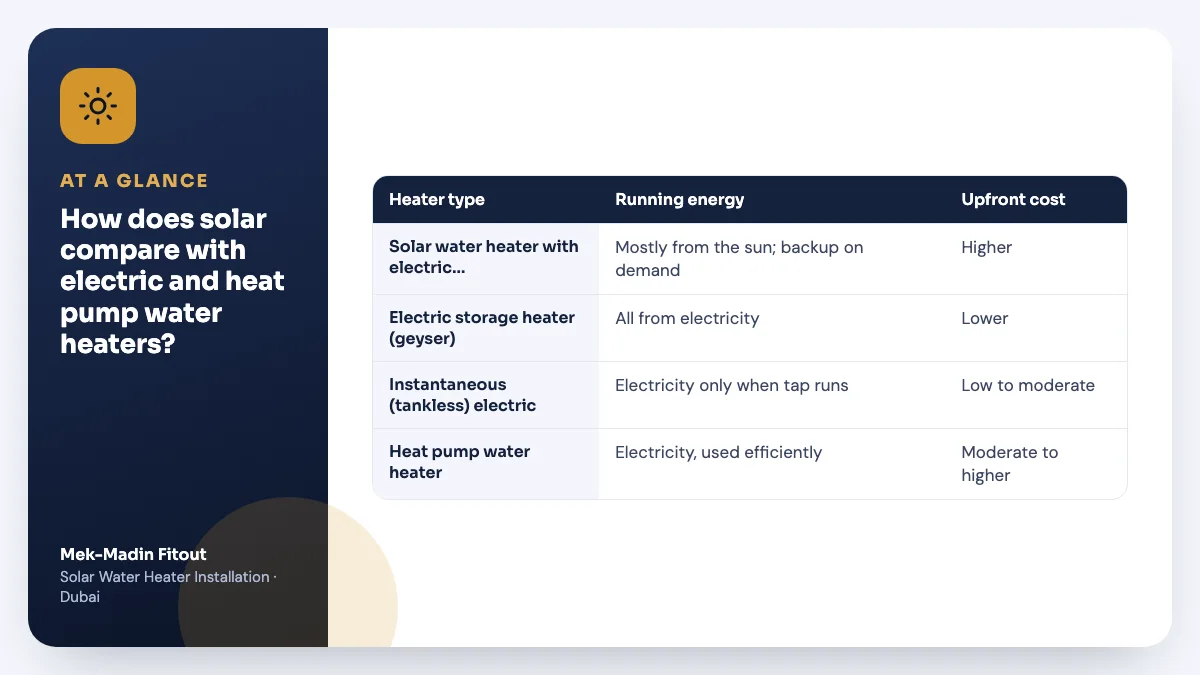
| Heater type | Running energy | Upfront cost | Space needed | Best fit |
|---|---|---|---|---|
| Solar water heater with electric backup | Mostly from the sun; backup on demand | Higher | Roof collectors plus tank | Villas and townhouses with open roofs |
| Electric storage heater (geyser) | All from electricity | Lower | Tank indoors or in a loft | Apartments, small households |
| Instantaneous (tankless) electric | Electricity only when tap runs | Low to moderate | Small wall unit | Single basins or kitchens |
| Heat pump water heater | Electricity, used efficiently | Moderate to higher | Unit with airflow plus tank | Homes without good roof access |
The table compares typical patterns, not exact figures. Running costs depend on your usage, system size, tank insulation and electricity tariff.
When is a solar water heater worth it in Dubai?
A solar water heater is most likely to pay off in Dubai in a villa or townhouse with a sunny roof, a household that uses a lot of hot water, old or always-on electric heaters, and owners who plan to stay for several years. Tenants also need the landlord's agreement before any installation.
A system is more likely to pay off when most of these are true:
- You live in a villa or townhouse with roof space that gets direct sun for most of the day.
- The household is large, or uses a lot of hot water for showers, laundry or a kitchen.
- Your current electric heaters are old, oversized or on all the time.
- You plan to stay in the property for several years.
- You own the property, or your landlord agrees to the installation.
DEWA bills residential electricity in consumption bands, so cutting usage tends to matter more for higher-consumption homes. Check your own bills to see how much water heating might contribute.
DEWA's slab tariff page explains that the price "increases progressively with the increase of electricity and water consumption". For residential electricity, the published rate rises from 0.230 D/kWh for 0 to 2000 kWh a month to 0.380 D/kWh above 6000 kWh, with a fuel surcharge and VAT on top.
When is solar water heating probably not worth it?
Solar water heating is usually not worth it in Dubai apartments, where most towers do not allow individual roof collectors, on roofs shaded by buildings or trees, for households that use little hot water, or if you plan to move soon and would not see the benefit.
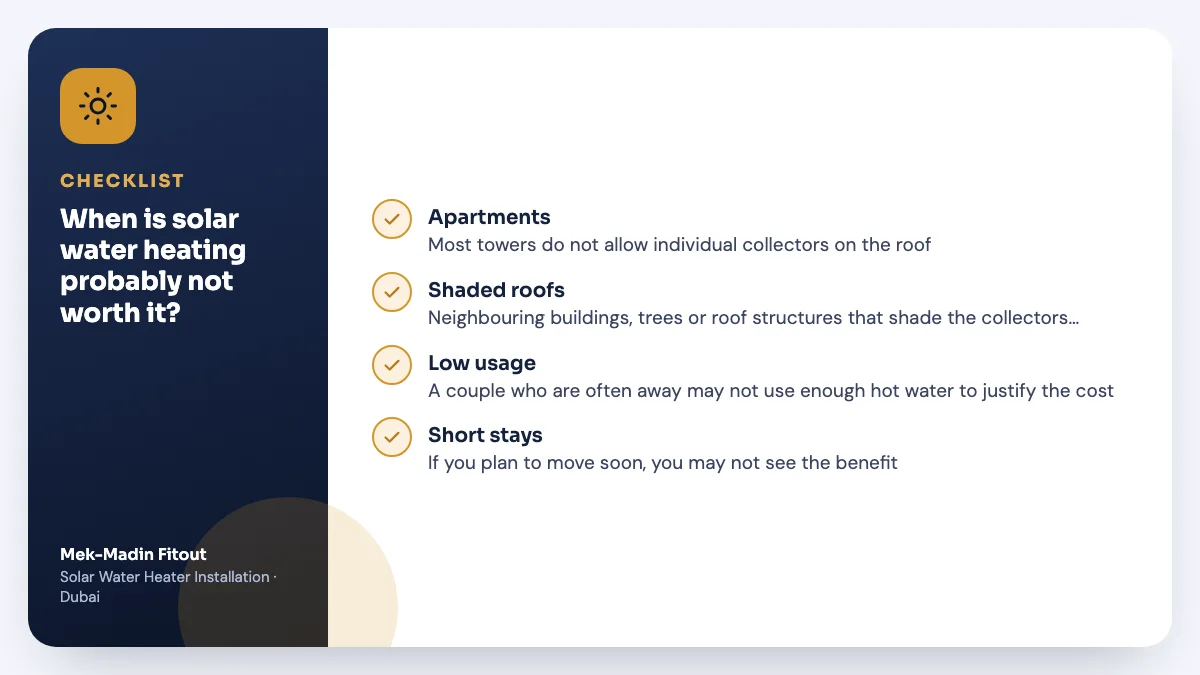
- Apartments. Most towers do not allow individual collectors on the roof. Some buildings have central hot water systems already.
- Shaded roofs. Neighbouring buildings, trees or roof structures that shade the collectors reduce output.
- Low usage. A couple who are often away may not use enough hot water to justify the cost.
- Short stays. If you plan to move soon, you may not see the benefit.
What Dubai rules apply to solar water heaters?
Dubai's green building regulations require solar water heating in certain types of new buildings. Requirements depend on the building type, size and when the permit was issued. They are mainly a matter for developers and consultants on new projects. Our guide to solar water heating rules for new villas explains how they work in practice.
Dubai Municipality's Al Sa'fat green building system (2nd edition, January 2023) says hot water systems "shall be configured utilizing a sustainable hot water heating technology, such as solar hot water", except where that would be impractical or where point-of-use electric heaters would be more energy-efficient. Where a solar system is used, the designer "shall target 75% of the total hot water daily demand" from it.
For an existing villa, the bigger question is usually community approval. Many master developers and community managers control roof equipment, its height and how visible it is from the street. Confirm the current requirements with Dubai Municipality, DEWA, your master developer or community management before you buy.
What upkeep does a solar water heater need in Dubai?
A solar water heater in Dubai needs its collectors kept free of dust, with a rinse every few weeks and after sandstorms, a thermostatic mixing valve to prevent scalding, a periodic flush and anode check to limit scale and corrosion, and an electric backup set to run only when needed.
How does dust affect solar collectors?
Dust on the glass cuts the amount of sun reaching the absorber. Rinsing the collectors with water every few weeks, and after sandstorms, keeps output up. Avoid abrasive pads that scratch the glazing.
How do you stop solar-heated water from scalding?
In summer, stored water can get very hot. A thermostatic mixing valve blends it with cold water before it reaches the taps. This is an important safety feature, especially in homes with children or elderly relatives.
How do you limit scale and corrosion?
Heated water can leave scale in tanks and collectors over time. A periodic flush, plus checking the anode rod in the tank, helps the system last. Our guide to electric water heater faults in Dubai explains what happens when an anode is used up. Follow the manufacturer's service schedule.
How should the electric backup be set?
Many owners leave the electric backup on all day, which wastes the solar gain. A timer or thermostat that runs the backup only when needed, often in the evening, makes better use of the sun.
What should you ask before buying a solar water heater?
Before buying a solar water heater in Dubai, ask whether your community allows roof-mounted collectors, whether the roof can take a full tank and where pipes will run, which collector type and tank size suit you, whether safety valves and a backup timer are included, how roof penetrations will be sealed and what servicing involves.
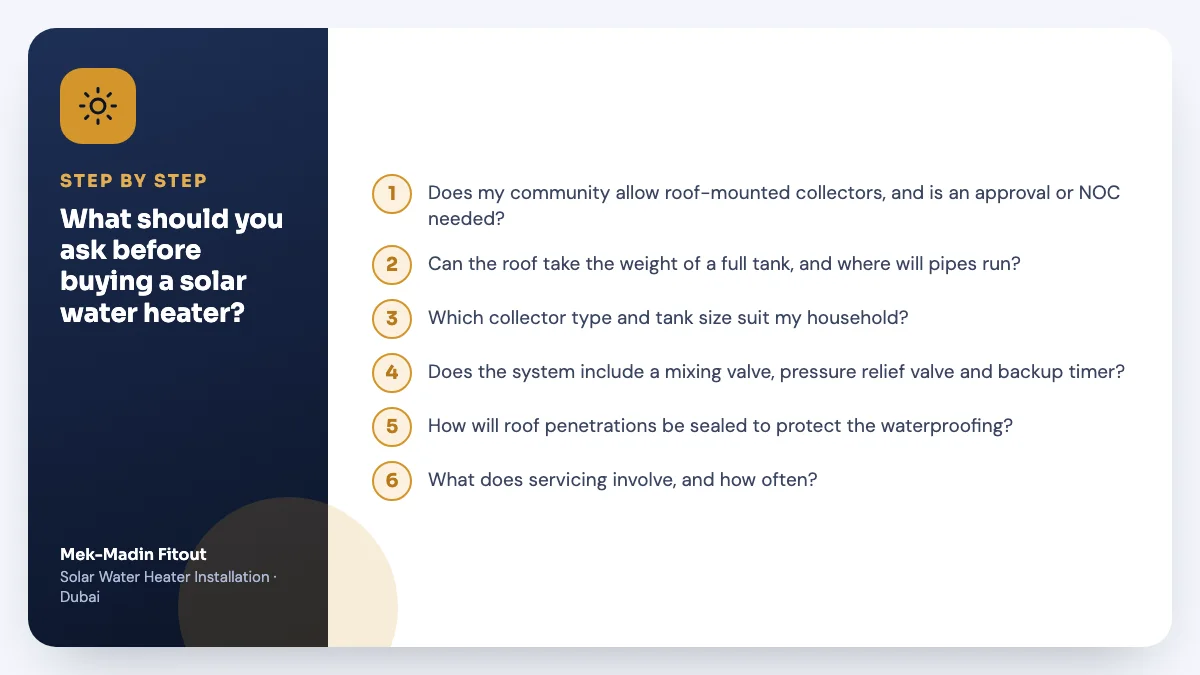
- Does my community allow roof-mounted collectors, and is an approval or NOC needed?
- Can the roof take the weight of a full tank, and where will pipes run?
- Which collector type and tank size suit my household?
- Does the system include a mixing valve, pressure relief valve and backup timer?
- How will roof penetrations be sealed to protect the waterproofing?
- What does servicing involve, and how often?
When should you get a professional to assess a solar installation?
Installing a solar water heater involves roof work, plumbing, electrical connections for the backup element and sometimes structural checks. Mistakes can cause leaks, scalding water or damaged waterproofing. It is worth having the roof, plumbing layout and approvals checked before you commit.
We offer solar water heater installation in Dubai, from assessing roof space to fitting and commissioning. If your existing pipes or heaters need work first, our plumbing services cover that too. Call or WhatsApp +971 52 884 8916 and we will confirm a visit time.
FAQs
Will a solar water heater work in a Dubai winter?
Yes. Dubai's winter days are usually sunny, so collectors still heat water well. Shorter days and higher demand mean the electric backup may switch on more often, especially on cloudy days or after heavy evening use.
Can I install a solar water heater in an apartment?
Usually not. Most towers do not allow residents to place equipment on the roof, and pipe runs to individual flats are difficult. Ask your building management whether a central system exists or is planned.
How much roof space does a solar water heater need?
It depends on the collector type and tank size. A typical household system needs room for one or two collectors, the tank if it is roof-mounted, and access for cleaning. A site survey will confirm what fits.
Do I still need an electric water heater?
Most solar systems include an electric backup element inside the tank. That covers cloudy days and peak demand. Some owners keep a separate small heater for a distant bathroom where hot water would take long to arrive.