

Before you hand back the keys in Dubai, fix damage you or your household caused, return the property to the condition recorded at move-in, and clean it thoroughly. Normal wear and tear is usually not your cost. Check your tenancy contract for clauses on painting and deep cleaning, as these often decide deposit deductions.
Getting this right can save a lot of back-and-forth with your landlord. This guide covers what to check, what to fix and how to handle disagreements. It is general guidance, not legal advice.
How does the security deposit work when you move out in Dubai?
When you sign a tenancy in Dubai, you normally pay a security deposit to the landlord or their agent. At the end of the tenancy, the landlord inspects the property. If everything is in order, the security deposit is returned, and normal wear and tear is usually not the tenant's cost.
If there is damage beyond normal use, the landlord may deduct the cost of repairs. The terms of your tenancy contract matter here. Read it again before you start packing, especially any clauses about painting, cleaning, AC servicing or the condition the property must be returned in. For repairs during the tenancy itself, our guide on who pays for repairs, tenant or landlord explains how costs are commonly split.
Dubai's tenancy law describes the deposit in the same terms. Article 20 of Law No. (26) of 2007 regulating the relationship between landlords and tenants in Dubai says the landlord may take a security deposit "to ensure maintenance of the Real Property upon the expiry of the Lease Contract", and must refund the deposit "or remainder thereof" when the lease ends.
What counts as wear and tear, and what counts as damage?
In a Dubai tenancy, "wear and tear" means the gradual decline that happens through normal living, such as light scuffs or slightly faded paint, while "damage" is harm caused by accident, misuse or neglect, such as holes, burns or chipped tiles. The difference between the two is where most deposit disputes start.
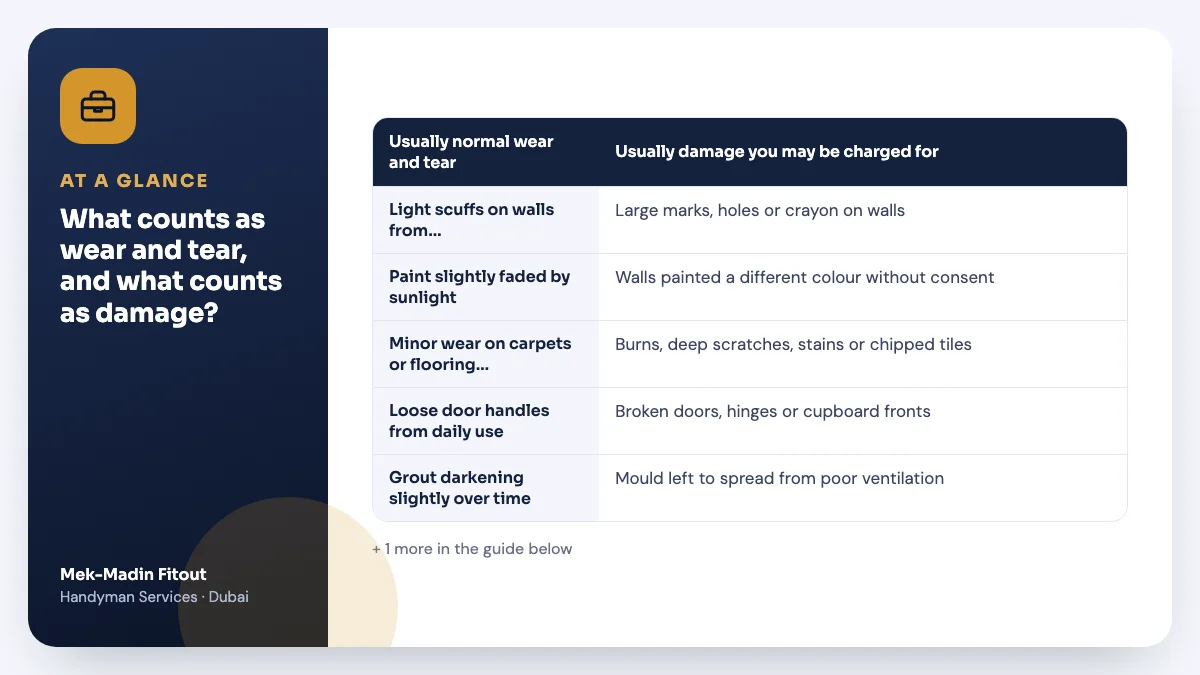
| Usually normal wear and tear | Usually damage you may be charged for |
|---|---|
| Light scuffs on walls from furniture | Large marks, holes or crayon on walls |
| Paint slightly faded by sunlight | Walls painted a different colour without consent |
| Minor wear on carpets or flooring in walkways | Burns, deep scratches, stains or chipped tiles |
| Loose door handles from daily use | Broken doors, hinges or cupboard fronts |
| Grout darkening slightly over time | Mould left to spread from poor ventilation |
| Ageing fittings that still work | Missing items listed in the inventory |
The line is not always clear. The longer you have lived there, the more wear is reasonable. Your move-in inspection report and photos are the best evidence of how things started.
The law draws the same line. Article 21 of Law No. (26) of 2007 says that when the lease expires, the tenant must hand the property back "in the same condition in which the Tenant received it", except for "ordinary wear and tear or for damage due to reasons beyond the Tenant's control".
How do you use your move-in report before moving out?
Before moving out of a Dubai rental, find the inventory or check-in report you received when you moved in, plus any photos or videos you took at the time. Compare each room with how it looked then, because the move-in report is the best evidence of the condition you need to return.
If you never received a report, your own dated photos are still useful. From now on, take clear photos of every room before and after your repairs. Date-stamped images help if there is a disagreement later. Holiday home hosts use the same habit at every turnover, as our holiday home maintenance checklist for Dubai shows.
What should you repair before moving out, room by room?
Before moving out of a Dubai rental, go through the walls and ceilings, doors and windows, kitchen, bathrooms, electrics, air conditioning and any outdoor areas, fixing what you can. Typical jobs include filling holes, tightening handles and hinges, replacing split silicone, clearing slow drains, replacing blown bulbs and cleaning AC filters.
TV brackets on partition walls often use cavity fixings, and our guide on mounting a TV on a gypsum wall explains how these are fitted and what they leave behind.
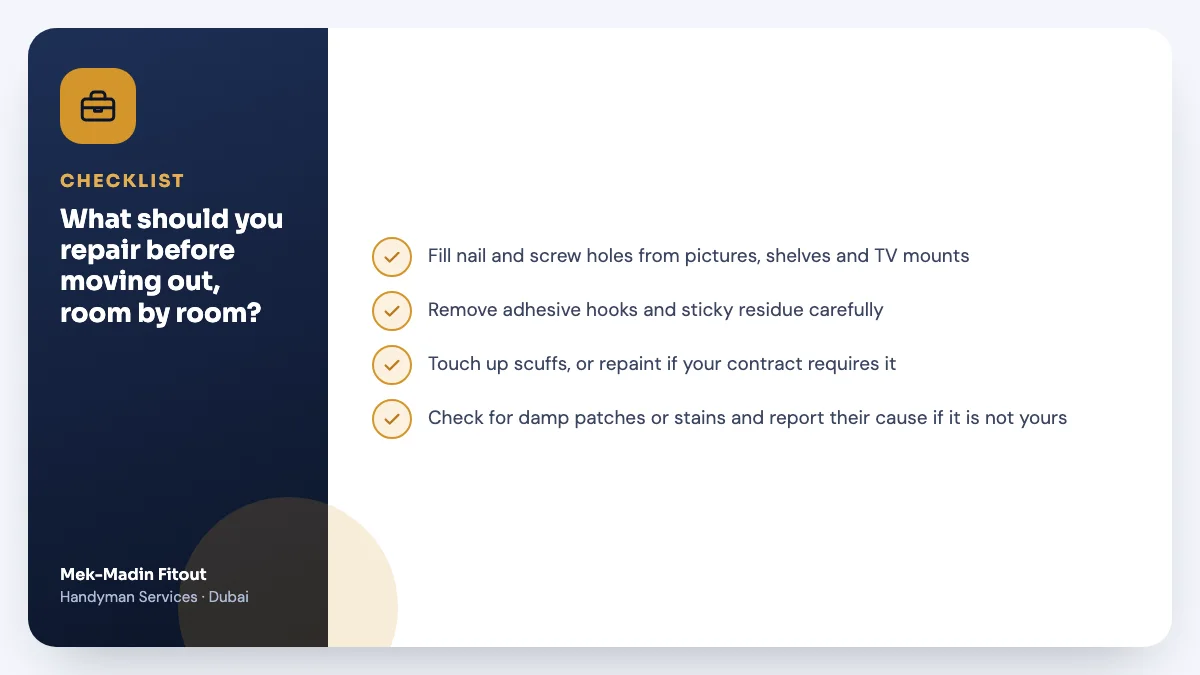
Work through each room with this list. Fix what you can, and note anything you are unsure about.
Walls and ceilings
- Fill nail and screw holes from pictures, shelves and TV mounts
- Remove adhesive hooks and sticky residue carefully
- Touch up scuffs, or repaint if your contract requires it
- Check for damp patches or stains and report their cause if it is not yours
Doors, windows and joinery
- Tighten loose handles, hinges and cupboard doors
- Make sure every door closes and locks properly
- Check sliding doors and wardrobe runners move smoothly (our guide to fixing a sliding door that won't close covers tracks and rollers)
- Replace broken blinds or curtain fittings that were supplied with the property
Kitchen
- Clean the oven, hob, extractor hood and filter
- Check the sink drains freely and the tap does not drip
- Wipe and degrease cabinet fronts and inside drawers
- Make sure supplied appliances work and are clean inside
Bathrooms
- Clean limescale from taps, shower heads and glass screens
- Check silicone around baths, basins and showers; replace if mouldy or split
- Make sure toilets flush properly and do not run on
- Clear hair from drains and check for slow drainage
Electrical and lighting
- Replace blown bulbs, including in extractor hoods and fridges
- Check all switches and sockets work
- Do not leave any of your own fittings that were not there before, unless agreed
Air conditioning
- Clean or replace AC filters
- Check your contract to see if a final AC service is required, and keep the receipt if so
Outdoor areas (villas and townhouses)
- Clear the garden, terrace and balcony of rubbish
- Return planting to the condition agreed in the contract
- Check gates, outdoor lights and garage doors work
Why does painting cause so many deposit deductions?
Painting is one of the most common deposit deductions in Dubai, because some tenancy contracts say the tenant must repaint before leaving. Other contracts say nothing, and normal fading would then usually count as wear and tear, although holes, heavy marks or colour changes may still be charged.
If your contract does require painting, use a matching colour and finish. A patchy job can lead to a deduction anyway. If you changed a wall colour during the tenancy, you will usually need to return it to the original colour. Our guide on how often to repaint a Dubai apartment explains when touch-ups show and when repainting the whole wall gives a more even result.
What admin do you need to finish before leaving a Dubai rental?
Before you leave a Dubai rental, close the Ejari registration, settle your DEWA final bill, close any district cooling or gas account, book the service lift with building management and return every key and access card. A DEWA clearance or final bill is often needed before the deposit is released.
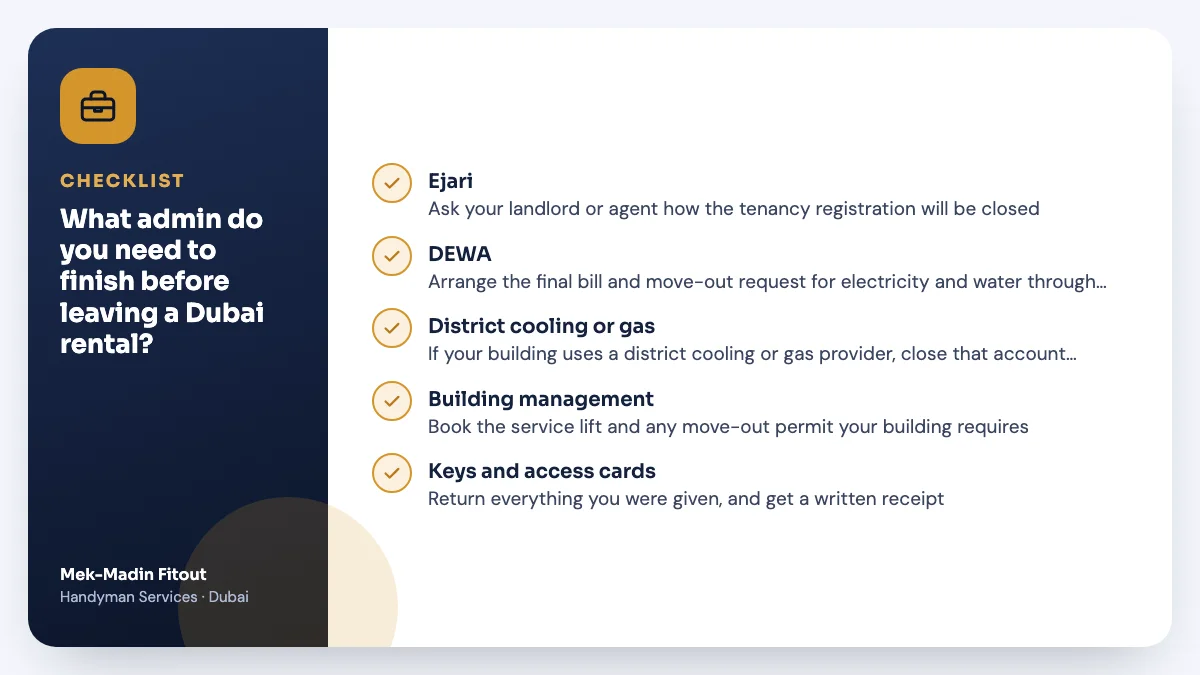
Repairs are only part of moving out. A few admin steps also need doing. Requirements can change, so confirm the current process with your landlord, agent or the relevant authority:
- Ejari. Ask your landlord or agent how the tenancy registration will be closed. Dubai Land Department runs Ejari and can confirm the process.
- DEWA. Arrange the final bill and move-out request for electricity and water through DEWA. A clearance or final bill is often needed before the deposit is released.
- District cooling or gas. If your building uses a district cooling or gas provider, close that account too.
- Building management. Book the service lift and any move-out permit your building requires.
- Keys and access cards. Return everything you were given, and get a written receipt.
What happens at the final inspection?
At the final move-out inspection, you walk through each room with the landlord or agent and agree on anything that needs attention, so try to be present. Ask for the outcome in writing, and if the landlord wants to make deductions, ask for an itemised list with quotes or invoices.
An itemised list keeps the conversation factual.
What can you do if you disagree with deposit deductions?
Most deposit disputes in Dubai are settled by talking calmly and sharing evidence. Show your move-in report, your photos and any receipts for work you had done, and offer to fix small items rather than having them charged. If you still cannot agree, the Rental Disputes Centre under Dubai Land Department handles rental disputes.
Check the Rental Disputes Centre's current process and fees on the official site, or take advice before filing a case.
When should you call a professional for move-out repairs?
Small jobs like replacing a bulb or wiping cupboards are easy to do yourself. Filling and painting walls neatly, resealing bathrooms, fixing doors and checking plumbing take more time and the right tools. A tidy, professional finish is also easier to defend at the inspection.
Mek-Madin Fitout offers handyman services across Dubai for move-out repairs, from wall patching and door adjustments to silicone and fixtures. For full repainting, see our painting and decoration service. Call or WhatsApp +971 52 884 8916 with your list, and we will confirm a visit time when you call.
FAQs
Do I have to repaint my apartment when I move out in Dubai?
It depends on your tenancy contract. Some contracts require the tenant to repaint, while others do not mention it. If there is no painting clause, normal fading is usually treated as wear and tear, but holes, heavy marks or colour changes may still be charged.
Can my landlord keep the whole deposit?
A landlord can usually deduct only the reasonable cost of damage beyond normal wear and tear, plus any unpaid amounts due under the contract. Ask for an itemised breakdown. If you disagree, you can raise it with the Rental Disputes Centre under Dubai Land Department.
How long does it take to get my deposit back?
There is no single answer, and it often depends on the landlord, the inspection and final utility bills. Having a DEWA final bill or clearance and agreeing the inspection in writing usually helps. Agree a timeframe with your landlord or agent before you hand over the keys.
Should I fix damage myself or let the landlord deduct it?
Fixing small items yourself is often cheaper, as long as the work is done to a good standard. Poor repairs can still lead to deductions. For anything beyond simple jobs, use a professional and keep the receipt as proof.