You can only enclose a balcony in Dubai if your building, your community or master developer and, where needed, the relevant authority approve it. Many towers do not allow enclosures at all, because they change the façade and can affect fire safety and drainage. Ask building management first, and get any approval in writing before ordering glass.
This guide explains who usually has a say, why the answer is often no, and what you can do instead. It is general information, not legal advice. Rules differ from building to building and change over time.
Can you legally enclose a balcony in Dubai?
Sometimes, but only with approval, and in many towers the answer is simply no. A balcony is part of the building's external appearance and safety design, so you cannot treat it like an internal room. Your building, your community or master developer and, for bigger changes, the relevant authority each decide what is allowed.
There is no single answer that covers every building. Two towers in the same community can have different rules, set by their own owners' associations and management companies.
The safest starting point is your building management office or owners' association. They can tell you what their rules say and who else needs to approve the work.
Who has to approve a balcony enclosure?
Approval usually comes in layers: a tenant needs the landlord first, and the owner then needs building management or the owners' association, and often the master developer or community management. Work that changes the structure, façade or floor area may also need a permit from the relevant authority. Each layer can say no on its own.
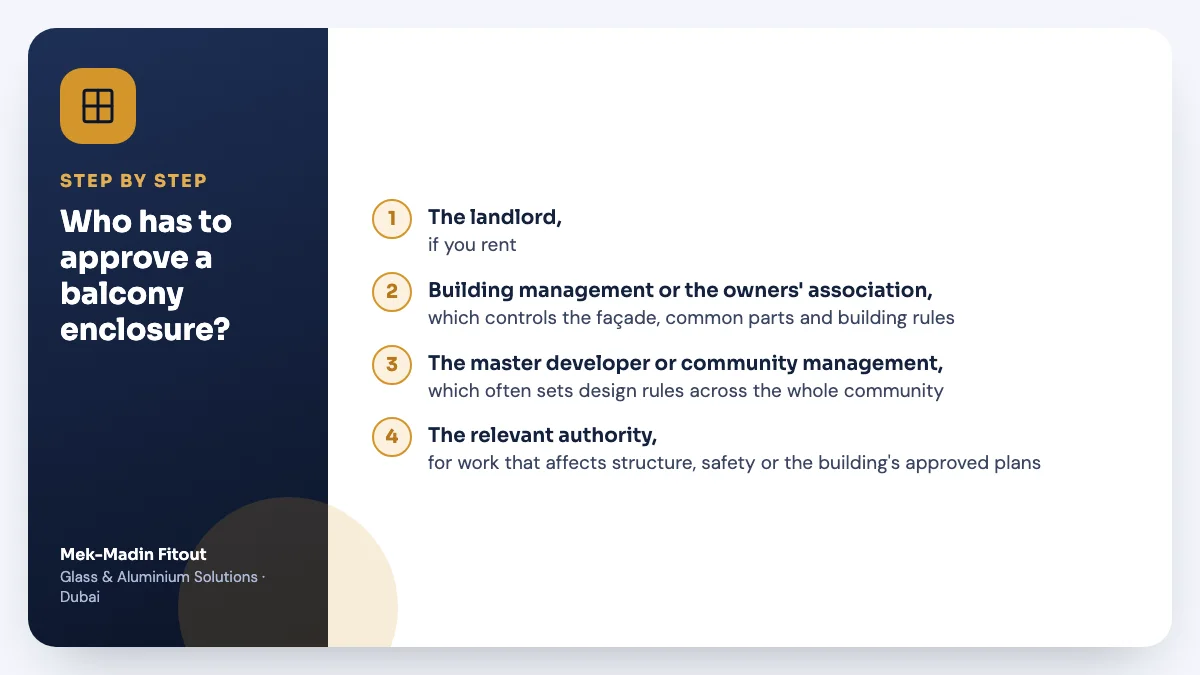
- The landlord, if you rent. Ask for written consent that names the exact work.
- Building management or the owners' association, which controls the façade, common parts and building rules.
- The master developer or community management, which often sets design rules across the whole community.
- The relevant authority, for work that affects structure, safety or the building's approved plans. Building management can usually tell you which authority covers your building.
If you rent, our guide on renovating a rented apartment in Dubai explains how landlord consent and building NOCs usually work together.
Why do many towers refuse balcony enclosures?
Towers refuse enclosures mainly because they change the look of the façade, can affect fire safety and smoke ventilation, and add loads and wind exposure that the balcony was not designed for. Enclosed balconies can also trap heat around AC units and block drainage. Building managers usually prefer one consistent rule for every unit.
The common concerns include:
- Façade consistency: owners' associations protect the building's approved external appearance
- Fire safety: open balconies can play a part in smoke ventilation and access, which an enclosure may affect
- Wind loads at height: glass panels on upper floors face strong gusts and need proper design and fixing
- Added weight: frames and glass add load to a slab edge that was designed as an open balcony
- Heat around AC units: outdoor units on balconies need open air to release heat
- Drainage: balcony drains and falls are designed for rain and washing water, not for a sealed room
- Floor area: an enclosed balcony can be treated as extra internal space, which may affect the approved plans
In high-rise areas such as Dubai Marina, wind at height and façade consistency are often the main reasons building management gives.
Which balcony changes usually need approval?
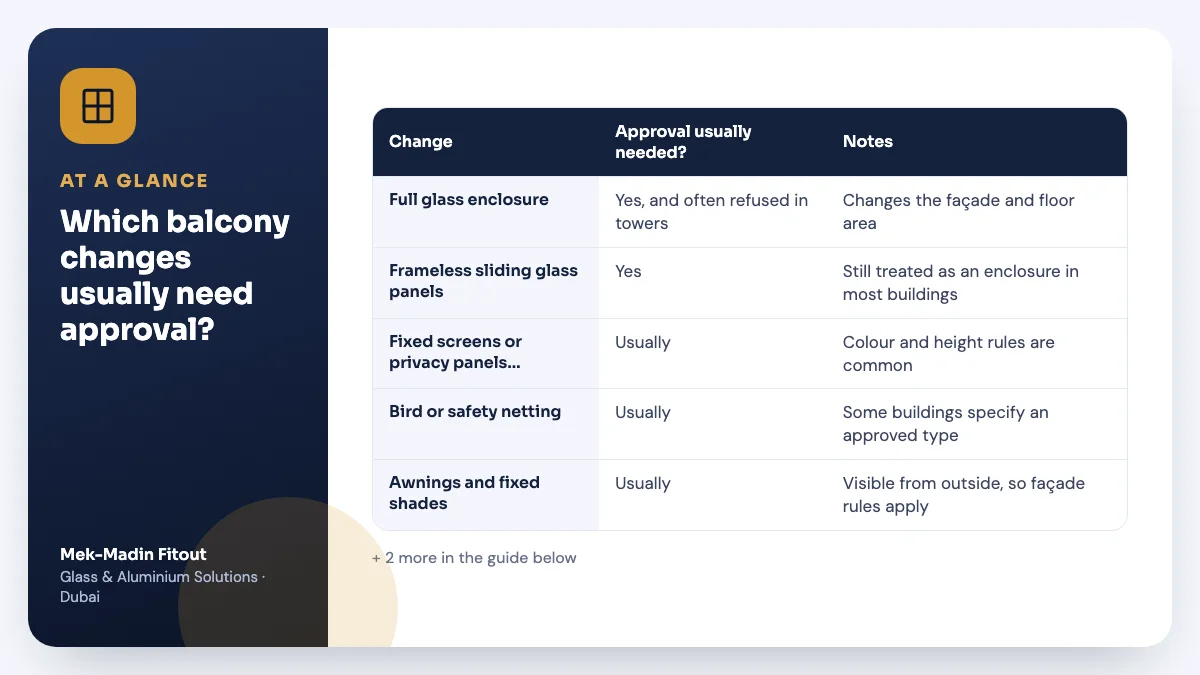
Almost anything fixed to the balcony walls, ceiling, railings or façade usually needs approval. Freestanding furniture and pots usually do not, though some buildings still limit what is visible from outside. The table below is a starting point for your conversation with building management, so treat anything uncertain as needing approval.
| Change | Approval usually needed? | Notes |
|---|---|---|
| Full glass enclosure | Yes, and often refused in towers | Changes the façade and floor area |
| Frameless sliding glass panels | Yes | Still treated as an enclosure in most buildings |
| Fixed screens or privacy panels on railings | Usually | Colour and height rules are common |
| Bird or safety netting | Usually | Some buildings specify an approved type |
| Awnings and fixed shades | Usually | Visible from outside, so façade rules apply |
| Roller blinds inside the balcony | Often | Depends on building rules and visibility |
| Freestanding furniture and plants | Usually not | Check rules on weight, height and items over the railing |
Some buildings also restrict how balconies are used, such as hanging laundry or storing items above the railing. These rules are in the building's own regulations, so ask for a copy.
Are villa terraces treated differently from tower balconies?
Villa terraces follow community rules instead of tower rules, but approval is still needed. Enclosing a terrace or roof area usually counts as an extension, because it adds enclosed space. That typically needs a master developer or community NOC, often a building permit from the relevant authority, and design guidelines may control materials and colours.
Our guide on villa renovation permits in Dubai explains how NOCs and building permits usually fit together.
If you are thinking of a shade structure rather than glass, the rules are often different again. Our guide to pergola approval in Dubai communities covers terraces and penthouses as well as gardens.
What happens if you enclose a balcony without approval?
Work done without approval can be ordered removed, usually at the owner's cost. The building may also apply penalties under its own rules, and unapproved work can cause problems when you sell, rent out or hand back the unit. If something goes wrong, such as water damage or a failed panel, you may carry the responsibility.
Removing an enclosure is rarely simple. Fixing holes in the slab, walls or railings may need repair and waterproofing once the frames come out.
Approval also protects you. It confirms that the design has been checked and gives you a clear record if questions come up later.
What should you ask building management before planning?
Ask whether enclosures are allowed at all, what types are accepted and what the application needs. Get the answer in writing, along with a copy of the building rules. Clear answers before you get quotes save you paying for a design that will never be approved, so keep a record of every reply.
- Are balcony enclosures or glass panels allowed in this building?
- Is there an approved system, colour or supplier specification?
- What documents do you need, such as drawings, product details and contractor papers?
- Does the work also need master developer or authority approval?
- Is a refundable deposit or fee required?
- Are there rules on working hours, lift use and debris removal?
- Who is responsible for maintenance and leaks once the work is done?
We often find that owners who ask these questions first avoid the most common problem: ordering custom glass before the building has said yes.
What can you do if enclosing your balcony is not allowed?
You can still make a balcony more usable without enclosing it. Better shade, privacy screens where allowed, plants, outdoor furniture and good door seals all help. Improving the door between the balcony and the living room often does more for comfort than glass on the outside, because it controls heat, dust and noise.
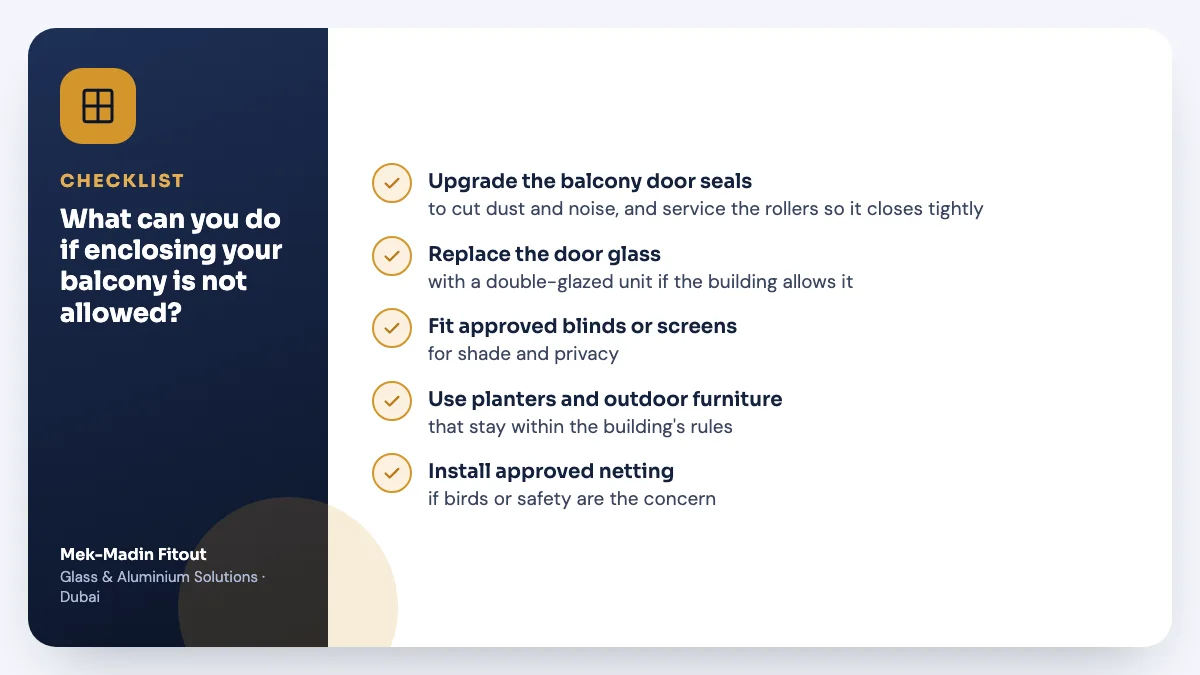
Options worth considering include:
- Upgrade the balcony door seals to cut dust and noise, and service the rollers so it closes tightly
- Replace the door glass with a double-glazed unit if the building allows it
- Fit approved blinds or screens for shade and privacy
- Use planters and outdoor furniture that stay within the building's rules
- Install approved netting if birds or safety are the concern
A stiff sliding door is a common reason balconies let in dust and noise. Our guide on a sliding door that will not close explains how to fix it, and our guide on whether double glazing is worth it in Dubai covers glass upgrades. Both are part of everyday glass and aluminium work for balconies and windows.
When should you bring in a glass and aluminium specialist?
Bring in a specialist once building management has confirmed what is allowed, or earlier if they ask for drawings and product details as part of the application. A specialist can measure, suggest a system that meets the building's specification, and prepare the details the approval needs. Work should only start after written approval.
Our glass and aluminium solutions cover balcony doors, windows, seals, rollers, balustrades and approved glass installations across Dubai. We build within what your building and community have approved.
Send us your building name, photos of the balcony and any rules or approvals you already have. Call or WhatsApp +971 52 884 8916, and we will confirm a visit time when you call.
FAQs
Do I need permission to put glass on my balcony in Dubai?
Yes. Glass panels or an enclosure change the façade, so building management, and often the master developer or community, must approve them first. Many towers do not allow them at all.
Can a tenant enclose a balcony?
Only with the landlord's written consent, and the building's approval as well. The landlord, as owner, usually needs to apply to building management or sign the application.
Are retractable or frameless balcony glass systems allowed?
They are still treated as an enclosure in most buildings, even if the panels slide open. Ask building management whether any system is accepted before getting quotes.
Can I put up a privacy screen on my balcony?
Often yes, but many buildings set rules on height, colour and fixing to the railings. Check the building rules first. Freestanding screens are usually easier to get approved than fixed ones.