
An apartment strip-out in Dubai usually follows a set process: building approval and lift booking, protection of shared areas, isolating water and power, then removal from the top down. Fixtures and the kitchen come out first, then tiles and ceilings, then any approved partitions. Debris is bagged and removed by the agreed route, and the shell is cleaned.
Knowing the process helps you plan around it and spot skipped steps. This guide walks through each stage in the order it normally happens, and what you should see at the end.
What approvals and bookings does an apartment strip-out need?
Before an apartment strip-out in Dubai, get building management approval, usually a no-objection certificate (NOC) or work permit, confirm the work hours and noise rules, and book the service lift and loading bay. If you rent, the landlord's written consent comes first, and the landlord usually applies to building management.
Offices follow a similar process with extra reinstatement steps, covered in our guide to an office strip-out at lease end.
Do you need building approval for a strip-out in Dubai?
Most towers in Dubai ask for a no-objection certificate (NOC) or work permit before a strip-out starts. The application usually includes a description of the work, contractor details and sometimes a method statement. Some buildings ask for a refundable deposit against damage to common areas.
If you rent, the landlord's written consent comes first. The landlord usually applies to building management, not the tenant. Rules differ from tower to tower, so check with your building management before you book anyone.
When is noisy strip-out work allowed?
Buildings set their own hours for noisy work such as breaking tiles and drilling. Many limit it to set daytime hours and ban it on certain days. Quieter tasks, such as unscrewing cabinets or bagging debris, may be allowed for longer.
Ask for the rules in writing so the crew can plan around them.
How are the service lift and loading bay booked?
Debris and materials normally go down the service lift only, never the passenger lifts. Many towers ask contractors to book the service lift and loading bay for set slots. In busy towers in areas such as Business Bay, these slots can fill up, so book early.
What happens on the first day of a strip-out?
On the first day of an apartment strip-out, the crew protects the service lift, corridors and apartment floors, isolates water and power to the work area, and covers AC return grilles and, with building management's agreement, the smoke detectors. Take photos of the corridor and lift before any removal starts.
How are lifts, corridors and the apartment protected?
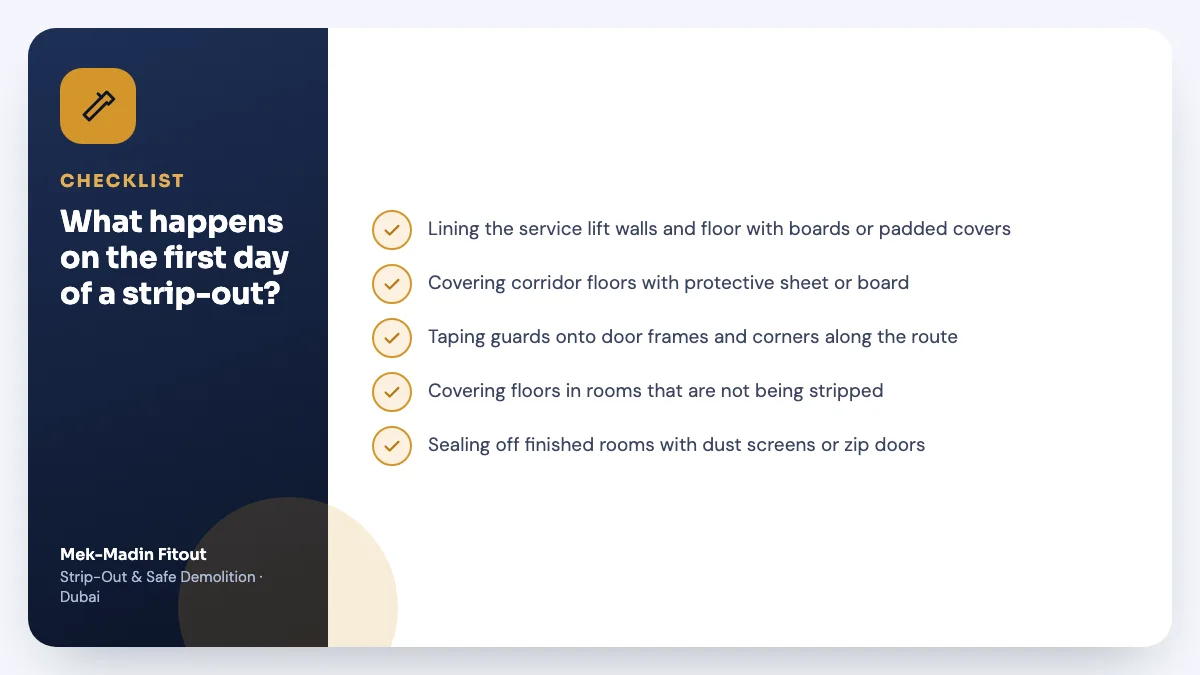
Before any removal, the route from the apartment door to the loading bay is protected. That usually means:
- Lining the service lift walls and floor with boards or padded covers
- Covering corridor floors with protective sheet or board
- Taping guards onto door frames and corners along the route
- Covering floors in rooms that are not being stripped
- Sealing off finished rooms with dust screens or zip doors
Take photos of the corridor and lift before work starts. If damage is reported later, you have a record of the condition beforehand.
How are water and power isolated?
Water to the work area is shut off at the apartment's isolation valves. Pipes to the kitchen, bathroom or other areas being removed are then capped. A capped pipe should be tested so it does not drip once pressure returns.
Power to the circuits in the work area is switched off at the distribution board. Exposed cable ends are made safe and labelled. Only licensed electricians and plumbers should alter supplies, and the building may ask to see that the work was done properly.
How are the AC and fire safety devices protected?
Fine dust drawn into fan coil units spreads through the whole apartment. AC return grilles near the work area are usually covered, and the AC may be switched off in that zone.
Smoke detectors can be triggered by dust. Covering them is normally agreed with building management first, because it affects the building's fire safety system. Never cover a detector without their agreement.
In what order are things removed during a strip-out?
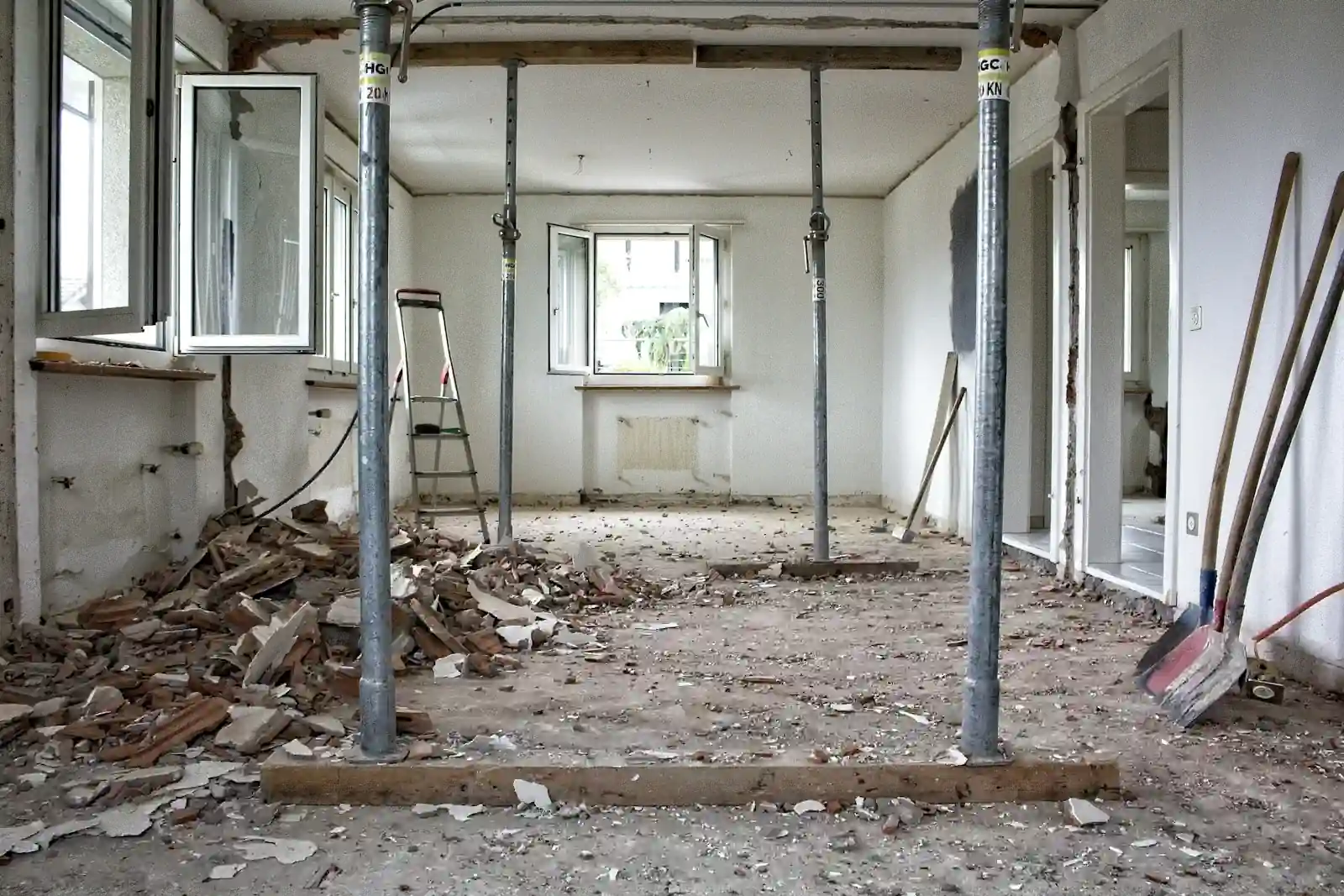
An apartment strip-out works from the top down and from loose items to fixed ones: fixtures and fittings first, then the kitchen and wardrobes, sanitaryware, ceilings and bulkheads, wall then floor tiles, and finally any approved non-structural partitions. This order keeps debris from falling onto finished surfaces and makes each layer easier to reach.
1. Fixtures, fittings and loose items
Light fittings, curtain rails, mirrors, bathroom accessories and appliances come out first. Anything you want to keep, such as appliances or doors, should be agreed and set aside before work starts.
2. Kitchen and wardrobes
Wall cabinets come down before base units. Worktops are lifted off, and sinks and hobs are disconnected and removed. Built-in wardrobes are taken apart panel by panel rather than broken, which keeps dust down and makes carrying easier. If you are replacing them, our guide to fitted versus freestanding wardrobes compares the options.
3. Sanitaryware
Toilets, basins, shower trays and bathtubs are removed after the water is isolated. Open drain pipes are plugged straight away so debris and smells do not get into the building's drainage.
4. Ceilings and bulkheads
False ceilings and gypsum bulkheads come down next. This often exposes AC ducts, pipe runs and cables, so care is needed around them. Any service still in use is protected and left in place.
5. Wall and floor tiles
Wall tiles are removed before floor tiles, so the falling pieces land on surfaces that are also coming out. Floor tiles bedded on thick screed are the noisiest and dustiest part of most strip-outs. They usually fall within the strictest noise hours.
6. Partitions, only if confirmed non-structural
Partition walls come out last, and only once they have been confirmed as non-structural and approved by building management. A wall that looks like a partition can carry load, fire separation or hidden services. If there is any doubt, an engineer must check it first. Our guide to load-bearing and partition walls in apartments explains who can confirm whether a wall is structural.
What should you check at each stage of a strip-out?
At each stage of a strip-out, check for proof the step was done properly: written approval shared with the crew, photos of common areas before work, dry pipe caps and safe cable ends, plugged drains, work kept to permitted noise hours, nothing left in corridors and an engineer's confirmation before any partition comes out.
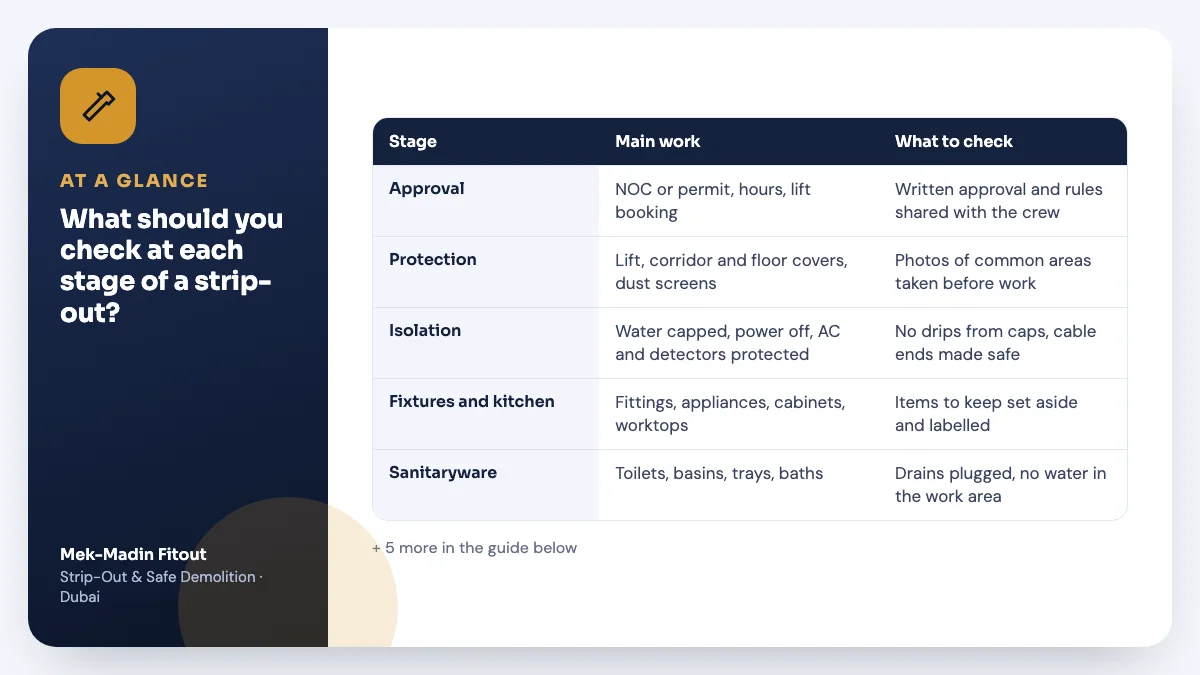
| Stage | Main work | What to check |
|---|---|---|
| Approval | NOC or permit, hours, lift booking | Written approval and rules shared with the crew |
| Protection | Lift, corridor and floor covers, dust screens | Photos of common areas taken before work |
| Isolation | Water capped, power off, AC and detectors protected | No drips from caps, cable ends made safe |
| Fixtures and kitchen | Fittings, appliances, cabinets, worktops | Items to keep set aside and labelled |
| Sanitaryware | Toilets, basins, trays, baths | Drains plugged, no water in the work area |
| Ceilings | False ceilings and bulkheads | Live ducts and pipes protected |
| Tiles | Walls first, then floors | Work kept to permitted noise hours |
| Partitions | Only approved, non-structural walls | Engineer's confirmation where needed |
| Debris | Bagging, lift runs, disposal | Nothing left in corridors or bins |
| Final clean | Sweep, vacuum, remove protection | Shell ready and services marked |
How is strip-out debris bagged and disposed of?
Strip-out debris is bagged inside the work area, not in the corridor. Strong bags are used for broken tile and screed, and heavy loads are kept to a weight that can be carried safely. Bags go down in the service lift during booked slots.
Construction waste must not go into rubbish chutes, residents' bins or community skips. It should be removed for disposal at an approved facility. Ask your contractor how and where the debris will be taken.
Dubai's waste law sets the framework. Law No. (18) of 2024 Regulating Waste Management in the Emirate of Dubai says a waste producer must "transport the Waste generated from his activities to Disposal Sites using authorised Vehicles", and defines a disposal site as one "designated or approved by the DM" (Dubai Municipality). The same law prohibits "dumping in a Waste Container any materials that may cause damage to the Waste Container or to the Waste transport Vehicle".
How is dust controlled during a strip-out?
Dust during an apartment strip-out is controlled with sealed screens between the work area and the rest of the home, damping debris before it is bagged, tools with dust extraction, a front door kept closed except for lift runs, and regular sweeping so dust is not walked into the corridor.
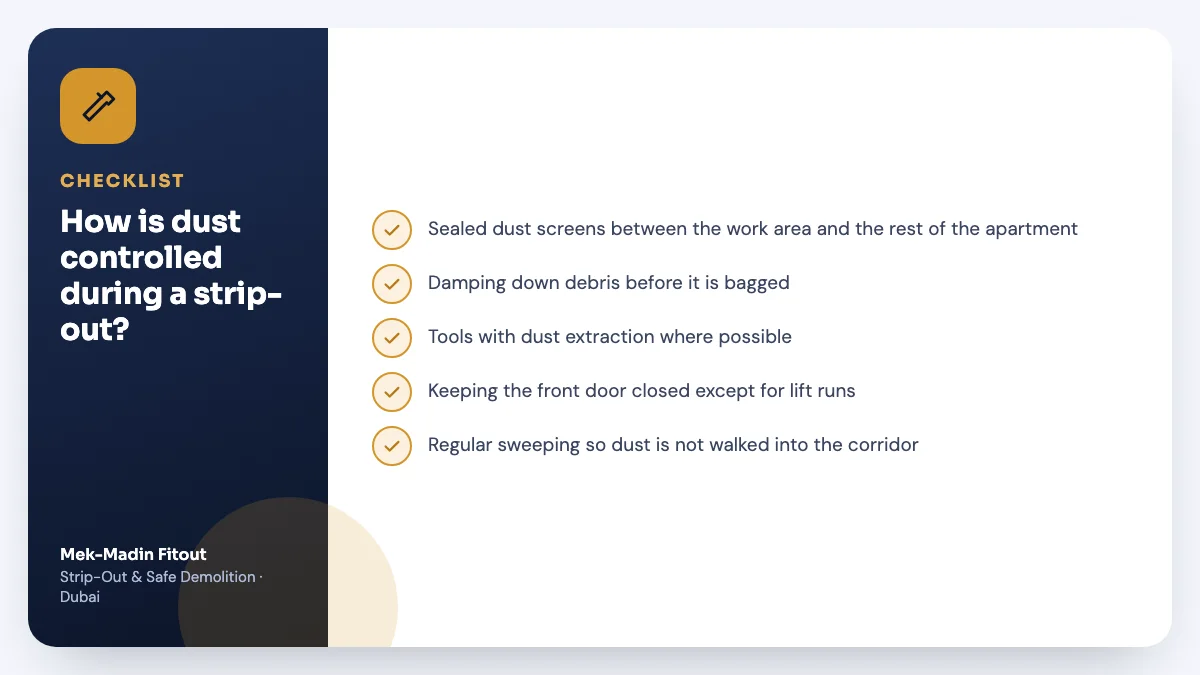
Dust is the main thing neighbours notice, and it causes most complaints. Good practice usually includes:
- Sealed dust screens between the work area and the rest of the apartment
- Damping down debris before it is bagged
- Tools with dust extraction where possible
- Keeping the front door closed except for lift runs
- Regular sweeping so dust is not walked into the corridor
Summer heat makes sealed rooms hard to work in. Crews may plan shorter shifts or work in stages so ventilation and safety are not compromised.
What should a finished strip-out look like?
A good apartment strip-out leaves a clean, safe shell ready for the next trade. Expect the floor to be swept and vacuumed, protection taken up from shared areas, pipes capped, cables made safe and labelled, and any marks or damage found behind the old finishes reported to you.
The shell should also show clearly what was found. Pipes are capped, cables are made safe and labelled, and any damage behind the old finishes has been pointed out. Leaking pipes, damp walls and failed waterproofing under old tiles are common finds.
This is the right moment to plan the next stage. If you are refitting a kitchen, our guide to the order of works for a kitchen renovation explains what comes after the strip-out.
When do you need a professional strip-out contractor?
Small jobs, such as removing a mirror or a single cabinet, can be simple, but a full apartment strip-out is different. A full strip-out needs building approval, protection of shared areas, licensed trades to isolate water and power, and a proper route for debris down the service lift to an approved disposal facility.
Mek-Madin Fitout carries out interior strip-out and safe demolition for apartments across Dubai, from protection and isolation to debris disposal and the final clean. Anything that may be structural is referred to an engineer before work starts. Call or WhatsApp +971 52 884 8916 to talk through your apartment, and we confirm a visit time when you call.
FAQs
How long does an apartment strip-out take?
It depends on the size of the apartment, what is being removed and the building's rules on hours and lift use. Approval often takes longer than the physical work. Ask building management about their process before you fix a start date.
Can I stay in the apartment during a strip-out?
It is possible for a partial strip-out, such as one bathroom, if the work area is sealed. For a full strip-out, most people stay elsewhere because of noise, dust and no water or power in parts of the home.
Who is responsible if the lift or corridor is damaged?
Usually the owner who applied for the work, and the cost may come out of any deposit held by building management. That is why protection and before-and-after photos matter. Agree with your contractor who covers damage before work starts.