At lease end, many Dubai office leases require the tenant to remove their fit-out and return the space to an agreed condition, often shell and core or the original handover state. Read the reinstatement clause and the building's fit-out guide first, agree the scope with the landlord, get approvals, then strip out in a safe order.
Every lease and building is different. The landlord and building management decide what has to come out and which permits apply, so treat this guide as a planning checklist rather than a rule book.
What does reinstatement to shell and core mean?
Shell and core usually means the bare space the landlord built: structure, floor slab, core walls and base building services, with no tenant fit-out. Reinstatement is the work of removing your additions and making good, so the unit matches what the lease requires at handback. The exact definition comes from your lease.
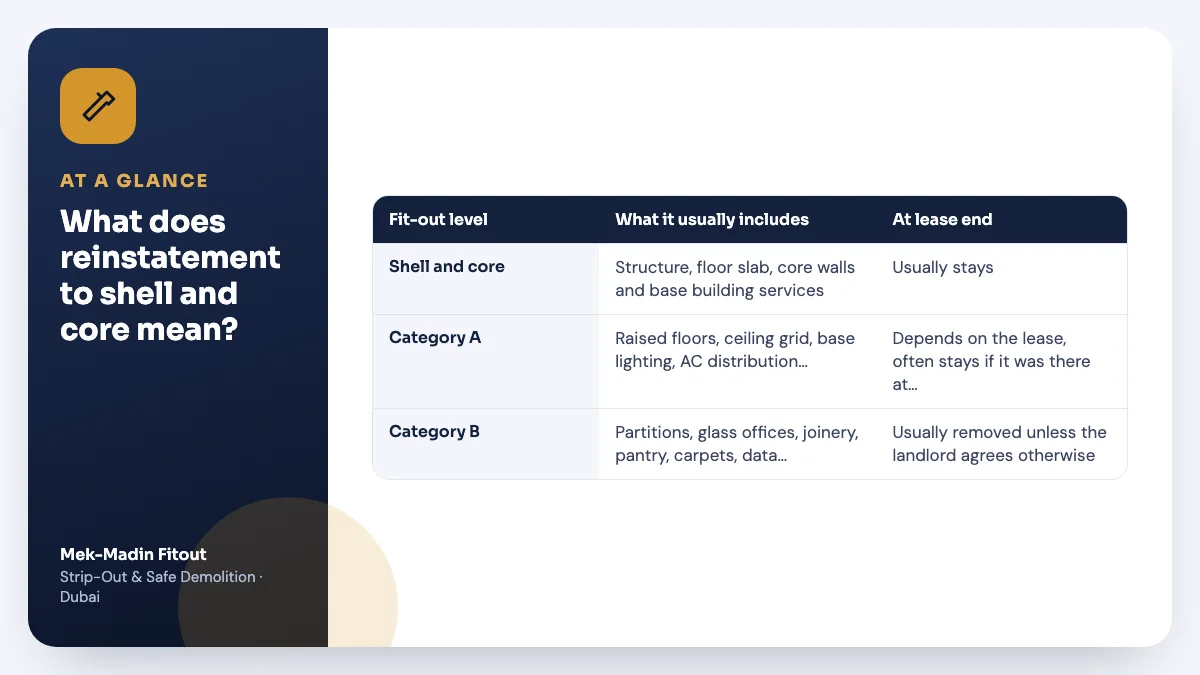
| Fit-out level | What it usually includes | At lease end |
|---|---|---|
| Shell and core | Structure, floor slab, core walls and base building services | Usually stays |
| Category A | Raised floors, ceiling grid, base lighting, AC distribution and fire services extended into the unit | Depends on the lease, often stays if it was there at handover |
| Category B | Partitions, glass offices, joinery, pantry, carpets, data cabling and signage | Usually removed unless the landlord agrees otherwise |
Some leases ask for the space back "as handed over" instead. That can mean keeping a ceiling or floor that came with the unit, so your handover report and photos are the best reference.
What should you check in your lease before stripping out?
Check the reinstatement clause, the condition the unit must be returned in, any notice the landlord needs, the handback date and whether the landlord can choose to keep some of the fit-out. Also check how the security deposit is tied to the final inspection, and who pays if work is left unfinished.
- Reinstatement clause. What must be removed, and to what standard.
- Handover condition. The original handover report, drawings and photos.
- Landlord's option to keep items. Some landlords prefer to keep partitions, ceilings or a pantry for the next tenant. Get any agreement in writing.
- Dates. When your access ends and when the inspection happens. Strip-out usually has to finish before then.
- Deposit and unfinished work. Whether the landlord can complete the work and charge you for it.
- Make-good standard. Whether walls must be repainted, floors cleaned of adhesive or holes in the slab filled.
If anything is unclear, ask the landlord or your legal adviser before work starts. Our guide to who pays for repairs between tenant and landlord is written for homes, but the same point applies: the contract usually has the final say.
What approvals does an office strip-out need?
Most office towers require a work permit or NOC from building management before any strip-out, and set rules on working hours, lift use, protection and debris removal. The building's fit-out guide usually lists the documents needed. Depending on the building and the work, a master developer or authority approval may also apply.
Check these with building management before you book contractors:
- Work permit or NOC application, and any contractor registration the building requires
- Permitted hours for noisy work, which are often outside office hours
- Service lift and loading bay bookings
- Protection for lifts, corridors and common areas
- Rules for fire alarm and sprinkler changes, which buildings often reserve for their own approved contractor
- Hot works permits if any cutting or welding is needed
- Any deposit against damage to common areas
In busy office districts such as Business Bay, requirements can differ from tower to tower. Always work from the current fit-out guide for your building rather than a previous project.
How should you plan an office strip-out?
Plan backwards from the handback date. Survey the space against the handover records, agree the scope with the landlord, apply for permits, then book contractors for each trade. Leave room for the landlord's inspection and any snagging, because extra work found late can be hard to schedule in a busy tower.
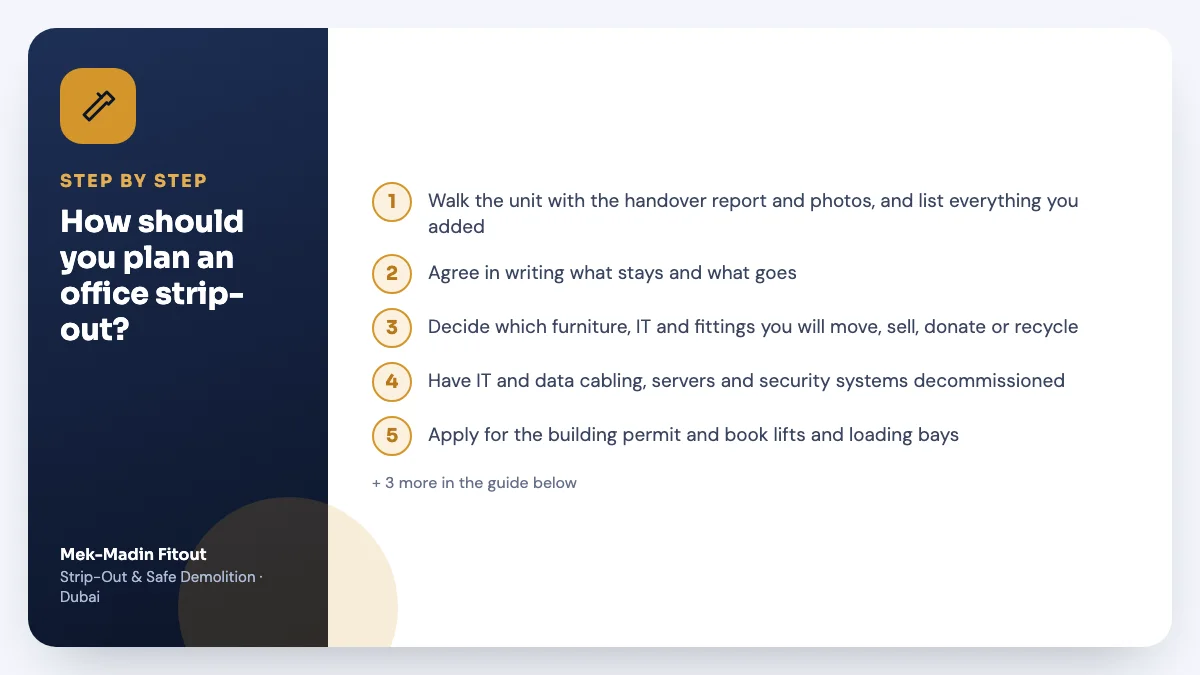
- Walk the unit with the handover report and photos, and list everything you added.
- Agree in writing what stays and what goes.
- Decide which furniture, IT and fittings you will move, sell, donate or recycle.
- Have IT and data cabling, servers and security systems decommissioned.
- Apply for the building permit and book lifts and loading bays.
- Arrange MEP, fire and AC contractors for any building services you altered.
- Book the strip-out, debris removal and final clean.
- Arrange the handback inspection with the landlord and building management.
If you would rather have one team coordinate the trades, our interior strip-out team can walk the unit with you against the lease requirements and the building's rules.
In what order is an office stripped out?
Strip-out usually runs from loose items to fixed fit-out, then services and finishes. Furniture and IT go first, then joinery, partitions, ceilings and floor finishes, while services are made good and the space is cleaned last. Working in order keeps the site safe and protects anything that must stay.
1. Furniture, IT and loose items
Clear desks, chairs, storage, equipment and files. Remove or securely wipe any devices that hold data.
2. Isolating power, water and systems
A qualified electrician isolates and tests tenant circuits at the distribution board, and pantry water points are isolated and capped. Fire alarm and sprinkler changes are coordinated with building management. Never isolate fire systems yourself.
3. Joinery, glass and partitions
Remove reception counters, pantry units, storage walls, glass partitions and the gypsum or block walls the tenant added. Confirm that no wall to be removed is structural or part of the base build.
4. Ceilings, lighting and floor finishes
Take out bulkheads, feature ceilings, tenant lighting, carpet tiles, vinyl and any raised floor the tenant installed, as the lease requires.
5. Services make-good
Return AC diffusers, ductwork, sprinkler heads and fire detectors to the layout the landlord requires. This is specialist work, often done by the building's approved contractors.
6. Debris removal and final clean
Bag debris and remove it through the agreed route, then clean the unit ready for inspection.
The steps are similar on a residential job. Our guide to the apartment strip-out process in Dubai covers protection and dust control in more detail.
How do you keep an office strip-out safe?
Treat every cable as live until a qualified electrician has isolated and tested it. Keep fire exits and corridors clear, protect common areas and control dust so detectors and neighbouring tenants are not affected. Stop work and get advice if you find damaged services, suspected hazardous materials or anything that looks structural.
- Switch off and isolate power before any electrical removal, and leave that work to a qualified electrician
- Have any gas supply to a pantry or kitchen isolated by a qualified professional
- Keep escape routes and fire doors clear throughout
- Do not cover or disable smoke detectors unless building management arranges it
- Use dust screens and extraction, and keep debris bagged
- Stop and get advice if you find suspected hazardous materials in an older building
What happens at the handback inspection?
The landlord or building management walks the unit against the lease requirements and the handover records. They note anything missing, damaged or not reinstated, and you then fix the snag list or agree a cost. Once the unit is accepted, you return keys and access cards and settle final accounts as the lease requires.
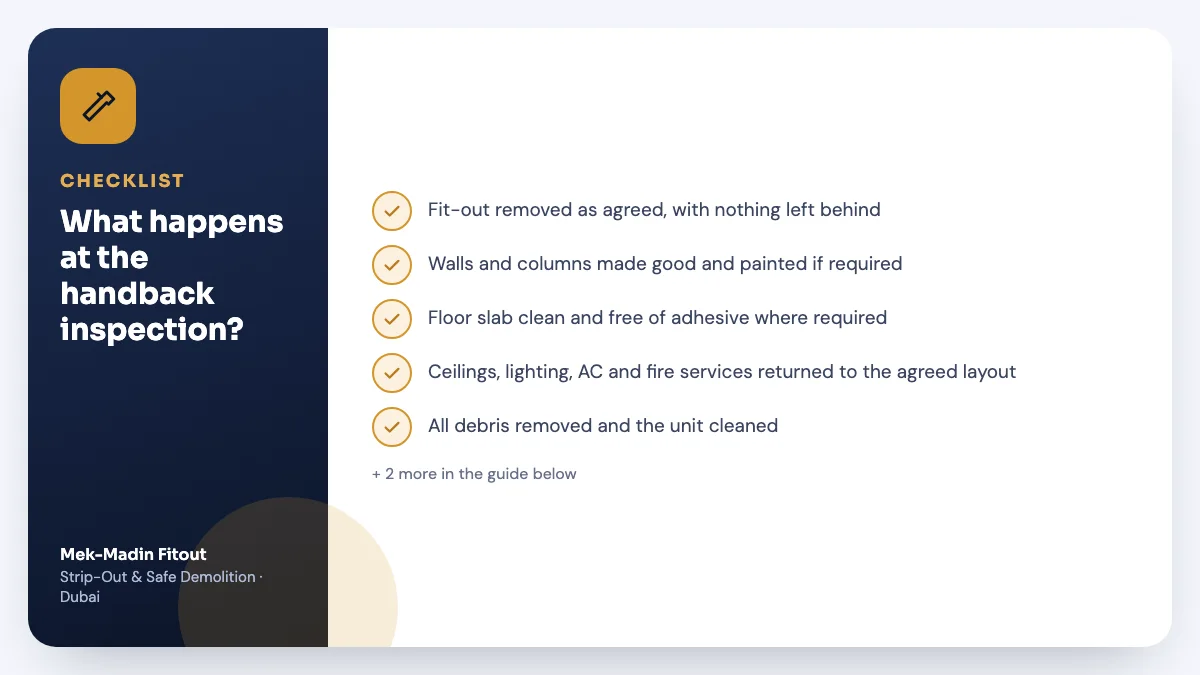
- Fit-out removed as agreed, with nothing left behind
- Walls and columns made good and painted if required
- Floor slab clean and free of adhesive where required
- Ceilings, lighting, AC and fire services returned to the agreed layout
- All debris removed and the unit cleaned
- Keys, access cards and parking cards returned
- Utility accounts such as DEWA closed or transferred, and tenancy registration dealt with as required
Photograph the finished unit and keep the signed inspection record. It helps if there is any dispute about the security deposit later, in the same way a move-out inspection protects a home tenant's deposit.
When should you call a professional strip-out contractor?
Bring in a professional when the strip-out involves partitions, ceilings, floors or building services, when the building requires approved contractors and method statements, or when the handback date is tight. A contractor who knows tower rules can plan permits, protection and debris routes so the work does not hold up your handback.
Our office strip-out and safe demolition service covers fit-out removal to shell and core, isolating and capping points, dust control, debris disposal and the final clean. We work to your lease and the building's fit-out guide. Call or WhatsApp +971 52 884 8916, and we will confirm a visit time when you call.
FAQs
Do I always have to strip an office back to shell and core?
Not always. It depends on the lease and what the landlord agrees. Some landlords keep part of the fit-out for the next tenant, so get any agreement in writing.
Who applies for the strip-out permit?
Usually the tenant or their contractor applies to building management, following the fit-out guide. Some buildings also need landlord consent first. Check the process with your building.
Can I leave furniture and partitions for the next tenant?
Only if the landlord agrees in writing. Otherwise anything left behind may be removed at your cost. Any handover to an incoming tenant also needs the landlord's approval.
What if the strip-out reveals damage?
Report it to the landlord and building management, with photos, before covering or repairing it. Depending on the lease, damage to base building services or the slab may not be the tenant's responsibility.