The plants that survive a Dubai summer best are the ones adapted to heat, drought and sandy soil. Date palms, the native ghaf, oleander, bougainvillea, lantana, natal plum, aloe, agave and desert rose all cope well once established. Planted in improved soil with drip irrigation and mulch, they need far less water than a lawn or thirsty flowering shrubs.
The other half of the answer is timing. Plants go in most successfully during the cooler months, roughly November to March. That gives roots a few months to grow before the summer heat arrives, so autumn is the time to plan, ready to plant as the weather cools.
Why do some plants survive a Dubai summer and others die?
Some plants survive a Dubai summer because small, waxy, grey or succulent leaves, deep roots or water-storing stems help them lose less water, and most of them dislike wet, heavy soil. Plants from cooler or wetter climates often wilt, scorch or rot at the roots in the same intense sun, heat and hot wind.
Dubai summers bring intense sun, high temperatures and, near the coast, humid nights. Soil dries quickly, and hot wind pulls moisture from leaves. Plants from cooler or wetter climates often wilt, scorch or rot at the roots.
Plants that last usually have small, waxy, grey or succulent leaves that lose less water. Many have deep roots or store water in thick stems, and most dislike wet, heavy soil.
Dubai's green building system favours these plants too. For all new buildings, Al Sa'fat requires that "a minimum of 25% of the total planted area within the building plot, including green roofs, must utilise plant and tree species indigenous or adapted to Dubai's climate and region".
Which trees and palms cope with Dubai's summer heat?
The date palm and the native ghaf both handle full sun and heat, and the ghaf survives on very little water once established. The date palm also tolerates some salt in the soil, while the ghaf, the UAE's national tree, gives light, dappled shade from its open canopy.
Date palm
The date palm is a familiar sight in Dubai gardens, streets and parks. It handles full sun and heat well and tolerates some salt in the soil. Fruiting palms drop dates and need regular pruning of old fronds, so keep them away from pool edges and parking spots.
Ghaf
The ghaf is a native desert tree and the UAE's national tree. Its deep roots let it survive on very little water once established, and its open canopy gives light, dappled shade. It is a protected tree in the UAE, so check with Dubai Municipality before cutting back or removing an established one.
Which shrubs and hedges grow well in Dubai?
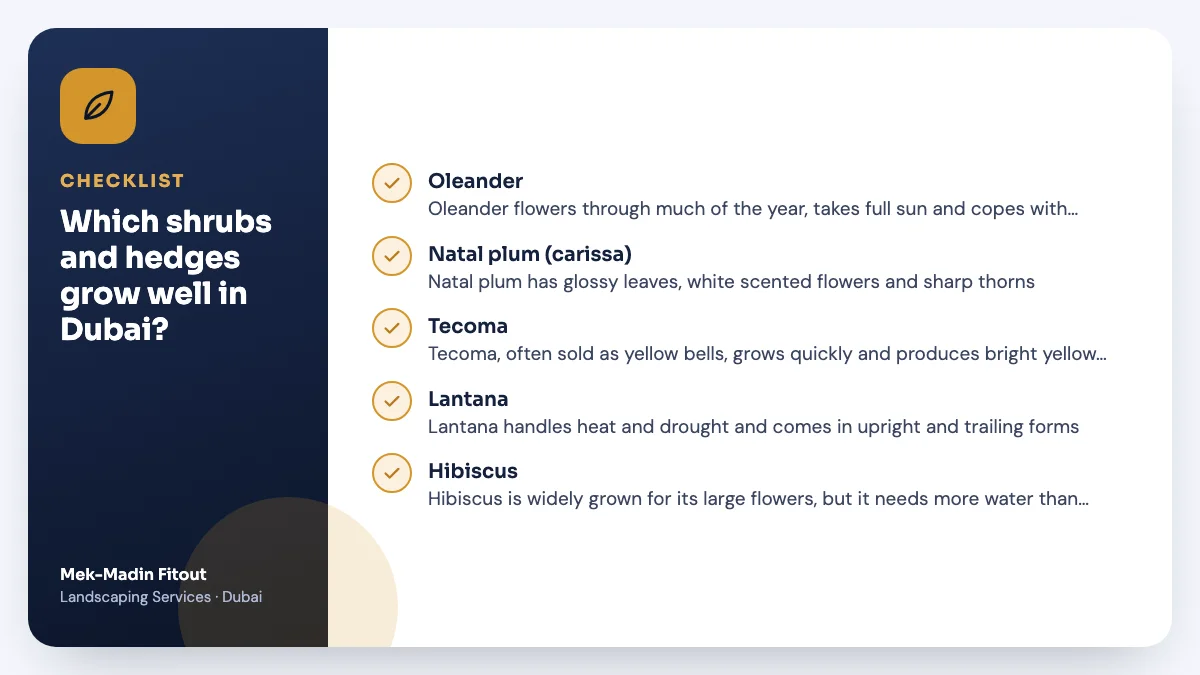
Oleander, natal plum, tecoma and lantana all take full sun and heat. Hibiscus also grows well but needs more water and some afternoon shade. Oleander and natal plum cope with salt, which suits coastal hedges, but oleander is poisonous and lantana berries and leaves can harm pets.
Oleander
Oleander flowers through much of the year, takes full sun and copes with salty soil and sea air. It makes a good screening hedge. All parts of the plant are poisonous if eaten, so avoid it in gardens used by small children or pets.
Natal plum (carissa)
Natal plum has glossy leaves, white scented flowers and sharp thorns. It is one of the more salt-tolerant hedging plants, which makes it popular in coastal gardens. The thorns also make it a useful barrier along a boundary.
Tecoma
Tecoma, often sold as yellow bells, grows quickly and produces bright yellow trumpet flowers. It likes full sun and moderate watering.
Lantana
Lantana handles heat and drought and comes in upright and trailing forms. It flowers for long periods and attracts butterflies. Its berries and leaves can be toxic to pets, so keep it out of areas where dogs spend time.
Hibiscus
Hibiscus is widely grown for its large flowers, but it needs more water than the other shrubs here. It does best with some afternoon shade and regular drip irrigation. Treat it as a feature plant rather than a hedge if you want to keep water use down.
What groundcover or lawn grass survives the heat?
Portulaca is a low-water groundcover for edges, gravel beds and pots. Seashore paspalum and zoysia are common lawn grasses in the UAE, though any lawn uses far more water. Paspalum copes with heat and some salt, while zoysia is often chosen for areas with partial shade.
Portulaca
Portulaca is a low, spreading succulent with small, bright flowers that open in the sun. It needs little water and suits edges, gravel beds and pots. It can be short-lived but is easy to replace.
Lawn grasses
Any lawn uses far more water than the planting around it. Where a real lawn is wanted, seashore paspalum and zoysia are commonly used in the UAE. Paspalum is known for coping with heat and some salt, while zoysia is often chosen for areas with partial shade. Our comparison of artificial grass and real grass in Dubai weighs water use against heat.
Which climbing plants do well in Dubai?
Bougainvillea thrives in full sun on little water once rooted, and cape honeysuckle, with its orange tubular flowers, handles heat well, though both need wires or a frame to climb. Bougainvillea has thorns and drops papery bracts, so plan for sweeping near terraces and pools.
Bougainvillea
Bougainvillea is the best-known climber in Dubai. It thrives in full sun, needs little water once rooted and flowers in pink, red, orange, purple and white. It has thorns and drops papery bracts, so plan for sweeping near terraces and pools. Leaves and bracts in the water add to the skimming in a summer pool care routine.
Cape honeysuckle
Cape honeysuckle is a scrambling shrub that can be trained up a wall, fence or pergola post. It has orange tubular flowers and handles heat well. Both climbers need wires or a frame to grip, as they do not cling on their own.
Which succulents need the least care in Dubai's heat?
Aloe, agave and desert rose need very little water once settled, and aloe and desert rose should never sit in wet, waterlogged soil. Agave has sharp spines, so keep it back from paths and play areas, and desert rose has toxic sap, so wear gloves when pruning.
Aloe and agave
Aloe and agave store water in thick leaves and need very little irrigation once settled. They look good in gravel gardens and large pots. Agave leaves have sharp tips and spines, so keep them back from paths and play areas.
Desert rose (adenium)
Desert rose has a swollen trunk and pink or red flowers. It loves full sun and hates wet roots, so plant it in free-draining soil or a pot. Its sap is toxic, so wear gloves when pruning and keep it away from children and pets.
Which plants suit which spot? (quick reference)
Most plants that survive a Dubai summer want full sun and little water. Hibiscus and the lawn grasses, seashore paspalum and zoysia, are the thirsty exceptions, while natal plum, hibiscus, zoysia and aloe also take part shade. Near the coast, oleander, natal plum and date palms are good starting points for salt tolerance.
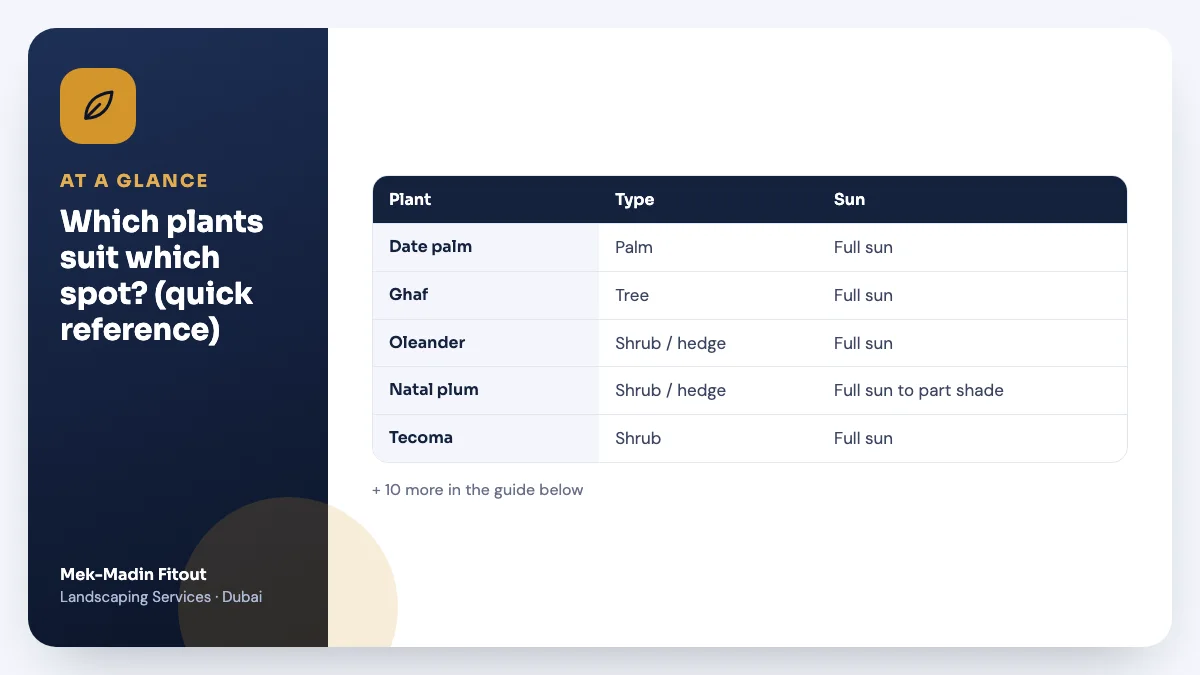
| Plant | Type | Sun | Water need | Notes |
|---|---|---|---|---|
| Date palm | Palm | Full sun | Low to medium | Tolerates some salt; prune old fronds |
| Ghaf | Tree | Full sun | Low | Native, protected; needs space for roots |
| Oleander | Shrub / hedge | Full sun | Low | Toxic to people and pets; salt tolerant |
| Natal plum | Shrub / hedge | Full sun to part shade | Low to medium | Very salt tolerant; thorny |
| Tecoma | Shrub | Full sun | Medium | Fast growing; good screen |
| Lantana | Shrub / groundcover | Full sun | Low | Berries and leaves toxic to pets |
| Hibiscus | Shrub | Sun to part shade | High | Likes afternoon shade |
| Portulaca | Groundcover | Full sun | Low | Short-lived; easy to replace |
| Seashore paspalum | Lawn grass | Full sun | High | Copes with some salt |
| Zoysia | Lawn grass | Sun to part shade | High | Often used where there is some shade |
| Bougainvillea | Climber | Full sun | Low | Thorny; drops bracts |
| Cape honeysuckle | Climber / shrub | Full sun | Medium | Needs a support |
| Aloe | Succulent | Sun to part shade | Low | Avoid waterlogged soil |
| Agave | Succulent | Full sun | Low | Sharp spines |
| Desert rose | Succulent | Full sun | Low | Toxic sap; needs free drainage |
How should you prepare soil, watering and shade for new plants?
To prepare soil, watering and shade for new plants in Dubai, mix compost or a soil conditioner into the sandy soil, water by drip irrigation in the early morning or evening, mulch the surface with bark, wood chip or gravel, and give young or thirsty plants some shade. Group plants with similar water needs together.
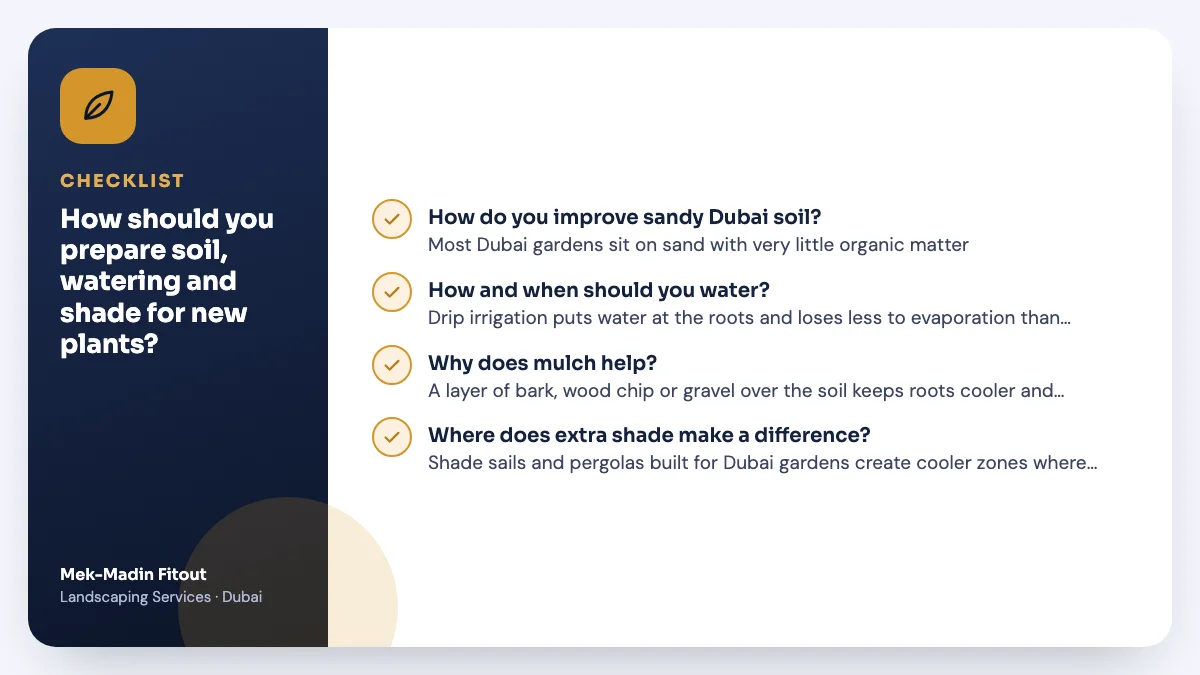
How do you improve sandy Dubai soil?
Most Dubai gardens sit on sand with very little organic matter. Water drains straight through and takes nutrients with it. Mix compost or a soil conditioner into planting holes and beds so roots can hold onto moisture.
How and when should you water?
Drip irrigation puts water at the roots and loses less to evaporation than spray heads. Set timers to run in the early morning or evening, never in the midday heat. DEWA's tips for managing electricity and water use give a specific window: "Water your plants before 8 am or after 6 pm to reduce evaporative losses." Check timers as the seasons change, because summer and winter needs are very different.
Overwatering is as common as underwatering, and it wastes water that shows up on your DEWA bill. Group plants with similar water needs on the same line, so the hibiscus is not soaking the agave. Our guide to setting up drip irrigation zones explains how.
For new buildings, Al Sa'fat's water efficient irrigation rule requires the "100% water requirement for the total exterior landscaping" to be irrigated "using non-potable water or by use of drip or subsoil water delivery systems".
Why does mulch help?
A layer of bark, wood chip or gravel over the soil keeps roots cooler and slows evaporation. It also stops wind lifting the sand. Keep mulch a short distance from stems and palm trunks.
Where does extra shade make a difference?
Shade sails and pergolas built for Dubai gardens create cooler zones where hibiscus, pots and young plants do better. Temporary shade cloth also helps new planting through its first hot months. Our guide to the best pergola material for Dubai's climate compares aluminium, timber and steel.
How do the coast, balconies and community rules change what you plant?
The coast, balconies and community rules all change what you plant. Near the coast, start with salt-tolerant plants such as oleander, natal plum, date palms and bougainvillea. On windy tower balconies, choose low, sturdy plants in heavy pots, and in villa communities, check the planting guidelines before major front-garden planting.
Which plants cope with salt near the coast?
Gardens on the Palm Jumeirah and along Jumeirah face salty air and sometimes salty soil. Oleander, natal plum, date palms and bougainvillea are good starting points there.
What grows on a windy tower balcony?
Higher floors get strong wind that dries pots quickly and can knock plants over. Choose low, sturdy plants such as aloe, agave, portulaca and compact bougainvillea. Use heavy pots with saucers that do not drip onto the balcony below, and check your building rules on what can be fixed to walls or railings.
Do villa communities restrict planting?
Many villa communities have guidelines on front gardens, hedge heights and large trees near boundaries. In places such as Arabian Ranches, check with community management or the master developer before major planting at the front of the plot.
When should you bring in a landscaping team?
Planting a few pots or a small bed is a simple job to do yourself. A whole garden is different: it needs soil preparation, an irrigation layout, plant choices matched to sun and salt, and attention to community rules. Mistakes are often expensive to fix once roots and pipes are in the ground.
If you want a garden planned and built around these plants, our garden design and landscaping team can help, from bare plots to reworking tired gardens. Call or WhatsApp +971 52 884 8916 to arrange a site visit. We confirm a visit time when you call.
FAQs
When is the best time to plant in Dubai?
The cooler months, roughly November to March, are the best time. Temperatures are lower, so new plants can establish roots before summer. Planting in summer is possible, but expect more losses and plan for extra shade and careful watering.
Which plants need the least water in Dubai?
Native trees such as ghaf, along with succulents like aloe, agave and desert rose, need the least water once established. Bougainvillea, oleander and lantana are also low-water options. Every new plant needs regular watering in its first months, whatever its type.
Are any common garden plants unsafe for pets?
Yes. Oleander is poisonous to people and pets, lantana berries and leaves can harm pets, and desert rose has toxic sap. If you have children or animals, keep these out of reach or leave them out, and ask the nursery about any new plant before buying.
Can I keep a lawn without high water use?
You can reduce it, but any real lawn uses more water than shrubs or succulents. Keep the lawn small, use a grass suited to heat, water early in the morning and surround it with gravel or drought-tolerant beds.