Drip irrigation is usually the most efficient way to water a Dubai villa garden. It delivers water slowly at the roots, loses less to evaporation and wind than sprinklers, and lets you water each plant group differently. To work well, it needs sensible zones, a filter, a pressure regulator, a timer set for the season and regular checks.
This guide explains how the parts fit together, what goes wrong in Dubai conditions and how to keep a system working through the year.
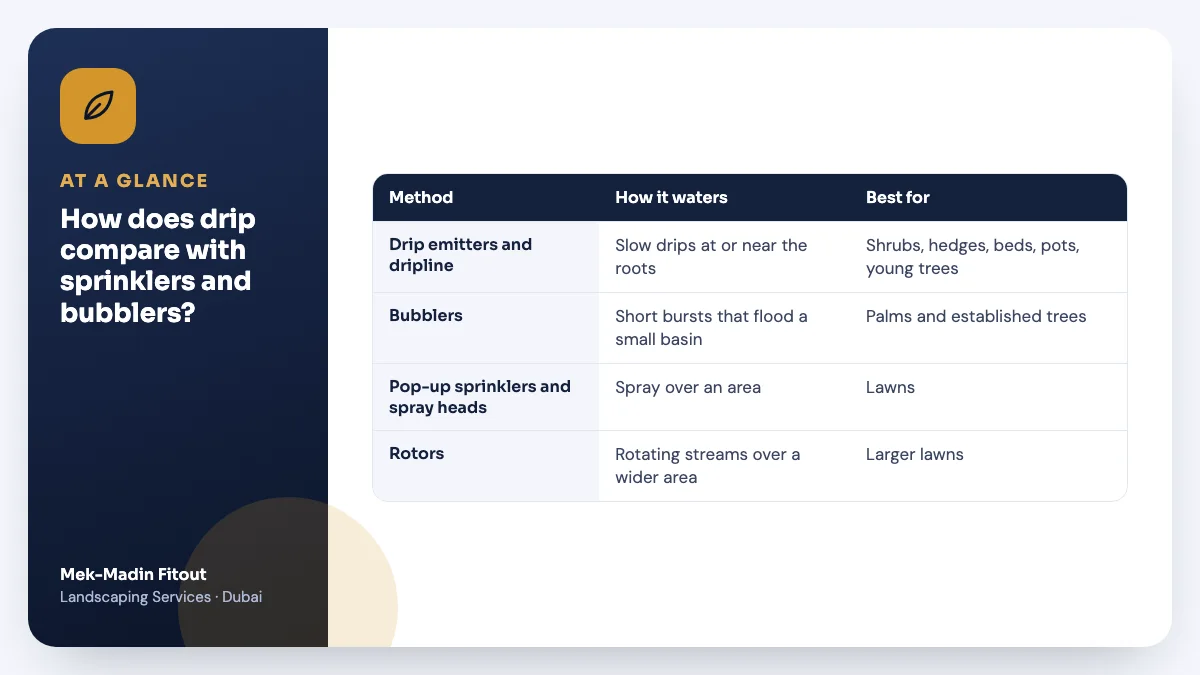
How does drip compare with sprinklers and bubblers?
Drip irrigation suits shrubs, hedges, beds, pots and young trees in a Dubai villa garden, bubblers suit palms and established trees, and sprinklers suit lawns. Most villa gardens use a mix of methods, each where it suits the plants, with drip delivering water slowly at the roots and losing less to evaporation and wind.
| Method | How it waters | Best for | Watch out for |
|---|---|---|---|
| Drip emitters and dripline | Slow drips at or near the roots | Shrubs, hedges, beds, pots, young trees | Clogging from sand, salt and scale |
| Bubblers | Short bursts that flood a small basin | Palms and established trees | Run-off if the basin is not formed properly |
| Pop-up sprinklers and spray heads | Spray over an area | Lawns | Evaporation, wind drift, wet walls and paths |
| Rotors | Rotating streams over a wider area | Larger lawns | Overspray onto paving, pools and windows |
Sprinklers still have a place on a real lawn, because grass needs water across its whole surface. Everywhere else, drip or bubblers usually do the job with less waste. They also keep water off walls, where repeated wetting can stain render and paint. If you are still deciding on a lawn, our comparison of real and artificial grass sets out how much water each needs.
DEWA's water-saving tips for homes give the same advice: "Use drip irrigation system for shrubs and trees so that water goes straight to the roots, preventing run-off."
How should you plan irrigation zones in a villa garden?
Plan irrigation zones in a villa garden by grouping plants that want roughly the same amount of water on each zone, because each zone runs on its own valve and schedule. Give pots their own zone with adjustable drippers, keep the lawn on its own sprinkler zones, and water trees and palms separately.
Keep drippers and sprinkler spray clear of house walls, as irrigation is a common cause of damp ground floor walls in Dubai villas.
A zone is a group of emitters controlled by one valve. Each zone runs on its own schedule, so the plants on it should want roughly the same amount of water. Our guide to heat-tolerant plants for Dubai gardens notes which ones are thirsty.
The most common fault we see in older gardens is one long line feeding everything. The lawn edge gets too little, the succulents get far too much and the palm gets whatever is left.
How should trees and palms be watered?
Large trees and palms have deep, wide roots. They do better with longer, less frequent watering that soaks down, rather than a little every day. Bubblers or a ring of drippers around the root zone suit them.
What suits shrubs and hedges?
Hedges along boundary walls are usually best on inline dripline running the length of the bed. Keep them on a separate zone from flowering shrubs if their water needs differ.
Why do pots need their own zone?
Pots dry out much faster than beds, especially on sunny terraces. Give them their own zone with adjustable drippers, so you can water them more often without drowning the beds.
Can the lawn share a zone with drippers?
Keep the lawn on its own sprinkler zones. Mixing spray heads and drippers on one valve rarely works, because they run at different flow rates and pressures.
How do irrigation timers and controllers work?
A controller opens and closes each zone's valve on a schedule. Basic timers let you set start times and run lengths for each zone. Some controllers also offer a seasonal adjustment setting, which scales every zone up or down at once.
When you set a controller, keep these points in mind:
- Run zones one after another, not all at once, so pressure stays even.
- Use more than one short cycle for sandy beds if water runs straight through.
- Label each zone on the controller and on a simple garden sketch.
- Fit or keep the backup battery, so the schedule survives a power cut.
What is the best time of day to water a garden in Dubai?
The best time to water a garden in Dubai is the early morning or the evening, never the middle of the day. Midday watering loses more to evaporation, and much of it never reaches the roots. Early morning is usually better, because plants go into the heat with moist soil.
Evening watering works too, but beds that stay wet overnight can encourage fungus on some plants.
Why does a drip system need a filter and pressure regulator?
Every drip zone in a Dubai garden should have a filter and a pressure regulator near its valve. The filter catches sand, grit and debris before they reach the emitters, and the regulator stops fittings blowing apart and keeps flow even along the line. They are small parts, but they decide how long the system lasts.
What does a drip irrigation filter do?
A filter catches sand, grit and debris before they reach the emitters. Screen and disc filters are both common. Either way, the filter only helps if someone opens and cleans it.
Why fit a pressure regulator?
Drip components are made to work at lower pressure than a typical garden supply. Without a regulator, fittings can blow apart and drippers can spray instead of drip. A regulator also keeps flow more even from the start of the line to the end.
Why do drip emitters clog in Dubai?
Drip emitters in Dubai usually clog with sand and dust, salt and scale, or roots and debris, and clogging is the main reason drip systems stop working. A filter on each zone, pressure-compensating emitters and regular flushing of the line ends all help clear sediment before it settles in the emitters.
There are three usual causes.
Sand and dust. Sand gets in through open line ends, damaged pipe and unfiltered taps. Wind also blows dust into emitters that sit on the surface.
Salt and scale. Minerals in the water dry on and around emitter openings and build up as a crust. Coastal gardens, such as those on Palm Jumeirah, also deal with salt spray settling on exposed fittings.
Roots and debris. Some roots grow towards the steady moisture at a dripper and work their way in. Leaves and mulch can also block emitters laid on the surface.
Pressure-compensating emitters cope better with uneven pressure along long runs, and many are easier to clean. Flushing the line ends regularly pushes out sediment before it settles in the emitters.
How do you check a drip system for leaks?
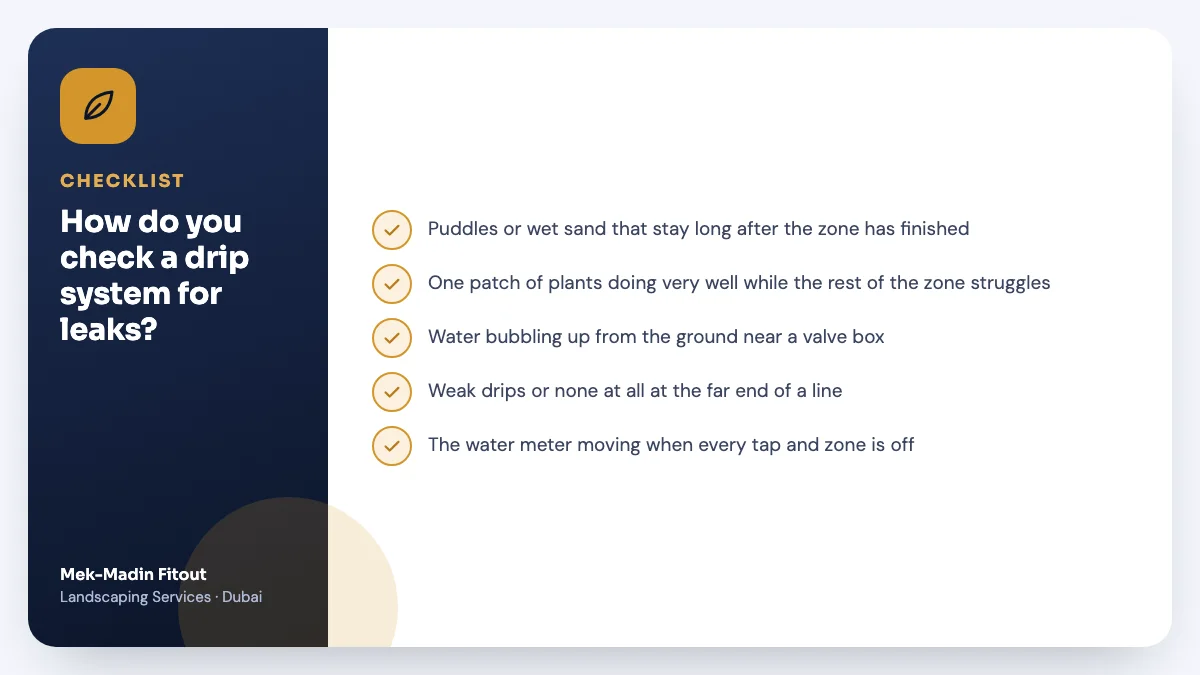
To check a drip system for leaks, walk each zone while it runs, one at a time, and look for lasting puddles, uneven plant growth, water bubbling near a valve box and weak drips at line ends. A water meter that keeps moving with every tap and zone switched off also points to a leak.
A leaking drip system can waste a lot of water without being obvious. It often shows up first on your DEWA bill.
Look for these signs:
- Puddles or wet sand that stay long after the zone has finished.
- One patch of plants doing very well while the rest of the zone struggles.
- Water bubbling up from the ground near a valve box.
- Weak drips or none at all at the far end of a line.
- The water meter moving when every tap and zone is off.
Walk each zone while it is running, one at a time. Many leaks come from cracked fittings, pipes cut by garden tools, or lines chewed by pests. If the meter moves with the irrigation off, the problem may be on the supply side, and our plumbing team can trace it. In villas with a pool, a pool losing water to a leak can also push up water use.
DEWA's July 2023 notice to customers links wet patches to "leaks in internal connections or the house irrigation system within the property", and says its High-Water Usage Alert service helps customers "detect any leakage in water connections after the meter".
What regular maintenance does drip irrigation need?
Drip irrigation in a Dubai villa garden needs a walk round each zone every week or two, monthly filter cleaning and line-end flushing, controller adjustments at each change of season and a full check of every zone before summer. After a sandstorm, rinse dust off surface emitters and check the filters too.
| How often | Task |
|---|---|
| Every week or two | Walk each zone while it runs. Look for dry plants, puddles and spraying fittings. |
| Every month | Clean the filters. Flush line ends. Clear or replace blocked emitters. |
| Each season change | Adjust run times and start times on the controller. |
| Before summer | Check every zone fully, add drippers for plants that have grown, and test the controller battery. |
| After a sandstorm | Rinse dust off surface emitters and check filters. |
| After building or garden works | Check for cut or crushed lines near new paving, posts and planting holes. |
As plants grow, move drippers further out and add more where roots have spread.
How should you adjust drip irrigation for Dubai's seasons?
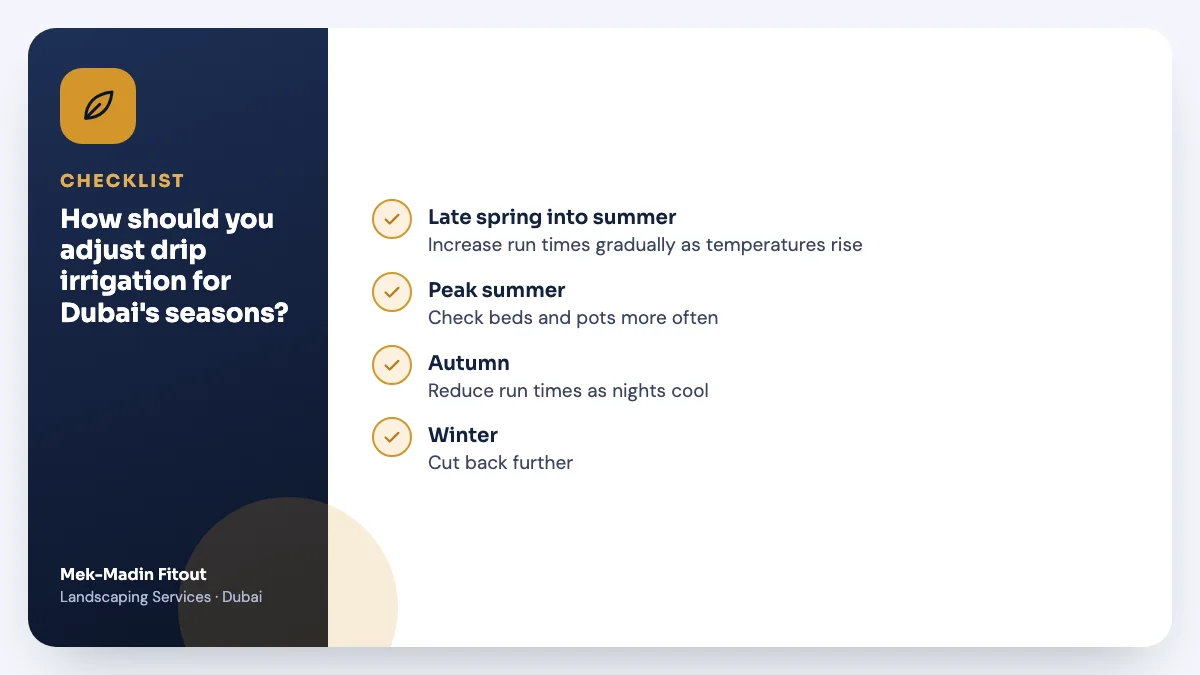
Adjust drip irrigation for Dubai's seasons by increasing run times gradually into summer, reducing them through autumn as nights cool and cutting back further in winter, when many established plants need much less water. A schedule set in July will overwater badly in January, so check the soil before and after each change.
Summer and winter watering needs in Dubai are very different. A schedule set in July will overwater badly in January, and the reverse leaves plants stressed in summer.
As a general pattern:
- Late spring into summer. Increase run times gradually as temperatures rise. Water early in the morning.
- Peak summer. Check beds and pots more often. New planting may need extra shade as well as water.
- Autumn. Reduce run times as nights cool. This is also a good time to extend lines for new planting.
- Winter. Cut back further. Many established plants need much less water in the cooler months.
Check the soil with your finger a short way down before and after a change. If it is still wet before the next cycle, reduce the run time.
DEWA's water-saving tips make a similar point: "Your garden does not need to be watered daily." DEWA suggests checking the soil moisture two to three inches below the surface and watering only when the soil is dry.
In older villa communities such as Arabian Ranches, many gardens still run on lines and controllers fitted years ago. A full check before summer often finds zones that no longer match the planting.
When should you call an irrigation professional?
Small fixes, such as unblocking a dripper or replacing a cracked fitting, are easy to do yourself. A professional is worth calling when zones need redesigning, the controller or valves fail, leaks keep coming back, or you are replacing sprinklers with drip across the garden.
Our landscaping services for Dubai villa gardens cover irrigation design, new zones, controller set-up, repairs and leak finding. Call or WhatsApp +971 52 884 8916 and we will confirm a visit time when you call.
FAQs
Is drip irrigation better than sprinklers in Dubai?
For beds, hedges, pots and trees, usually yes. Drip puts water at the roots and loses less to heat and wind. Sprinklers are still the practical choice for lawns, because grass needs water across its whole surface.
Why are some of my drippers not working?
The most likely causes are a blocked emitter, a dirty filter, a leak earlier in the line or low pressure. Clean the filter and flush the line first. If only the far end of a line is dry, look for a leak or a crushed pipe.
How long should I run my drip irrigation?
It depends on the plants, soil, emitters and season, so there is no single answer. Start with a schedule from your installer, then check the soil moisture and adjust. Run times usually go up in summer and come down in winter.
Can I add drip irrigation to an existing sprinkler system?
Often, yes. A sprinkler zone can sometimes be converted to drip with the right filter and pressure regulator fitted at the valve. Keep drip and sprinklers on separate zones, as they need different pressures and run times.