
Damp low on a villa's ground floor walls usually comes from outside: irrigation or planters wetting the wall, soil or paving bridging the damp-proof course, or a leaking pipe. True rising damp from the ground is possible too. Salts carried in the water then cause the white marks, flaking paint and crumbling plaster.
Painting over it does not help. The fix is to find and stop the water source, let the wall dry, and then repair the plaster and paint with materials that let the wall breathe.
What does damp on ground floor walls look like?
Ground floor damp usually shows as a band of stained, blistered or flaking paint near the floor, often with a rough "tide mark" above it. White salt deposits, crumbling plaster, swollen skirting and a musty smell are common. The pattern and height of the damage help point to the cause.
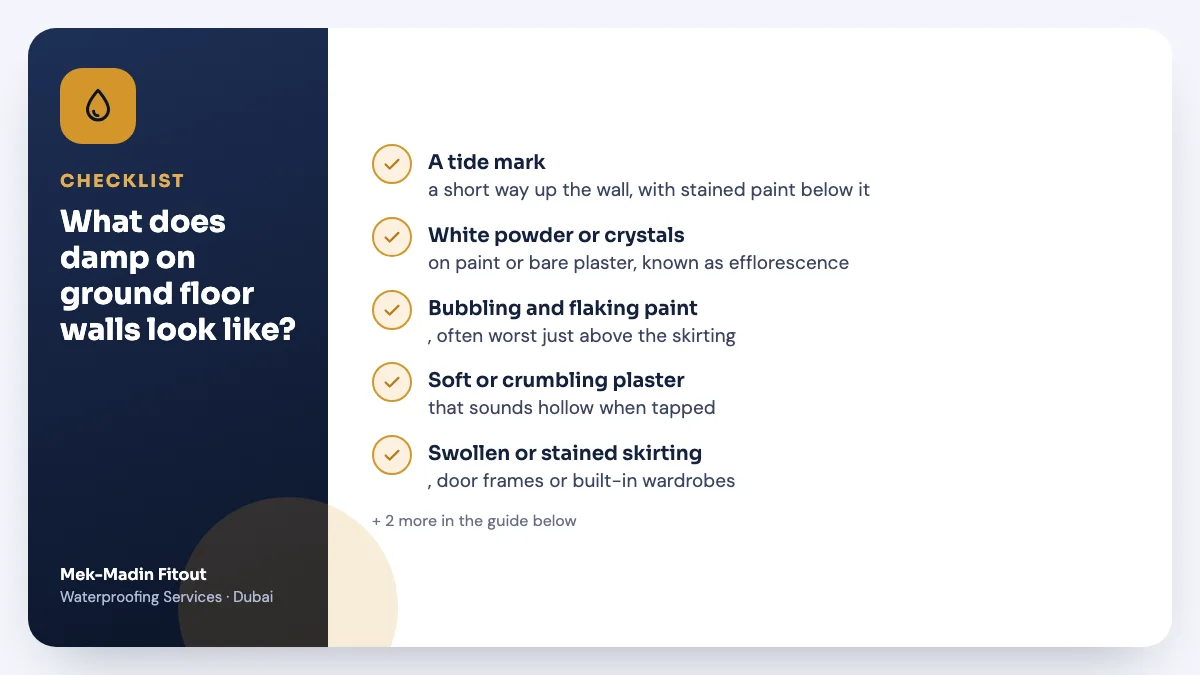
- A tide mark a short way up the wall, with stained paint below it
- White powder or crystals on paint or bare plaster, known as efflorescence
- Bubbling and flaking paint, often worst just above the skirting
- Soft or crumbling plaster that sounds hollow when tapped
- Swollen or stained skirting, door frames or built-in wardrobes
- Black mould spots behind furniture or in corners
- Damp patches that come and go, often after irrigation runs or rain
What is rising damp, and does it happen in Dubai?
Rising damp is ground moisture drawn up through masonry by capillary action, much like water soaking into a sponge. Walls are normally protected by a damp-proof course or membrane near ground level. If that layer is missing, damaged or bridged, moisture and dissolved salts can climb into the wall from the soil.
It can happen in Dubai, especially where groundwater sits closer to the surface, as in some low-lying or coastal areas. But many walls blamed on rising damp are really being wetted from outside. Ruling out external causes first saves money and avoids the wrong repair.
How does the damp-proof course get bridged?
A bridge is anything that lets moisture bypass the damp-proof layer. Common examples are garden soil, planters or new paving built up above it, and external render carried down into the soil. Rubble and mortar heaped against the base of a wall can do the same.
Why do salts make damp walls worse?
Much of the soil and groundwater in the UAE contains salts. As moisture moves through a wall and evaporates, the salts crystallise in the plaster, pushing off the paint and breaking up the plaster. Some salts also pull moisture from humid air, keeping the wall damp.
This is why a wall can look damp long after the source is fixed. Salt-contaminated plaster draws in moisture on humid days, particularly in late summer.
It also means moisture meters can give misleadingly high readings on salty walls. A meter reading alone does not prove a wall is wet.
The same white crust appears on roofs and parapets for similar reasons. Our guide to the signs a roof or terrace needs waterproofing covers efflorescence from above.
Which outside causes make villa walls damp?
The most common outside causes are irrigation spraying or soaking the wall, planters built against the house without waterproofing, soil or paving raised above the damp-proof level, and paving that slopes towards the house. Leaking garden pipes, pool splash and AC condensate draining at the base of the wall add water too.
| Outside cause | What to look for | Usual fix |
|---|---|---|
| Sprinklers or drippers near the wall | Damp worst after watering, wet soil at the wall base | Move or redirect heads, or switch to drip set back from the wall |
| Planter built against the wall | Damp patch matching the planter's length and height | Waterproof the planter inside, or rebuild it with a gap |
| Soil or paving above floor level | Ground outside higher than the floor inside | Lower the ground or add a drained channel |
| Paving falling towards the house | Water pooling at the wall after washing or rain | Re-lay paving to fall away from the house |
| Leaking garden or supply pipe | Constant damp in one spot, wet ground in dry weather | Trace and repair the pipe |
| AC condensate or roof drain outlet | Damp under the outlet, staining on the wall | Extend the outlet to a drain or gravel soakaway away from the wall |
| Pool splash and deck washing | Damp on walls facing the pool | Check deck falls and drainage |
Irrigation is a cause we find often in villa gardens. Our guide to drip irrigation for Dubai villa gardens explains how to set out zones and emitters so water reaches plants, not walls.
Can damp come from inside the villa?
Yes. Leaking pipes inside walls, failed waterproofing in a ground floor bathroom or kitchen, and condensation on cool walls behind furniture all cause damp that looks similar. Damp next to a wet room, damp that stays the same in every season, or mould only behind wardrobes all point to an inside cause.
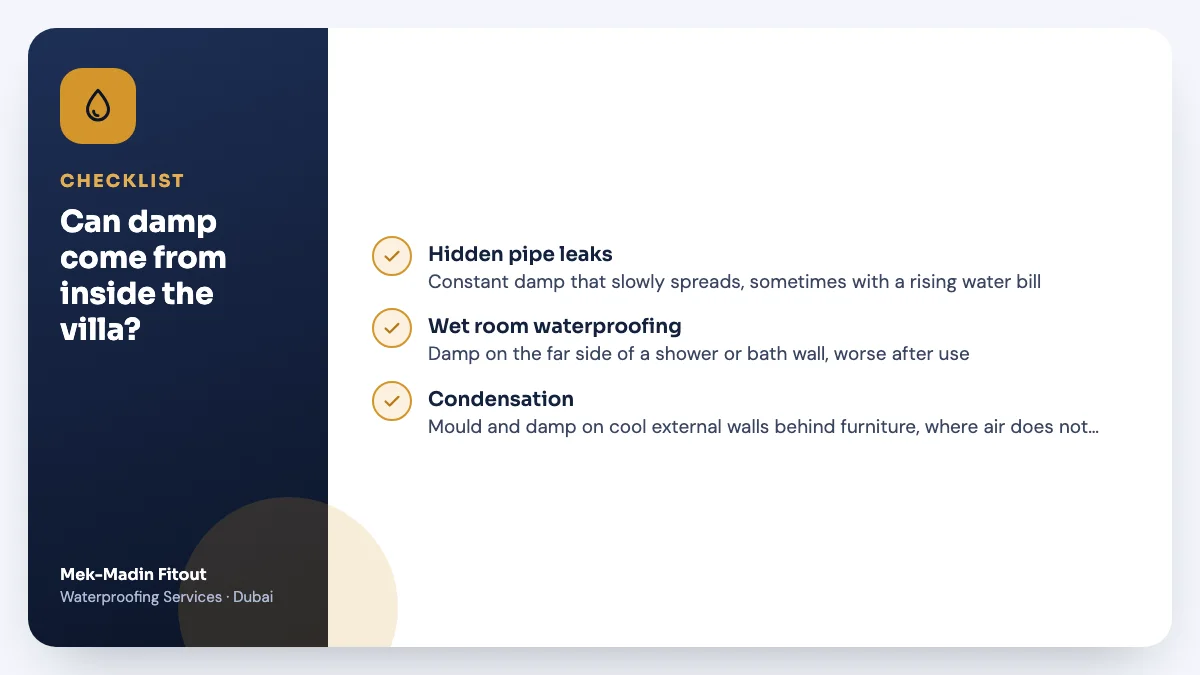
- Hidden pipe leaks. Constant damp that slowly spreads, sometimes with a rising water bill.
- Wet room waterproofing. Damp on the far side of a shower or bath wall, worse after use.
- Condensation. Mould and damp on cool external walls behind furniture, where air does not move.
Condensation is easy to confuse with a leak. Our guide to black mould and bathroom condensation explains how it forms and how to tell the two apart.
How can you find the source of damp on a ground floor wall?
Start by noting where the damp is, how high it reaches and whether it changes with irrigation, rain, pool use or the seasons. Then check the outside face of the same wall. Most sources show themselves once you compare inside and outside and switch things off one at a time.
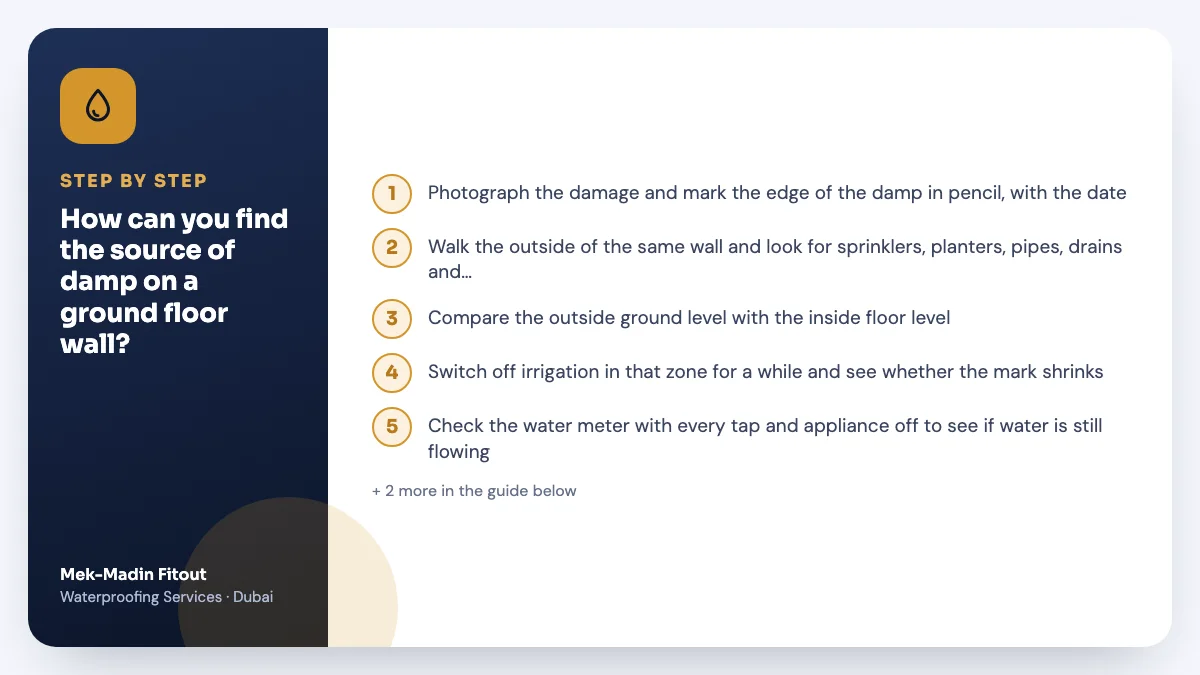
- Photograph the damage and mark the edge of the damp in pencil, with the date.
- Walk the outside of the same wall and look for sprinklers, planters, pipes, drains and raised soil or paving.
- Compare the outside ground level with the inside floor level.
- Switch off irrigation in that zone for a while and see whether the mark shrinks.
- Check the water meter with every tap and appliance off to see if water is still flowing.
- Note whether the damp sits beside a bathroom, kitchen or AC unit.
- If the cause is still unclear, get a professional moisture survey.
How is damp on a ground floor wall repaired?
A lasting repair has three stages. First, stop the water at its source, whether that is irrigation, a planter, a ground level problem or a leak, and let the wall dry out. Then remove salt-damaged plaster, replaster with a salt-resistant, breathable system and finish with a breathable paint.
Why should you not seal the wall with waterproof paint?
Sealing the inside face of a damp wall with a non-breathable paint traps moisture. The damp moves sideways or higher, and the paint blisters again. A breathable finish lets the wall keep drying.
When is a new damp-proof course needed?
If the original damp-proof layer has failed and there is no outside cause, a specialist may recommend an injected damp-proof course or a new membrane. This needs a proper assessment first. It does not fix damp caused by irrigation or leaks.
What about planters and walls below ground?
Planters against the house need an internal waterproof membrane, drainage and a protection layer. Walls below ground level, such as basement walls, may need tanking on the outside or inside face. These are jobs for our waterproofing services team, who can trace the source and recommend the right repair.
When should you call a professional about damp walls?
Call a professional when damp keeps returning after you have changed the irrigation, when plaster is crumbling, when you suspect a hidden pipe leak or failed bathroom waterproofing, or when damp is near electrical fittings. A proper investigation saves you replastering a wall that is still getting wet.
Older villas, such as many in Jumeirah, can have gardens and paving that have been changed several times over the years. That is why we check outside ground levels first.
Our damp and waterproofing investigations cover moisture checks, planter and wall waterproofing, and making good the plaster and paint afterwards. Call or WhatsApp +971 52 884 8916, and we will confirm a visit time when you call.
FAQs
Can I just repaint a damp wall?
Not until the source is fixed and the wall is dry. Paint over damp or salty plaster will blister and flake again. Use a breathable paint once the plaster is repaired.
Why does the damp look worse in summer?
Late summer is humid in Dubai, and salts in the plaster draw moisture from the air. Irrigation also tends to run longer in the heat, putting more water near the walls.
Is the white powder on my wall mould?
Usually not, as white powdery or crystal deposits on damp walls are normally salts. Mould tends to look black, green or grey and fuzzy. Brush salts off dry rather than washing them back into the wall.
Will a dehumidifier fix damp walls?
It helps a wall dry once the source is stopped, and it reduces condensation. It will not fix damp that keeps arriving from irrigation, ground moisture or a leak.